The Woman in the Glass Case - Ten Years Without a Name
She was born in a south London suburb, in England, in September 1905, and she worked in a sweet shop as a teenager.
In 1926, aged 21, she sailed for New Zealand. The following year she moved on to Sydney, Australia, and found work as an usherette in a cinema. People who knew her then described her as small, well liked and good company.
In April 1930 she married an Italian immigrant in Sydney. He worked as a machinist and a waiter. In 1933 the couple moved to Melbourne, about 880 km south-west, where she took a job in a hairdressing salon and he found work at an Italian-language newspaper.
The marriage went badly, and the record of that is not in dispute. There were frequent arguments. She drank heavily and disappeared from home for days at a time. He was, by his own later account, humiliated by this in front of the small Italian community he worked in.
In the last week of August 1934 there was a quarrel about a work trip he was about to make. After it, Linda Agostini was never seen again by anybody who left a record of it.
Everything that is claimed about her last evening comes from a single source: what her husband said about it 10 years later. There is no independent account of it at all.
A coroner would eventually place her death somewhere between about 28 August and 1 September 1934. That is as close as anyone has ever got.
The man with the bull
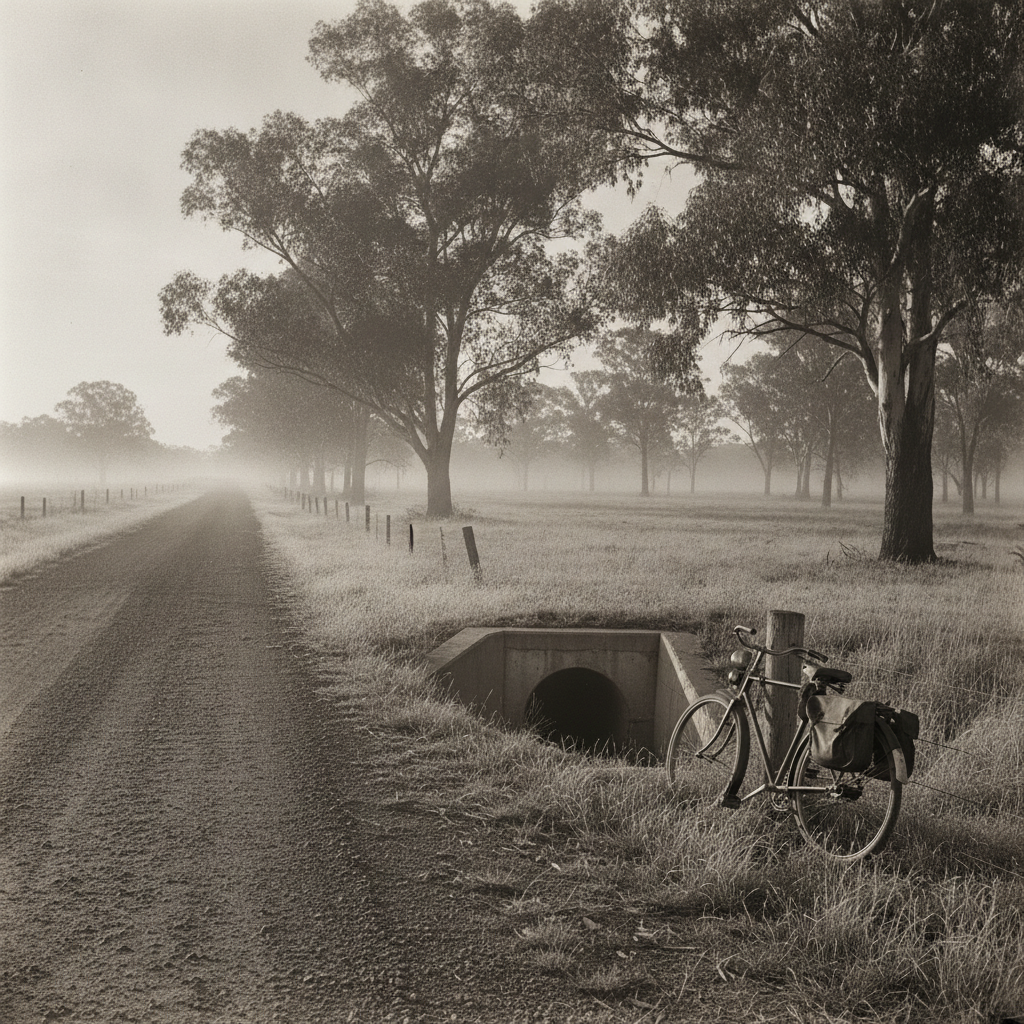
On the morning of 1 September 1934, a farm worker was leading a prize bull along a country road about 8 km outside Albury, a town in the state of New South Wales, Australia, close to the border with the state of Victoria.
The bull stopped and refused to pass a concrete culvert running under the road.
The man looked into the culvert. Pushed inside it was a hessian sack, and inside the sack was the body of a woman. It had been set on fire.
She was lying with a towel wrapped around her head. She was wearing yellow silk pyjamas with a Chinese dragon design on them, and nothing else. The fire had destroyed much of her face and upper body, but not the pyjamas, and it is those pyjamas that gave the case the name it has carried ever since.
The post-mortem was carried out on 3 September 1934. It found that she had been beaten about the head repeatedly, and that the cause of death was multiple fractures on the left side of the skull. It also found something that complicated matters: a bullet of small calibre had entered the head below the right eye and come to rest in the back of the neck. The examining doctor concluded that the shot had not been what killed her.
She was estimated to be between 20 and 30 years old, about 157 cm tall, slim, fair-skinned, with light bobbed hair.
Her fingerprints were taken and checked. There was no match anywhere in Australian records.
An investigation with nothing to investigate
A murder inquiry normally begins with a name, and then works outward: who she knew, who she owed, who saw her last, who gained.
Here there was no name, and almost every useful question depended on having one. The detectives were left holding a body and a pair of pyjamas.
They did what could be done. The description went out to newspapers across two states, then to police forces overseas. Reports of missing women were pulled and compared. Over the following years the list of women who might be her grew to 125 names.
The pyjamas were the only distinctive object in the case, and detectives spent months trying to establish where such a garment had been sold and to whom. It led nowhere that could be pinned to a person.
And then there was the matter of her teeth, which is the hinge on which this entire case turns.
Teeth were, in 1934, the best identification evidence available for a body whose face was gone. Dental work is individual, dentists keep records, and the comparison is straightforward if the record of the body is accurate.
The police asked a local dentist to examine and record her teeth. He had no experience in forensic work. His record contained two errors.
Those two errors did not merely slow the case down. They actively pointed it away from the answer, because the record was then used to eliminate candidates. Women whose dental charts did not match the flawed description were crossed off. One of the women crossed off in the first weeks of the investigation was the woman who would be identified as the victim 10 years later.
In October 1934 the body was taken about 550 km north-east to Sydney for further examination, and preserved there in a zinc-lined bath of formalin in the anatomy department of the university.
The body in the glass case
From 1935 the police did something no Australian force had done before. They put her on display.
The preserved body was placed in a glass case at the university so that members of the public could come and look at her and, they hoped, recognise her. Thousands of people came. There were queues outside the building. The case was in the newspapers constantly, and the display kept it there.
It did not produce an identification.
What it did produce was a slow problem that nobody weighed at the time. Long immersion in formalin changes human tissue. Colour drains and shifts, soft features firm and alter. Every year she spent in that bath made the body a less reliable witness to what the living woman had looked like. The police were preserving their only piece of evidence by degrading it.
The inquest finally opened at the Albury courthouse on 18 January 1938, more than 3 years after the discovery. Medical evidence confirmed that she had died of blows to the head. The coroner recorded that she had died by violence, beaten and shot, between about 28 August and 1 September 1934, and that despite inquiries in many countries she could not be named.
An open finding. No suspect, no victim, nothing.
In 1942 a woman came forward claiming the body was her daughter, who had gone missing in 1930. The claim was pressed as far as a court, which dismissed it: the evidence rested on hearsay with no direct corroboration, and police found that the hair and the teeth did not match. That same year the body was moved out of the university and into police headquarters in Sydney, so that the file and the body sat in the same building.
By then she had been unidentified for 8 years.
What changed in 1944
Two things changed at once, and it is worth separating them, because only one of them was scientific.
The first was a fresh forensic examination. The commissioner of the New South Wales police had taken a personal interest in the case for years, and in 1944 he ordered the preserved body looked at again. An anatomist and a dentist re-examined it, and this time the dental work was charted properly: the fillings, the extractions, the individual pattern of what had been done to her mouth and when.
That chart was compared with dental X-rays and the recollections of a Melbourne dentist who had treated a woman reported missing in 1934. It matched.
The woman it matched was Linda Agostini, who had been considered and ruled out in the first weeks of 1934 on the strength of a flawed dental record.
The second change had nothing to do with evidence. Her husband, Antonio Agostini, known as Tony, had spent part of the war interned as a national of a country Australia was at war with. By 1944 he had been released and was working in Sydney again as a waiter, and the commissioner knew exactly where to find him.
On 4 March 1944 he was brought in. By the account that has come down, he was not arrested and not charged. He was told that the body from the culvert had been identified as his wife, and he was observed to be in a nervous state. He was asked what was the matter.
He then confessed.
His account was this. There had been a struggle over a gun. The gun went off and shot her. Believing he had killed her, he struck her repeatedly about the head to be certain she was dead. He wrapped the body in a towel and a sack, moved it about 300 km, across the state border, and tried to burn it inside a roadside culvert. He said he had stayed silent for 10 years out of fear of deportation and shame within the Italian community.
He was arrested on 6 March 1944. A committal hearing in April found there was enough to try him.
The trial opened in the Supreme Court of Victoria, in Melbourne, on 28 June 1944. He pleaded not guilty to murder, maintaining that the shot had been an accident. The jury was out for less than 2 hours. On 29 June 1944 it acquitted him of murder and convicted him of manslaughter. On 30 June he was sentenced to 6 years' hard labour.
He served part of that sentence - accounts differ on precisely how much - and was deported to Italy on 21 August 1948.
On 13 July 1944, 10 years after she was pulled out of the culvert, she was buried in a Melbourne cemetery under her own name.
Why it did not stay closed
On paper this is a solved case: a victim named, a man tried in open court, a conviction, a sentence served. Almost no cold case of that era ended that tidily.
The problems began almost immediately, and they are physical.
The description of the body taken in 1934 did not match the description of the woman she was identified as. The eye colour was different. The bust was described differently. The shape of the nose was different. On the eye colour, the sources available today actually contradict each other about which woman had which colour, and that contradiction is itself worth stating plainly. What every version agrees on is that the two descriptions did not match each other.
Then there is the confession itself, which does not survive close reading of its logistics. There is no record of him owning a motor vehicle in 1934, in the depths of the Depression. No blood or other trace was ever recovered from any vehicle connected to him. And the story requires a man to drive roughly 300 km with a body in the car and cross a state border, at a period when border traffic was not unwatched.
He also, later, took part of it back. He retracted his acceptance of the identification and maintained until his death that the body in the culvert had not been his wife.
And the 125 women on the original list were, for the most part, never eliminated and never traced. Once the case was declared solved, nobody worked through them.
In 2004 a Melbourne historian published a book arguing that the identification had been wrong, that the conviction was the product of police pressure, and that it amounted to a miscarriage of justice.
One thing needs saying carefully. He was tried, and a jury convicted him of manslaughter. That verdict is a matter of record and it stands. What is disputed is not whether he was convicted, but who the woman in the culvert was.
That question can no longer be answered the easy way. The body spent 10 years in formalin, which ruins tissue for genetic testing, and it was buried in 1944 with no samples kept. No exhumation has ever been sought, although a comparison of what remains against living relatives on both sides is at least in principle possible.
Conclusions and Open Questions
There are three readings of this case, and each of them explains part of it and fails on another part.
One reading is that the case is exactly what it appears to be. A dental comparison carried out by qualified people matched, and a man who was not under arrest and not charged volunteered a confession to a killing, which is not a thing people usually do without cause. The problem: that comparison was made on a body that had been sitting in preservative for 10 years, by the same police force that had already got the dental evidence wrong once, and the physical description never fitted.
One reading is right man, wrong body. On this view he did kill his wife in August 1934 and disposed of her somewhere that has never been found, and the woman in the culvert was someone else entirely. It is the only reading that accounts for both the confession and the mismatched description. The problem: it requires two women to have been killed in the same few weeks, and it requires the second body never to have been found in 92 years.
One reading is that the confession was manufactured. That a man with reason to fear the authorities was told the body was his wife's and broke under it, and that the rest was fitted around him. The problem: a jury heard him and heard the case, he acquitted himself of nothing, and in 8 decades nobody has produced a credible alternative name for the woman in the pyjamas.
Three questions are still open, and none of them needs new technology to answer.
What happened to the other 124 names on that list, and do those files still exist?
Do the 1934 dental record, the corrected 1944 chart and the Melbourne dentist's X-rays survive, so that the comparison could be audited by somebody outside the police?
And would anyone now authorise an exhumation, given that the answer is either a confirmation or one of the worst identification failures in Australian legal history?
For 10 years she had no name, and thousands of strangers queued to file past a glass case and look at what was left of her face. She has had a name on a headstone for 82 years. Nobody has ever tested, by any method capable of settling it, whether it is hers.