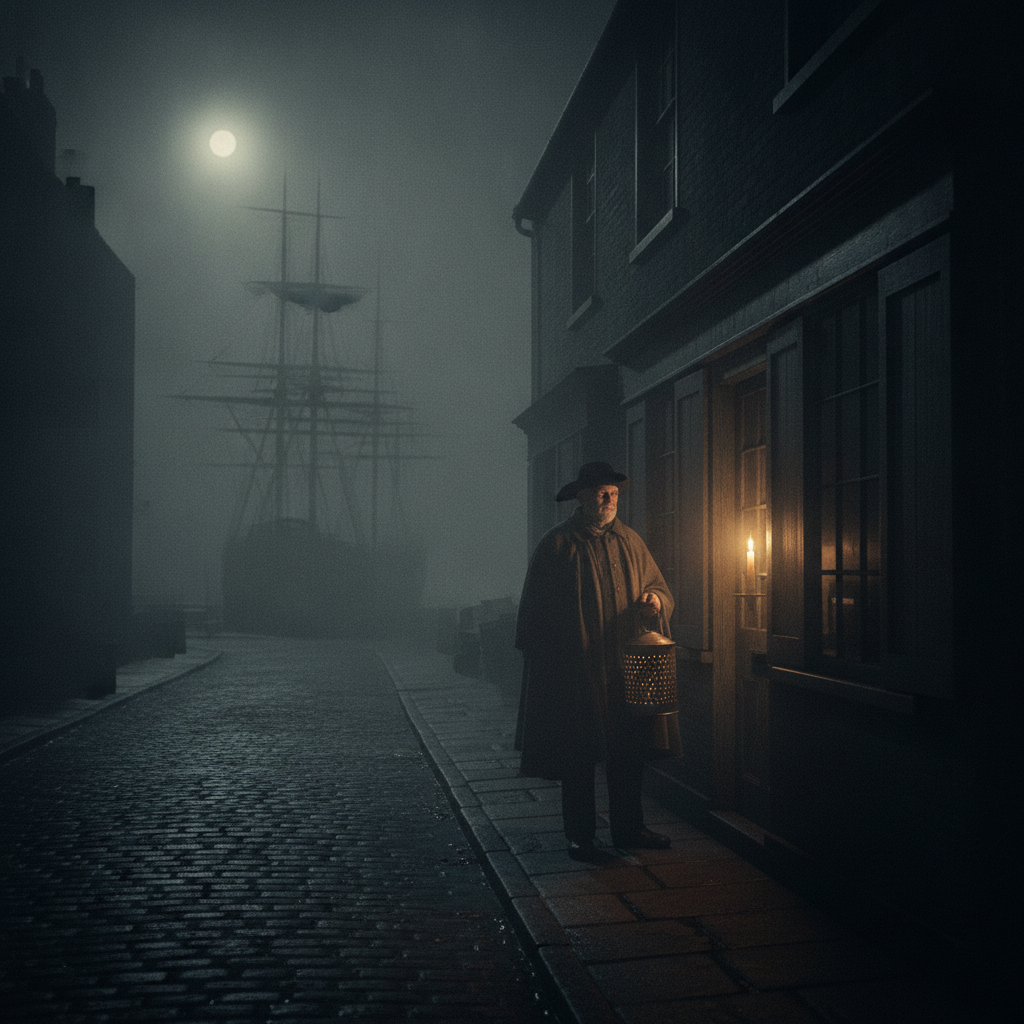
The Ratcliffe Highway Murders: 7 Dead in 12 Nights, and a Suspect Who Never Faced a Jury
On the night of Saturday 7 December 1811, Timothy Marr was still working at midnight.
He was a young shopkeeper, in his twenties. Sources disagree on his exact age: one gives 24, another 27. Before he opened his shop he had been a sailor on a ship of the East India Company, the great British trading company of the time.
Now he sold linen and clothing from a small shop on Ratcliffe Highway. That was a long, busy road in the docks district of east London, a short way east of the Tower of London. Sailors, dock workers, carpenters and shopkeepers lived packed close together there.
Saturday was pay day. It was the busiest shopping day of the week, so the shop stayed open late.
Behind the shop and above it lived the family. His wife Celia was still recovering from giving birth. Their son, also named Timothy, was 14 weeks old. He had been born on 29 August. The apprentice, a boy named James Gowen, also slept in the house.
A little before midnight, at 23:55, Marr gave his servant girl some money. He sent her out to buy oysters for a late supper and to pay a bill at the bakery.
She walked out into the dark street. When she came back, about 25 minutes later, everyone she had left in the house was dead.
The door that would not open
At about 00:20 the servant girl returned to the shop.
It was dark. The door was locked. She knocked, and nobody answered.
She knocked again and again. Nothing.
A neighbour, a pawnbroker, would later say that at about 00:10 he had heard bumping noises through the wall. He thought nothing of it at the time.
The servant girl's loud knocking brought the night watchman. In those years London had no proper police force. Each parish paid old men to walk the streets at night, carry a lamp and call out the time every half hour.
The watchman saw that the window shutters were in place but not fastened. He called through them. No one replied.
The pawnbroker next door then climbed over the wall into the back yard. He found the back door of the Marr house standing open, and he went inside with a candle.
At the foot of the stairs lay the apprentice, James Gowen. His head had been smashed.
Near the front door lay Celia Marr. She too had been beaten to death.
Behind the shop counter lay Timothy Marr.
The pawnbroker unlocked the front door and let the crowd in. Someone then remembered the baby.
They went down to the room where the child slept. Little Timothy lay dead in his cradle. He too had been killed.
What the house told the searchers
An officer of the river police was among the first men to arrive. London's river police had been founded in 1798 to stop theft from ships on the Thames, and it was one of the very few organised police units in the city.
In an upstairs bedroom he found the weapon. It was a maul: a heavy hammer with a long handle, used by ship carpenters to drive large nails into the hulls of ships. Its head was covered in blood and hair.
The investigators believed the killer had dropped it there. The servant girl's knocking had frightened him, and he had fled through the back.
In the shop they found a second tool, a ripping chisel, used for prying wood apart. It was clean.
There were footprints at the back of the house. They showed 2 sets of feet, marked with blood and with sawdust. A carpenter had been working in the shop that very day, so the floor was covered in sawdust.
A witness said he had seen about 10 men running away from an empty house nearby that night.
Then came the detail that made the murders impossible to understand. Nothing seemed to have been stolen.
There was money in the shop till. In a drawer in the bedroom lay £152, a large sum for a small shopkeeper in 1811. The killer had not touched it.
This, in one sentence, is the mystery: 7 people were beaten and cut to death in 2 houses within 12 days, in a crowded part of London, and although a suspect was arrested, he died before any court heard the evidence, so no jury ever decided whether he did it.
Panic in the streets
The murder of an entire family, including a 14-week-old baby, shocked the country.
The newspapers covered the case day after day. People in the docks district began to bolt their doors at dusk. Shopkeepers closed early.
The local authorities offered a reward of 50 guineas. Handbills describing the crime were pasted on church doors.
On 10 December an inquest was held. An inquest is the official hearing that decides how a person died. Its jury concluded that someone must have watched the house for some time, waiting for a chance.
On Sunday 15 December the 4 victims were buried together at the church of St George in the East, the parish church of the area. The baby had been baptised there only 3 months earlier. A large crowd followed the coffins.
The first suspects
The authorities arrested whoever looked possible.
3 sailors were detained. One of them had spots of blood on his clothes. All 3 could show where they had been that night, and all 3 were released.
The carpenter who had worked in the shop that day was taken in and questioned. He was released.
Timothy Marr's own brother was held and questioned for 48 hours. He had an alibi, and he too was released.
A woman who had once worked as a servant in the Marr house was questioned. The investigators decided she was too small to have done the killing alone, and that she had no reason to do it.
Other arrests followed, and each one fell apart.
The investigation was being run by local magistrates. Each district had its own office, and the offices did not share information well. There was no central detective force. There was no way to test blood, and no science of fingerprints. Everything depended on witnesses.
Only 12 days later
On Thursday 19 December 1811 the killer struck again.
This time the target was the King's Arms, a public house in a street of the same district. It stood about 800 metres from the Marr shop.
The landlord, John Williamson, was 56 years old. He had run the pub for 15 years. His wife, Elizabeth, was 60. Their servant, Bridget Anna Harrington, was in her late 50s.
Also in the house were their 14-year-old granddaughter, Catherine, and a lodger. The lodger was a working man who had rented a room upstairs for about 8 months.
Earlier that evening, John Williamson had been worried. He told a constable that he had seen a man in a brown jacket listening at his door, and asked him to arrest the man. Nothing came of it.
Late that night the lodger was upstairs when he realised something was wrong below. He later said that he saw a tall man, about 1.8 metres, in a heavy sailor's coat, going through the pockets of Elizabeth Williamson.
The lodger went back up to his room. He knotted his bed sheets together into a rope, tied it to the bed, and climbed down out of the window into the street, almost naked, shouting "Murder!"
The neighbours broke in.
John Williamson lay in the cellar at the foot of the stairs. He had been beaten and his throat had been cut. An iron crowbar lay next to him.
Elizabeth Williamson and the servant lay in the parlour. Both had been struck on the head and had their throats cut.
Upstairs, the granddaughter Catherine was found asleep in her bed. She had not heard a thing. She was unharmed.
The killer had escaped through a back window. There was blood on the window sill. Beneath the window was a slope of wet clay, and the investigators hoped that the man's clothes would be marked with it.
John Williamson's watch was missing.
London is sealed
This time the response was enormous.
Church fire bells were rung to call out volunteers. London Bridge was closed so that no one could cross the river. Officers from Bow Street, the most famous magistrates' office in London and the closest thing the city had to detectives, were sent to the docks.
The reward for the killer was doubled to 100 guineas. Three parishes offered rewards of their own.
At the inquest the lodger told his story. But his account was not fully believed. He had been inside the house, he was the only adult to survive, and for a time he himself was treated as a suspect. The jury's verdict was wilful murder by persons unknown.
The Home Secretary, the government minister responsible for law and order, appointed a senior Bow Street magistrate to take charge of the inquiry.
Many men were brought in for questioning.
The maul gives up its secret
Back at the first crime scene, the maul had been kept as evidence. On 19 December, the same day as the second attack, someone cleaned the blood off its handle properly for the first time.
Under the blood there were 2 letters punched into the wood. They looked like "I.P." or "J.P."
Sailors often marked their tools this way, with a metal punch.
The magistrates printed descriptions of the maul and the letters, and asked anyone who knew it to come forward.
The man from the Pear Tree
Among the men questioned was a 27-year-old sailor named John Williams. He was described as Irish or Scottish, and he lodged at a pub called the Pear Tree, a short walk from both crime scenes.
The 2 surviving descriptions of him do not agree. A writer of the time described him as slim, with bright yellow hair. A leading newspaper said he was about 1.75 metres tall and slender. A later drawing showed a stocky labourer.
Several things drew suspicion to him.
He drank at the King's Arms.
A man who shared his room at the Pear Tree said that on the night of the second murders Williams had come home after midnight.
According to some accounts, Williams had served on the same ship as Timothy Marr, and there had been bad feeling between them. That claim was never proven.
On 23 December he was questioned at the magistrates' office. He had 2 pawn tickets, some silver coins and a £1 note on him. Before the murders, he had told people he had no money at all.
Williams explained this. He said he had pawned some of his clothes, and he named a surgeon and a woman with medical knowledge whom he said he had visited. No one ever checked his story. No one checked the dates on the pawn tickets.
He was sent to Coldbath Fields, a prison in the Clerkenwell area of London, to wait for the next hearing.
The landlord in the debtors' prison
On 24 December the decisive witness came forward.
He was the landlord of the Pear Tree, where Williams lodged. At that moment the landlord himself was locked in Newgate prison, because he owed money.
He identified the maul. He said it belonged to a sailor named John Petersen, who had left his tool chest at the Pear Tree when he went to sea. The letters on the handle, he said, were Petersen's initials.
The constables opened the sailor's chest at the pub. The maul was missing from it. The landlord admitted that he had used the maul himself once, and that he had chipped it.
The case against Williams now rested on this: the maul came from a chest in the house where he lived, and he could have taken it.
Other evidence was added. The woman who washed his clothes said that about 2 weeks earlier one of his shirts had come back torn, and another had blood on the collar. Williams said the damage came from a fight over a game of cards. When he tried to say more, the magistrates told him to be quiet.
Later reports also spoke of muddy, bloodstained stockings, and of a chisel that came from the same sailor's chest.
There was also a knife. At first the authorities said a knife had been found in Williams's coat. Then they said it was missing. Later a knife with blood on it was found. Whether it was really his, nobody can now say.
Modern historians have pointed out one more thing. The landlord who identified the maul was in prison for debt. The reward money would have paid what he owed.
The cell at Coldbath Fields
On the morning set for his next hearing, John Williams was found dead in his cell.
He had hanged himself with his scarf from an iron bar. Sources disagree on the date: some give 27 December 1811, others 28 December.
He was never tried. No jury ever heard the evidence against him, and he never had a lawyer to answer it.
**This is the point where the documented record of the investigation stops. Everything that was said about his guilt after this moment was said about a dead man who could not reply.**
The hearing went ahead anyway, without him. The magistrates heard the remaining witnesses. Then they declared that John Williams had committed both sets of murders, and that his suicide proved it.
The cases against the other men still held collapsed. The magistrates considered the matter closed.
The procession
The government wanted the people of the docks to see for themselves that the killer was dead.
On 31 December 1811, New Year's Eve, Williams's body was laid on an open cart so that the crowd could see it.
The cart was drawn slowly through the streets of the district, guarded by the river police, mounted officers from Bow Street and local constables. Some accounts put the crowd at 180,000 people. That figure cannot be checked.
The procession stopped for almost 15 minutes in front of the Marr house. It stopped again, for about 10 minutes, outside the King's Arms.
Then the body was buried at a crossroads, as suicides often were in England at that time. A stake was driven through the body.
A skeleton under the road
In August 1886, 75 years later, workers digging a trench for a gas company at that crossroads found a skeleton. It lay upside down, with a stake through its body.
Everyone assumed it was John Williams. According to reports, the landlord of a nearby pub kept the skull. Where it is now is unknown.
Where it stands
Officially, in 1811, the case was closed. The magistrates had named a killer.
But by any modern standard it was never solved. The man accused was never tried, never convicted, and never had a chance to defend himself. In law, a person who has not been convicted is presumed innocent, and John Williams died without ever being convicted.
The most important evidence was never tested. Nobody checked his alibi. Nobody checked the pawn tickets. The descriptions given by witnesses did not match each other, and some did not match him. The lodger at the King's Arms described a tall man, while the descriptions of Williams range from slim to stocky.
Basic questions were never answered. How could one man have killed 4 people in a few minutes in the first house, and 3 adults in the second? Why were there 2 sets of footprints at the Marr house? Why did the killer leave £152 behind in the first house?
The motive has never been established.
The suspects and the theories
**The magistrates' verdict: John Williams did it alone.** The evidence: the maul came from a chest in his lodging house. He had money after the murders that he had not had before. He came home late on the night of the second attack. His laundry showed a torn shirt and blood. The problem: none of it was tested in court. The key witness had a reward to gain. And the evidence that more than one person was in the Marr house was never explained.
**Williams had help.** Several writers since the 19th century have argued that one man could not have done all this alone, given the 2 sets of footprints and the speed of the killings. Investigators at the time looked at a lame sailor known as "Long Billy", who had sailed with Williams and was drinking with him at the King's Arms. He could not explain where he had been on parts of both nights. He was held as a suspect, and released after Williams's death. The problem: no evidence was ever produced that tied him to either house.
**Williams was innocent, and a scapegoat.** In 1971 a police historian and the crime novelist P.D. James published "The Maul and the Pear Tree", a full study of the case based on the original records. They argued that the authorities rushed to a conclusion to calm a terrified public, that clues pointing elsewhere were ignored, and that Williams may have been an unlucky man who was in the wrong lodging house. They pointed to the carpenter who had worked in the Marr shop that day. He had lost a chisel, and after Williams's arrest he went to ask whether Williams was still being held. The problem: this, too, is a theory. The carpenter was questioned and released in 1811, and no evidence has ever been found that he took part. Over 200 years later, every person involved is long dead, and the original evidence is gone.
**The motive.** Some writers suggested a grudge from Williams's time at sea with Timothy Marr. Others suggested robbery that went wrong, or a man driven by hatred of everyone around him. The problem: there is no document that proves any of them. The money was left behind, and the shipmate story was never confirmed.
The writer Thomas De Quincey made the case famous in 1827, in his darkly ironic essay "On Murder Considered as One of the Fine Arts". He treated Williams as guilty. Many readers have done the same ever since.
The 7 victims, the Marr family, their apprentice, the Williamsons and their servant, lie in the churchyard and in the records. The question of who killed them was settled by a hearing at which the accused was already dead. It has never been settled by a trial.