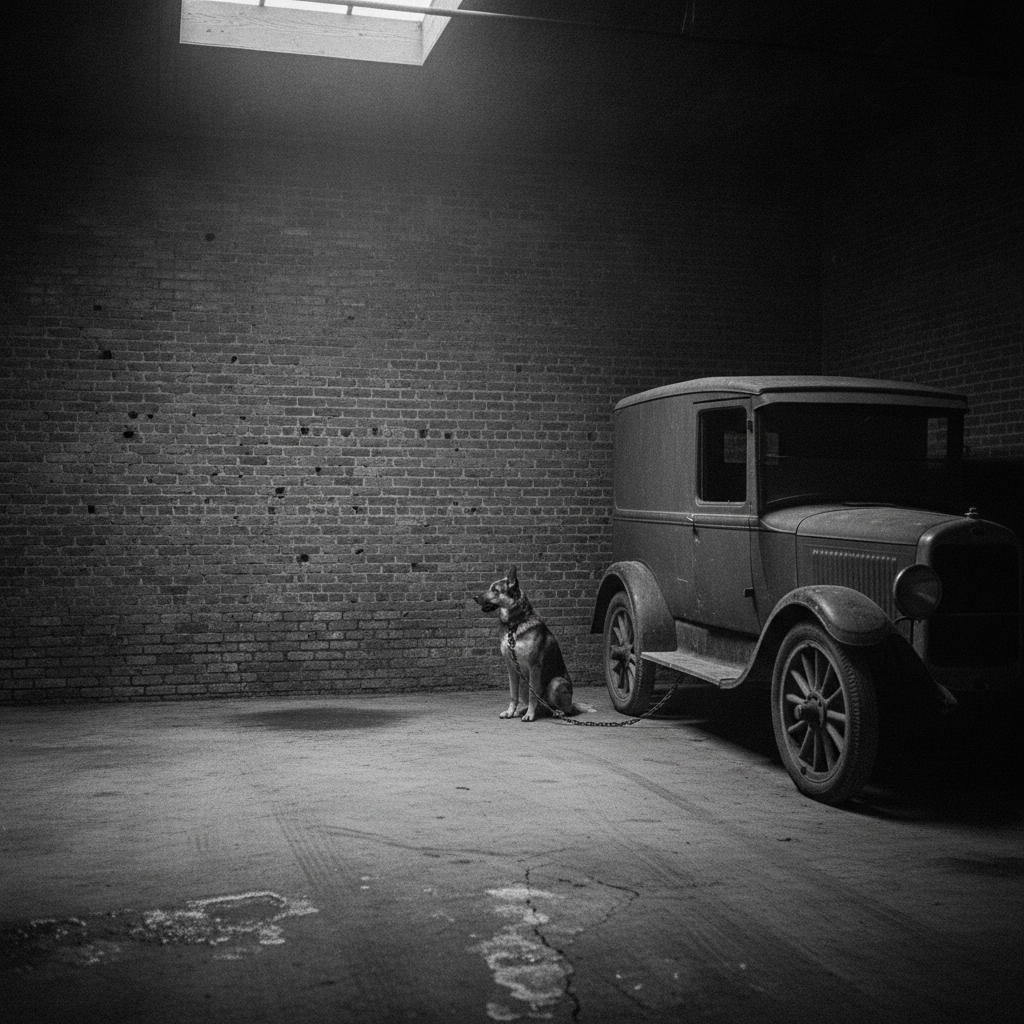
The St. Valentine's Day Massacre: 7 Men Against a Garage Wall, and Killers No Court Ever Tried
On the morning of Thursday, 14 February 1929, 7 men stood inside a cold brick garage in Chicago and waited.
Chicago was then the 2nd largest city in the United States. The garage stood at 2122 North Clark Street, on the north side of the city, in a quiet neighbourhood of boarding houses and small shops. A sign on the front said it belonged to a moving company. In fact it was a depot for trucks that carried illegal alcohol.
It was a freezing morning.
The 7 men were these. Peter and Frank Gusenberg were brothers, aged 41 and 37, and both were gunmen for the gang that controlled the north side. Albert Kachellek, 42, was the gang's 2nd in command. Adam Heyer, 40, kept the gang's books. Albert Weinshank, 36, ran its laundry businesses.
The last 2 were not gangsters at all. Reinhardt Schwimmer, 29, was an optician who liked the company of dangerous men. John May, 35, was a car mechanic who took repair work from the gang. That morning he was fixing the wheel of a truck. His dog, a German shepherd named Highball, was tied to the truck.
Within minutes, all 7 would be shot. The newspapers called it the St. Valentine's Day Massacre. It is the most famous gang killing in American history. It has a chief suspect, 2 murder weapons that still exist, and a confession of sorts. But nobody was ever tried for it, and to this day no court has said who fired.
Why they were there
In 1929 alcohol was illegal in the US. This period, called Prohibition, lasted from 1920 to 1933. People still wanted to drink, so gangs sold them beer and whiskey, and the gangs became rich.
In Chicago 2 gangs fought over the trade. The south side belonged to Al Capone, the most famous gangster in America. The north side belonged to a gang led by George Moran, known as "Bugs". For years the 2 sides had been shooting each other's men in the streets.
The 7 men in the garage worked for Moran, or hung around those who did.
Why they gathered that morning is not certain. The usual account says the gang had been offered a truckload of stolen whiskey at a low price, to be delivered at 10:30. Some historians doubt it. They point out that the men were too well dressed to unload a truck. On this point the sources do not agree.
Moran himself was expected. He was late.
The police car
At about 10:30 a black Cadillac stopped outside the garage. It looked like a police detective car.
4 men got out, or perhaps 5. Witnesses did not agree on the number. 2 of them wore police uniforms. The others wore long civilian overcoats.
They went inside.
Nobody who lived saw what happened next. It has been reconstructed from the bodies and from the wall.
The 7 men seem to have believed it was an ordinary police raid. Raids were common, and they usually ended with a fine or a bribe. The men did not fight. At least one of them carried a loaded revolver. It was never fired.
They were told to face the back wall, a wall of bare brick, and they lined up shoulder to shoulder.
Then the visitors opened fire with 2 Thompson submachine guns. The Thompson was an army weapon that fired heavy pistol bullets, hundreds of them per minute. The gunmen swept the line of men, back and forth. 2 of the victims were also hit with a shotgun at close range.
The police later collected about 70 empty cartridges from the floor.
The clever exit
The noise was heard along the street. Some people thought it was a truck engine misfiring.
Then came the cleverest part of the plan. People at their windows saw 2 men in civilian coats come out of the garage with their hands up. Behind them walked 2 men in police uniform, holding guns on them.
It looked like an arrest. Nobody ran for help, and nobody tried to stop them. All of them climbed into the Cadillac, and it drove away down Clark Street.
Inside the garage, the dog began to howl.
It went on and on. At last a woman who lived next door sent one of her lodgers to look. He pushed the door open, saw the wall, and ran back out to call the police.
"Nobody shot me"
The first officers found 6 men dead on the floor. The 7th was still alive.
Frank Gusenberg had crawled about 6 metres from the wall toward the door. Sources disagree on how many bullets were in him. Some say 14, some say 22.
He was taken to a hospital, and a police sergeant who had known him for years sat by the bed. The sergeant asked him who had shot him.
According to the sergeant, Gusenberg answered: "Nobody shot me." Some later versions add that he muttered that policemen had done it. He would not say more. In the world he lived in, a man did not talk to the police, not even about his own killers.
He died about 3 hours after the shooting.
Now every man who had stood at that wall was dead. The only living witness from inside the garage was the dog.
The man who was late
Moran had come within a few steps of dying with them.
By the usual account he arrived a few minutes late, with 2 companions. He saw the police car at the kerb, decided a raid was on, and turned into a coffee shop round the corner to wait.
After that he disappeared for several days into a hospital in a nearby town, under a false name, saying he had the flu.
When a reporter reached him, he gave the sentence that fixed the case in the public mind for good: "Only Capone kills like that."
Capone had an answer ready. He was not in Chicago. He was at his winter house in Miami, in the state of Florida, about 1,900 km to the south. At the very hour of the shooting, by the usual account, he was sitting in the office of a local prosecutor, answering questions about his business.
It was a perfect alibi. To many people it looked a little too perfect. But an alibi that looks too good is not evidence.
First the police suspected the police
The first days of the investigation went in a direction nobody had expected.
The killers had come in a police car and in police uniforms. In the Chicago of 1929 many officers took money from the gangs. So the first question was an uncomfortable one: were they real policemen?
A senior federal official in charge of enforcing the alcohol ban said so publicly. He announced that Chicago police officers had carried out the killing. Within a day he took it back. Soon afterwards he was moved out of the city, and then dismissed.
The suspicion did not go away on its own. Somebody had to prove it false.
The next day the city coroner, the official who investigates violent deaths, brought a jury of respected citizens to the garage. He staged the shooting again in front of them, on the same floor, with the dog present. Then he did something that had rarely been done in an American murder case. He decided to let science examine the bullets.
The man with the microscope
The foreman of the jury was a wealthy businessman. He paid from his own pocket to bring an expert from New York: Calvin Goddard, a former army doctor.
Goddard worked with a new instrument, the comparison microscope. It showed 2 bullets side by side in one eyepiece. Every gun barrel leaves its own fine scratches on a bullet that passes through it, a little like a fingerprint. If the scratches on 2 bullets match, they came from the same gun.
He began with the question that worried the city most. He collected the Thompson guns of the Chicago police, fired test bullets from each, and laid them next to the bullets from the garage.
Not one matched.
This did not prove that no policeman was involved. But it showed that the guns were not police guns, and from that moment the investigators treated the uniforms as a disguise.
Goddard could say more. All the machine gun bullets had come from just 2 Thompsons. One had been fed from a drum holding 50 rounds, the other from a straight magazine holding 20. That fits the 70 cartridges on the floor.
So now the police knew exactly what to look for: 2 particular guns. They had no idea where they were.
The burned Cadillac
On 22 February, 8 days after the killing, a fire broke out in a small garage behind a house on Wood Street, roughly 3 km west of the scene.
Firemen found a 1927 Cadillac inside, partly cut to pieces. Somebody had been taking it apart, and it had caught fire. Around it lay a police siren, a scorched hat and coat, and a drum magazine for a Thompson gun.
A man with fresh burns had been seen at a doctor's office nearby. He was not found.
The trail from this garage led somewhere interesting. It had been rented under a false name. The address the tenant gave was next door to a cafe run by a gangster allied to Capone. The car itself had been bought second-hand 2 months earlier, for 350 dollars, by a man who also gave a false name.
5 days later a second car was blown up in a suburb west of the city. In its wreck lay another siren and a notebook belonging to one of the dead men. The detectives decided that this one had been planted to confuse them.
2 landladies across the street from the garage added one more piece. Before the killing, each had rented a front room to men who said they were taxi drivers. The men did not drive anywhere. They sat at the windows and watched the garage. After 14 February they never came back.
So the killing had been prepared in advance, with watchers, a false police car and a place to destroy it. But every name in the story was false.
Arrests that led nowhere
The police arrested the men they already knew.
The main one was Jack McGurn, a gunman for Capone. He was found on 27 February in a downtown hotel, where he was registered under a false name with his girlfriend. She swore that he had been with her in the room all that morning. The newspapers called her "the blonde alibi".
McGurn was charged with the 7 murders, along with 2 other Capone gunmen. The prosecutors had no witness who could place any of them in the garage. The 2 other men were found shot dead that May, by the usual account on the orders of Capone himself, over a different betrayal. The case against McGurn was dropped for lack of evidence.
In law he stayed what he had been before: a man accused and never convicted. He was shot dead in Chicago in February 1936, and nobody was tried for that either.
By the autumn of 1929 the investigation had stopped.
A car crash in Michigan
It was restarted by a small road accident, 10 months after the massacre and about 150 km away.
On the evening of 14 December 1929, in the lakeside town of St. Joseph in the state of Michigan, 2 cars bumped into each other. One driver tried to leave. A young policeman, Charles Skelly, jumped onto the side step of the car to stop him. The driver shot him 3 times. Skelly died about 3 hours later.
The killer's car was found wrecked outside town. Papers in it led to a neat house nearby, where a quiet man had been living under a false name.
The man was gone. In the house the police found a small arsenal: 2 Thompson submachine guns, rifles, a sawn-off shotgun, about 5,000 rounds, and more than 300,000 dollars in bonds stolen from a bank.
The 2 Thompsons were sent to Goddard.
He fired them and put the bullets under his microscope. Both guns matched the bullets from the garage wall. One of the 2 had also killed a New York gang leader in July 1928.
After 10 months the murder weapons had been found. And they had an owner.
Fred Burke
His real name was Fred Burke. He was a professional robber and killer from the city of St. Louis, and the police there already knew something about his methods. In earlier crimes, they said, he had dressed as a police officer. They also said he was missing a front tooth. In Chicago, a chauffeur who saw the false police car on Clark Street had told detectives that its driver was missing a front tooth.
Burke became one of the most wanted men in America. He was caught in March 1931, in the state of Missouri.
This is the point where the case could have reached a courtroom, and did not.
Michigan had him first, for the murder of the policeman, and Michigan put him on trial for that. He was sentenced to life in prison. Chicago never brought him back to stand trial for the 7 men in the garage.
Burke died in a Michigan prison in 1940. He never said a word in public about St. Valentine's Day.
This is where the proven record ends. 2 of the guns that fired in the garage were found in Burke's house 10 months later. Who held them that morning, who the other men were, and who gave the order, was never established in any court.
The lookout's story
In January 1935 federal agents arrested a criminal named Byron Bolton over a different matter. Under questioning he said something nobody had asked him about. He said he had been one of the watchers in the rented room across from the garage.
According to Bolton, the killing was ordered by Capone. He named 5 men as the team that went into the garage. One of them was Burke. The widow of another had written the same names in her memoir a year earlier.
Bolton's account also offered an explanation for the timing. The watchers' job was to signal when Moran entered. One of the 7 men looked like Moran from a distance. The watchers saw him go in and gave the signal too early.
The federal authorities did not take it further. A gang murder was a matter for the city, not for them. By 1935 several of the men Bolton named were already dead, and Burke was in prison for life. Nobody was charged.
Where the case stands
The coroner's inquiry closed in November 1931 with a finding that the 7 men had been killed by persons unknown. Nothing has replaced that finding since.
Capone was never charged over the massacre. In October 1931 he was convicted of something else entirely, failing to pay income tax, and was sentenced to 11 years. He died in 1947.
Moran lost his territory within 2 years. He died in prison in 1957, where he was serving time for robbery.
The killing changed 2 things outside the gang world. The businessman who had paid for Goddard went on to fund a permanent crime laboratory for him in Chicago, one of the first in the country. And in 1934 the US passed its first federal law restricting machine guns.
The garage was torn down in 1967. A Canadian businessman bought the bricks of the wall, and today the remaining ones are in a museum in Las Vegas. The 2 Thompsons are still kept by the sheriff's department of the Michigan county where they were found.
The theories, in short
Capone ordered it, and Burke's crew carried it out. This is what Bolton said, and the guns, the widow's memoir and the watchers' rooms all support it. The problem: it rests on the word of a criminal, given years later, and it was never tested in a courtroom. One modern biographer of Capone notes that 2 of the 5 men had alibis.
It was Chicago gunmen working for Capone. This was the first police theory, and it led to the charges against McGurn. A former Chicago detective who studied the case for decades argued that McGurn put the team together. The problem: no witness and no physical evidence ever tied any of them to the garage.
It was private revenge, and had nothing to do with Capone. In 1935 a letter reached the head of the federal investigators. It named a Chicago gunman and said the killing was revenge for the death of his cousin. One biographer of Capone prefers this version. The problem: jail records show that the man it names was locked up from March 1926 until July 1929.
All of the men named in these theories are long dead. None was convicted of the massacre, and in law each of them remains innocent of it.
What is left is a brick wall in a museum, 2 guns in a sheriff's cabinet, and a question the dying man refused to answer.