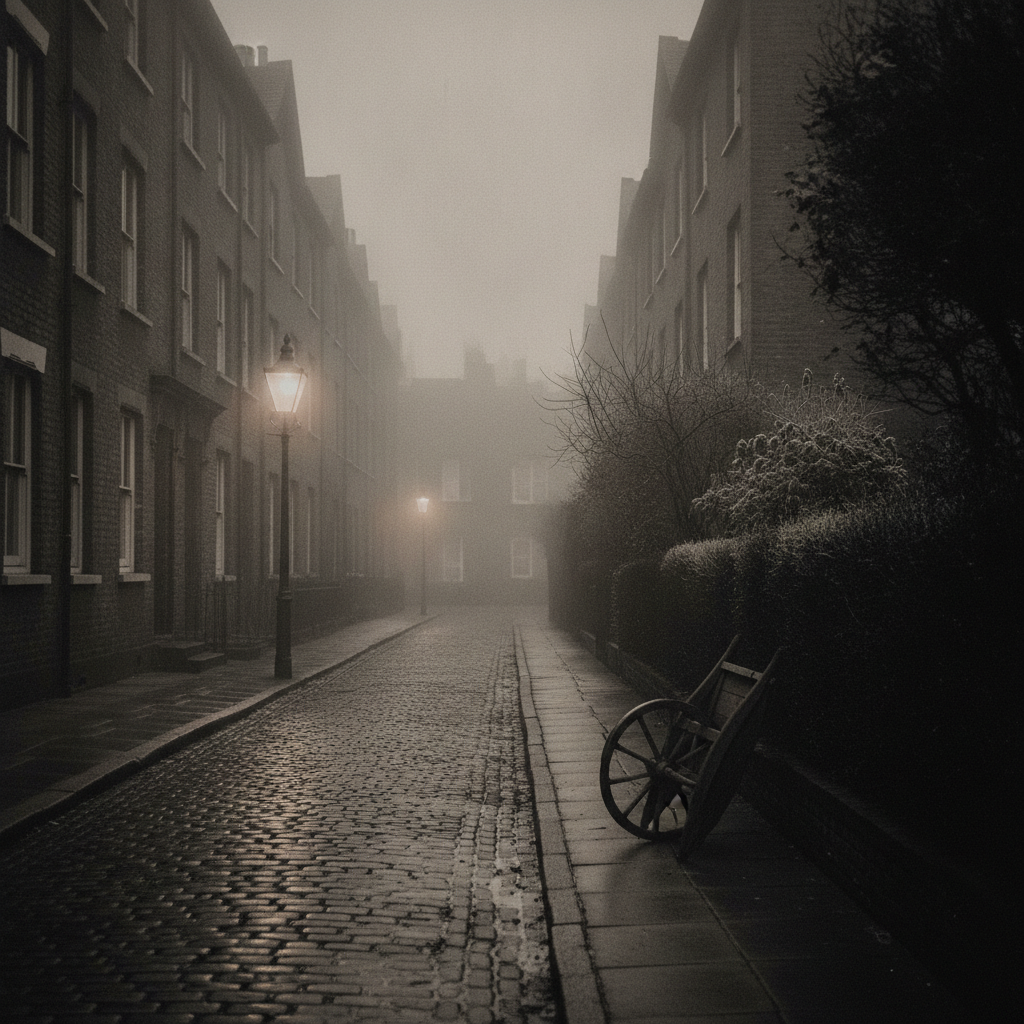
The Murder of Vera Page: A Red Beret, a Bandage and a Coal Cellar in Notting Hill, 1931
Monday, 14 December 1931. Notting Hill, a crowded working-class district in west London, England.
It is a cold winter afternoon. The street lamps come on early.
At about 4:30, a 10-year-old girl named Vera Page leaves her home and walks along her own street to her aunt's house. It is a short walk, about 45 metres.
She has a reason to be proud that day. At school she has just earned 2 certificates for swimming. Her aunt is keeping them for her, and Vera wants to take them home and show her parents.
She wears a red beret.
Vera was born in April 1921. She was the only child of a working family. Since January 1931 they had been renting the ground floor and the basement of a house in Notting Hill. Her teachers described her as friendly, shy and well-behaved.
At her aunt's house she stays about 10 minutes. She takes the certificates in a large white envelope and leaves. Her aunt later told the police that Vera left at about 4:45.
A little later a school friend sees her outside a chemist's shop, at the corner where her street meets the main market street. Vera is looking at the soap in the shop window and holding the white envelope. She says she has to hurry home.
The sources do not agree on the exact time of this sighting. Most put it just before 5 o'clock. One account says 5:40.
**After this moment, nobody who could be trusted ever saw Vera Page alive again.**
The evening she did not come home
Her parents expected her by 5 o'clock.
When she did not come, her father went to the aunt's house after 5:30. He was told that Vera had left long ago. He began to search the nearby streets.
At 10:25 that night he walked into the Notting Hill police station and reported his daughter missing.
The police sent a message across London by radio, asking the public to look for a 10-year-old girl in a red beret. Several people called in with a description of a short, dark-haired man in a black overcoat who had been seen handing sweets to children in the area. That lead never went anywhere.
All of Tuesday passed. No trace of Vera was found.
That evening, Tuesday 15 December, a woman found a small red beret on the ground, not far from the place where Vera had last been seen. She did not know what it was. She handed it to the police only 2 days later. Vera's parents identified it as their daughter's. It smelled of paraffin, the oil used in lamps and heaters.
The garden
Wednesday, 16 December 1931, in the morning.
A milkman is making his rounds in Kensington, the wealthier district just south of Notting Hill. In the front garden of a large house he sees something lying in the bushes, near the side entrance used by tradesmen.
It is the body of a child. It is Vera.
He found her at about 9:30 in the morning. One account gives 9:50. The garden was about 1.6 km from her home.
The body had not been hidden with any real effort. It had been dropped in the shrubbery, and a little earth and a few leaves had been thrown over it.
Many people had walked past the garden that morning. Nobody had noticed anything.
What the body told the police
The examination was carried out by the most famous pathologist in Britain at the time, a doctor who appeared in almost every major murder case of that era.
His findings were these.
Vera had been sexually assaulted and then strangled by hand. There were marks of fingers and a thumb on her neck.
There was also a thin mark around her neck, as if from a string or a cord. The pathologist concluded that it had been made after death, possibly when the body was dragged.
She had been dead for more than 24 hours. That meant she had been killed on Monday evening, not long after she was last seen.
But here was the strange part. Heavy rain had fallen on London the night before the body was found. Yet Vera's clothes were dry, even on the side that lay against the earth.
So the body could not have been in that garden for long. The police estimated no more than 2 hours. Someone had brought her there early on Wednesday morning, after the rain had stopped.
Where had she been for the 2 days in between?
The body itself gave a clue. It had begun to decompose faster than expected in December. It had been kept somewhere relatively warm.
And there was dirt on her. Soot and coal dust on her clothes and on her face. Spots of candle wax on her clothes, including on her right shoulder.
The wax did not match any candle in the Page home.
The pathologist's conclusion: Vera had been kept in a coal shed or a coal cellar, a dark place with no electric light, where someone had worked by candlelight.
The bandage
There was one more object.
When the body was moved to the mortuary, a small bandage fell out from the crook of her right arm. It was a finger bandage, the kind a man wears over a cut finger.
It had been soaked in ammonia, a strong chemical used in laundries for cleaning.
The pathologist believed the bandage had come from the killer's hand. He thought it had slipped off while the killer was carrying or handling the body.
For the police this was the best clue in the whole case. A bandage is a very personal thing. Find the man who lost it, and you have probably found the killer.
The search
The investigation was led by a detective superintendent from Scotland Yard, one of the 4 senior detectives the London newspapers of the time called "the Big Four".
He put more than 200 police officers on the case. They went from door to door in a fixed area around Vera's home. More than 1,000 people were questioned. Thousands of written statements were taken.
The police built their theory step by step.
Vera had disappeared within a few minutes, on a busy street, close to home. There had been no scream and no struggle that anyone noticed. So she had probably gone with someone she knew and trusted.
She had been held in a dark coal cellar, possibly heated. Then, early on Wednesday morning, she had been carried 1.6 km through the streets, perhaps in a wheelbarrow or a child's pram, and dropped in the garden.
Two discoveries seemed to support this.
Near the garden, a coal cellar was found that had no electric light. A witness told the police that its door had been left unlocked and open on the morning the body was found.
And a woman came forward with a sighting. At about 6:40 on Wednesday morning, she said, she saw a man pushing a wheelbarrow toward the street where the body was later found. On the barrow was a bundle covered by a red cloth, like a tablecloth.
The man the police looked at
Within days, the police had one name: Percy Orlando Rush.
Rush was 40. He was married and lived with his wife a few streets away. He worked at a laundry, washing cloth, a job in which he handled ammonia every day. He had served in the First World War.
His connection to Vera was close. His own parents lived on the upper floors of the same house where the Page family rented the ground floor. Rush had a key to that house and visited often.
He was first questioned on 18 December, 2 days after the body was found.
He said he knew Vera only by sight. He had not seen her for about 3 weeks, he said, and had never spoken to her.
Then the questions came to his finger.
Around 9 December, 5 days before Vera disappeared, Rush had cut the little finger of his left hand at work. A colleague told the police that Rush wore a bandage on it on the day Vera went missing. A police doctor who examined the finger found that the wound was still oozing pus.
Rush said he had thrown his last bandage away, or burned it, on 12 December, 2 days before the murder. His wife told the police that she had not dressed his finger in the days before the killing. She had been away from home at the time.
What the search of his home found
The police searched his home. What they found was, at first sight, very damaging.
A red tablecloth with a knitted fringe, similar to the cloth the woman had described on the wheelbarrow.
A partly used candle. The scientists reported that its wax matched the wax on Vera's shoulder.
His overcoat. It had spots of candle wax, coal dust, and also traces of semen, which Rush could not explain.
Rush explained the coal dust simply: he carried coal into his house, like almost everyone in London at that time.
And then the bandage itself. The bandage from the garden fitted Rush's injured finger.
Where the evidence fell apart
But every one of these points had a weakness, and the defence of a man who was never charged was, in the end, the weakness of the evidence itself.
The bandage fitted his finger. But the scientist from the Home Office examined it under a microscope and compared it with every bandage taken from Rush's home. The material was different from all of them.
The red tablecloth was similar to the one on the wheelbarrow. But there were thousands of red tablecloths in London. The scientists could not link this one to the cloth the witness saw.
The woman who saw the wheelbarrow said the man resembled Rush. But when she was asked to pick him out of a line of men, she could not identify him. No second witness ever came forward to support her.
The candle wax matched. But wax of that kind was sold everywhere. A match showed only that it was the same type of candle, not the same candle.
Coal dust was on the clothes of half of London.
Nobody had seen Rush with Vera on 14 December. Nobody had seen him near the garden on the 16th. Nobody had seen him near the coal cellar.
Years later, the detective superintendent admitted that a mistake had been made at the start. During the questioning, an officer told Rush that a bandage had been found on the body. The police also asked Rush for his bandages before they searched his home. In the superintendent's opinion, this gave Rush time to get rid of anything that could have tied him to the bandage in the garden.
He believed this was the error that lost the case.
The inquest
There was not enough evidence to charge anyone with murder. So the case went instead to a coroner's inquest, a public hearing that decides how a person died.
It opened on 10 February 1932 in a coroner's court in west London. It lasted 8 hours. 113 exhibits were shown to the jury.
Rush gave evidence himself. He told the court that on Monday 14 December he finished work at 6:15 in the evening. He then went shopping for collar studs, got home at about 8:30, and went to sleep at 10:15.
Nobody could confirm any part of that evening.
He denied that the bandage was his. He denied any part in the murder.
At one point the coroner rebuked him for smiling while he was being questioned.
The famous pathologist also gave long evidence, describing the coal dust, the wax and the bandage.
The jury went out for 5 minutes. They came back with this verdict: murder, by a person or persons unknown.
No name. No charge.
Vera's mother was led out of the courtroom in tears. As Rush left the building, a crowd of women in the public gallery booed him and shook their fists.
What the jury did not know
There was one thing the jury was never told.
Rush had a criminal record. In 1923 and again in 1927 he had been convicted of indecent exposure to young girls. In June 1931, 6 months before the murder, he had exposed himself to 2 girls.
None of this was disclosed at the inquest. In an English court of that time, a person's past convictions were generally kept from the jury, so that they would judge only the evidence about this crime.
This record does not prove that Rush killed Vera Page. Many men with such convictions have never killed anyone. But it explains why the police were so sure of their suspect, and why they kept watching him for years.
After the verdict
A week after the inquest, on 18 February 1932, a member of Parliament raised the case in the House of Commons. He asked the Home Secretary to make sure every possible effort was made to catch the killer, and that suspects would be closely watched. The Home Secretary answered that no effort was being spared, or would be spared, to obtain further evidence.
Newspapers offered rewards. In January 1932 one London daily offered a reward of £250. After the inquest a Sunday newspaper offered £1,000 for information leading to a conviction. Both offers produced nothing.
In December 1932 a former resident of the area wrote to the police, demanding that Rush be arrested. Nothing came of that either.
Vera had been buried long before, on 23 December 1931, in a cemetery in west London. More than 100 mourners came to the service. More than 1,000 people lined the streets as the funeral passed.
Where it stands
The murder of Vera Page was never solved.
Nobody was ever charged. Nobody was ever tried. The case remains officially open.
The physical evidence that might have settled it today, such as the bandage, the semen on the overcoat and the clothes, belongs to an age before DNA. In 1931 scientists could say only whether materials looked alike under a microscope. They could not say whose body they came from.
The coal cellar where Vera was held was never identified with certainty. The man with the wheelbarrow was never identified with certainty. The owner of the bandage was never identified with certainty.
**This is where the documented record ends. Everything beyond this point is the opinion of the people who investigated the case, not proven fact.**
Percy Rush lived for almost 30 more years. His wife died in 1937. He moved to another part of west London and lived there quietly, with no further trouble with the police. He died of natural causes in November 1961, at the age of 70.
The suspects and the theories
**Percy Orlando Rush.** He was the only suspect ever named publicly. The detective superintendent who led the case made it clear in his memoirs, published in 1935, that he believed Rush was the killer, although he did not name him there. The evidence: the bandage that fitted his finger, the ammonia from his workplace, the wax and coal dust on his overcoat, the red tablecloth, his closeness to the family, his empty alibi, and his past convictions. The problem: every piece of physical evidence was either similar rather than identical, or common to thousands of people. The bandage in the garden was made of different material from all of his. The witness could not pick him out. A coroner's jury heard all of it and named no one. Rush was never charged and never tried, and under the law he died an innocent man. He was suspected, not convicted, and that difference must be stated plainly.
**An unknown man from the neighbourhood.** The early reports of a short, dark-haired man in a black overcoat giving sweets to children suggest that someone else may have been watching the children of the area. The fact that Vera went quietly fits a man she had seen before, not necessarily one she knew well. The problem: that lead was never connected to any person, any cellar, or any evidence on the body.
**A police error that cannot be undone.** The detective in charge believed that telling the suspect about the bandage, and asking for his bandages before searching his home, let the decisive evidence disappear. If he was right, the case was lost in its first week. The problem: this is the detective's own judgement, made after he had failed to prove his case. Nobody can show that the missing bandage ever existed.