A Phone Call, an Address That Did Not Exist, and a Murder: the Wallace case
On the evening of Tuesday 20 January 1931, Julia Wallace was at home in Liverpool, a port city in the north-west of England, about 280 km from London.
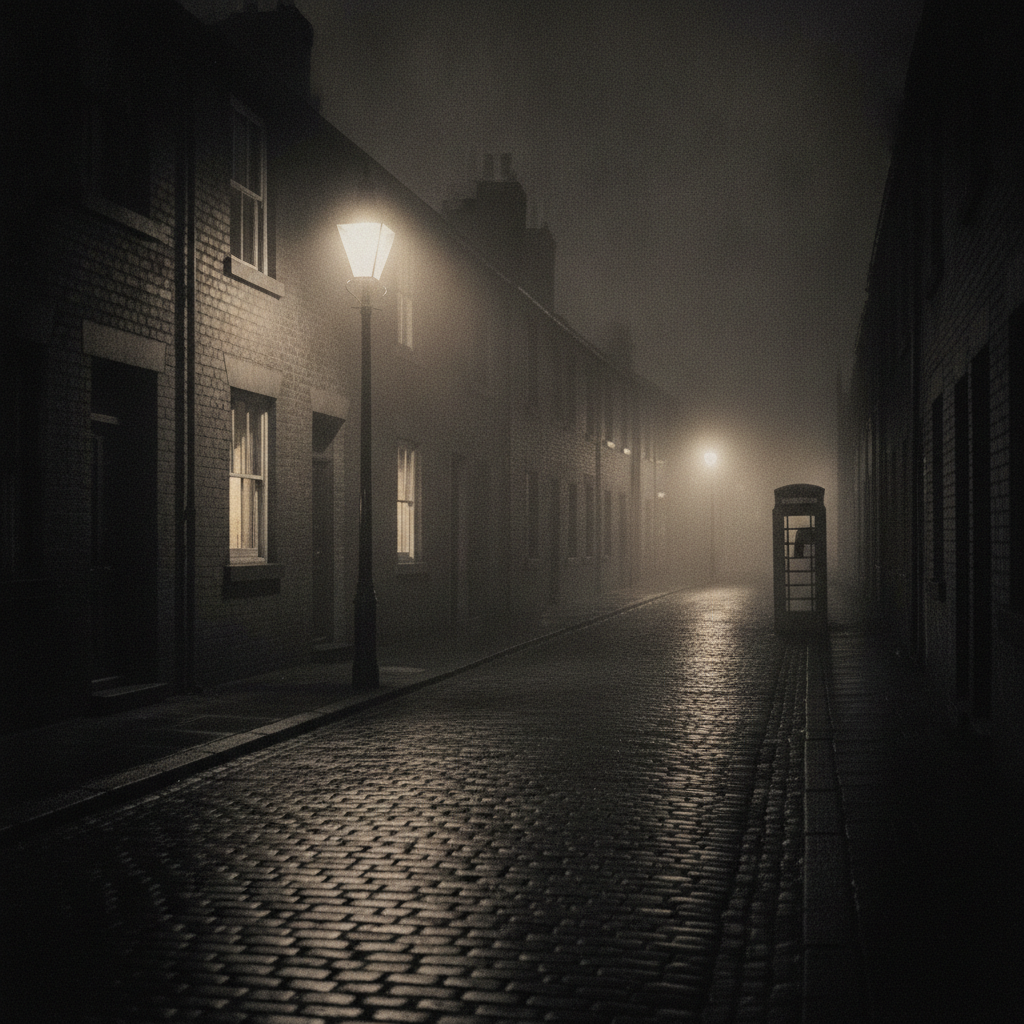
The house was small and ordinary. A narrow brick terrace in a working district, two rooms down and two up, a front parlour kept for best, a kitchen at the back, and a back yard opening onto an alley.
Julia had been married for almost 17 years to William Herbert Wallace, an insurance agent. Every week he walked his round from door to door, collecting small payments from working families, and he kept the money at home in a cash box until he paid it in.
They were a quiet couple. No children, few visitors. In the evenings she played the piano and he played the violin. He was interested in chemistry and chess. Neighbours later described them as polite and reserved.
Julia was older than most people thought. She gave her age as around 50. A researcher who found her birth certificate 70 years later showed that she was in fact about 17 years older than her husband, who was 52. She had kept that to herself all her married life.
That Tuesday her husband came home from his round at about 6 pm. They had tea together.
Some time between 6:30 and 6:45, the milk boy knocked at the door with the evening delivery. Julia opened it, took the milk and spoke to him for a moment.
He was the last person, apart from her killer, known to have seen her alive.
At about 6:45 her husband left the house. He was going to a business appointment on the other side of the city.
At about 8:45 he came back. Julia was lying dead on the floor of the front parlour.
So what is the mystery?
Here it is in one sentence. Either the husband killed his wife and built a clever alibi around a fake phone call, or somebody else made that phone call to get him out of the house, and then killed her.
The police chose the first answer. A jury agreed and sentenced him to death. Then, for the first time in British history, an appeal court threw out a murder conviction because the evidence simply did not support it.
Nobody else was ever charged. The killer of Julia Wallace was never identified.
The message at the chess club
The story starts one evening earlier, on Monday 19 January 1931.
On Monday evenings William Wallace often played at the city's central chess club, which met in a café in the city centre. A list on the club wall showed who was due to play whom, and his name was on it for that night.
At 7:20 pm the telephone rang in the café. The captain of the chess club took the call.
The caller asked for Wallace. When he was told Wallace had not arrived yet, he left a message. His name, he said, was R. M. Qualtrough. He wanted Wallace to call at his house the next evening, Tuesday, at 7:30 pm. The address was 25 Menlove Gardens East. It was about insurance business, a policy for his daughter. He said he could not ring back because he was busy with his daughter's 21st birthday.
The club captain wrote the message down.
About 25 minutes after the call, Wallace walked in. He was given the message. He said he did not know anyone called Qualtrough, and did not know where Menlove Gardens East was. Other players suggested routes. He said he would find it.
Later, the telephone exchange records showed exactly where the call had come from. It was a public call box about 370 metres from the Wallaces' front door.
An address that did not exist
On Tuesday, after leaving home at about 6:45, Wallace made his way across the city by tram. He was seen at 7:06 boarding a tram about 3 km from his home. He had to change trams more than once.
At every step he asked. He asked the tram conductors if they knew Menlove Gardens East. They did not, but one suggested where to get off.
He got off in the Menlove Gardens area, in the south of the city. There was a Menlove Gardens North. There was a Menlove Gardens South. There was a Menlove Gardens West.
There was no Menlove Gardens East.
He asked a man in the street. He asked a policeman on his beat. He knocked at number 25 Menlove Gardens West, in case the address had been written down wrong. The woman who lived there had never heard of Qualtrough. He went into a newsagent's shop and looked at a street directory.
He searched for about 45 minutes. Then he went home.
Every one of those people remembered him later, and that would count heavily against him.
The parlour
At about 8:45 pm the neighbours next door, a married couple, were leaving their house by the back door. In the alley they met Wallace.
He told them he had tried the front door and could not get in. Then he had gone round to the back, and that door would not open either. He seemed worried.
The neighbours said they would wait. He tried the back door again. This time it opened.
He went inside. The neighbours saw a light go on upstairs, then in another room. A minute or two later he came out and asked them to come and see. His wife, he said, had been killed.
Julia was lying face down on the rug in the front parlour, near the gas fire.
She had been beaten on the head with great force, again and again. The left side of her skull was smashed open. Blood had sprayed across the room, reaching about 2 metres up the walls.
Under her body lay a mackintosh, a raincoat. It was partly burned. It belonged to her husband.
In the kitchen, the cash box where Wallace kept his insurance collections had been opened. About 4 pounds were missing, a modest sum. The lid had been put back on, and the box had been returned to its shelf.
Other money had not been touched. Money in Julia's handbag was still there. So was money in a jar upstairs.
No weapon was found in the house. Later, the woman who cleaned for the Wallaces said that 2 things were missing: a small iron bar that was kept by the fireplace, and a poker from the gas fire.
Neither was ever found.
The first hours
The police arrived quickly. A senior pathologist, a professor of forensic medicine, came later that night.
He made one decision that haunted the case for ever. He did not take the body's temperature, the most reliable way at the time of estimating when someone had died.
Instead he judged from the stiffness of the body. At first he put the time of death at about 8 pm. Later, by the time of the trial, he had moved it to just after 6 pm. No new evidence was produced to explain the change.
This mattered enormously. At 8 pm Wallace was on the other side of the city, talking to strangers about an address that did not exist. At 6:30, he was at home.
Detectives searched the house. They found no blood on Wallace's clothes. His suit was clean. The bath and the drains had not been used recently and showed no blood.
There was one exception: a single tiny clot of blood in the toilet bowl upstairs. Where it came from was never established. It may have been carried in by someone at the scene that night, when many police officers walked through the house.
Why the police chose the husband
Within days the investigators had made up their minds. They believed there was no Qualtrough. They believed Wallace had made the call himself.
Their reasoning went like this.
The call box was very close to his house. The call was made at a time when Wallace, on his way to the chess club, could have been passing it. He arrived at the café about 25 minutes later.
The address did not exist. A real customer with a real house would not give a false address. So, said the police, the call was not about business. It was about building an alibi.
Then there was the way he searched. He asked everyone. Conductors, a policeman, a stranger, a woman at a door, a shop. To the detectives it looked like a man making sure that as many people as possible would remember him being far from home.
And there was the mackintosh. The police theory was that he had stripped, put on the raincoat to protect himself from the blood, killed his wife, then dropped the coat under her and dressed again.
The case had serious problems too.
The club captain, who knew Wallace's voice, said the voice on the telephone was not his.
The defence later showed that Wallace could have reached his tram from a different direction, nowhere near the call box.
And there was the clock.
The race against the clock
The whole case against Wallace depended on a few minutes.
The milk boy had seen Julia alive at the door. If that was 6:30, Wallace had perhaps 15 minutes. If it was 6:45, he had almost none. The boy's own estimates of the time moved around.
At 7:06 Wallace was seen boarding a tram about 3 km away.
On 26 and 27 January 1931, detectives ran timing tests. Pairs of officers walked from the Wallaces' front door to the tram stop by different routes and caught different trams. Their journeys took between 15 and 20 minutes.
From this, the police concluded that Wallace could have left home as late as 6:49. Relying on the milk boy's earliest time, they argued that this left him enough time.
Enough time, that is, to beat his wife to death with enormous force, clean every trace of blood from himself, burn part of a coat, empty the cash box and put it back, hide or dispose of a weapon, dress, and walk calmly out of the house.
The police also tested whether a fit young detective could do all of that and still reach the tram stop in time. Their own conclusion was that Wallace, 52 years old and in poor health, probably could not.
They arrested him anyway.
On 2 February 1931, 13 days after the murder, William Herbert Wallace was charged with killing his wife.
The trial
The trial opened on 22 April 1931, at the court in St George's Hall, the great courthouse in the centre of Liverpool.
His union of insurance agents paid for his defence. Before agreeing, it held a private mock trial in London. That mock trial found him not guilty.
Wallace pleaded not guilty.
The prosecution laid out its theory: the false call, the address that did not exist, the alibi built step by step, the raincoat, the few minutes that were, it said, just enough.
The defence answered: no blood on him, no weapon, no motive anyone could find in a quiet marriage, a voice the club captain did not recognise, and a timetable that left almost no time at all.
In the dock, Wallace was calm. He gave his answers in a precise, unemotional voice. He described himself as a stoic, a man who did not show his feelings. Observers believed this cost him dearly. The jury, they felt, expected a grieving husband and saw a cold one.
At the end, the judge summed up the evidence for the jury. His summing-up leaned strongly towards Wallace. He made it clear that the evidence was circumstantial and that suspicion was not proof.
The jury went out for about an hour.
They found Wallace guilty. The judge, as the law then required, sentenced him to death by hanging.
A first in British law
Wallace appealed. His case was heard in London on 18 and 19 May 1931 by 3 judges, led by the Lord Chief Justice of England.
At that time, an appeal court almost never overturned a jury's verdict on the facts. Juries decided the facts. Appeal courts looked for legal mistakes.
This time, the judges retired for 47 minutes. When they came back, they did something that had never been done before in a murder case.
They quashed the conviction. The verdict, they ruled, "cannot be supported, having regard to the evidence".
In plain words: the jury had convicted a man on suspicion, and suspicion was not enough.
It was the first time in British history that a murder conviction was overturned on those grounds. The case is still studied by law students today.
Wallace walked out of prison a free man.
Afterward
Freedom did not bring peace.
Many people in Liverpool still believed he had got away with murder. Neighbours turned away from him. He went back to his insurance company, but to an office job, not his old round.
In his diary he wrote of his grief for Julia. He also wrote that he believed he knew who had killed her: a younger man who had once worked with him at the insurance company.
His health, never good, collapsed. He had lost a kidney many years before. He left Liverpool and moved across the river.
On 26 February 1933, just over 2 years after the murder, William Herbert Wallace died in hospital of kidney disease. He was 54.
He was buried beside Julia, in the cemetery in Anfield, not far from the house where she died.
Where it stands
The murder of Julia Wallace has never been solved. No one else was ever charged.
**This is where what is known ends. Everything after this point is theory.**
The reasons it stayed unsolved are plain.
The weapon was never found. Neither the iron bar nor the poker ever turned up.
The time of death was never fixed, because no temperature was taken on the night. Everything that followed was argument about a few minutes.
The police settled on one suspect within days, and the investigation of anyone else was thin.
And the man who might have answered the most questions, the husband, died 2 years later, still saying he was innocent.
In 1977 a senior judge presided over a mock retrial using the original evidence. The verdict again was not guilty.
The suspects and the theories
All the people involved have been dead for decades. These are the theories on the documented record.
**The husband did it.** This was the police and prosecution case, and a famous British crime novelist reached the same conclusion in a study published in 2013. She suggested the call may have been a prank by someone else, which Wallace then used as cover. The evidence: the call box near his house, the address that did not exist, the long search in front of witnesses, the raincoat. The problem: no blood on him, no weapon, a window of minutes, a club captain who said the voice was not his, and an appeal court that found the evidence could not support a conviction.
**The former colleague.** Wallace himself named him to the police in his first statements: a young man who had worked for the same insurance company, knew the house, knew Julia, and knew where the cash box was kept. He had left the company after money was found missing from his collections. A crime writer identified him publicly in the 1960s. In 1981, a year after his death, a radio journalist broadcast a garage attendant's account: that on the night of the murder the young man came in late, upset, had his car washed, and that a bloody glove was seen in it. His fiancée of the time had given him an alibi. In 1933 she told one of Wallace's lawyers that the alibi was false. The problem: the garage story was told 50 years later, after the man had died. Police statements published in 2001 show that another witness placed him at her house between 5:30 and 8:30 that evening, an alibi that did not depend on the fiancée. He was never charged, never tried and never convicted, and denied any involvement until his death. Under the law he must be regarded as innocent.
**A robbery that went wrong.** A theory put forward in 2008, and developed in a book in 2018, holds that the colleague arranged the phone call only to get Wallace out of the house, and that someone else went in to steal the cash box money. Julia, according to this theory, caught him in the act. The problem: no accomplice was ever identified. The theory fits the facts, but there is no evidence for it beyond the fit.
A famous American crime writer once said of it: "The Wallace case is unbeatable; it will always be unbeatable."
Nearly a century later, nobody has beaten it.