Solved

The Waterfall That Swallowed Half a River — and How Two Numbers Solved It

2026-03-20 · Enigmatic Places · 2 min read

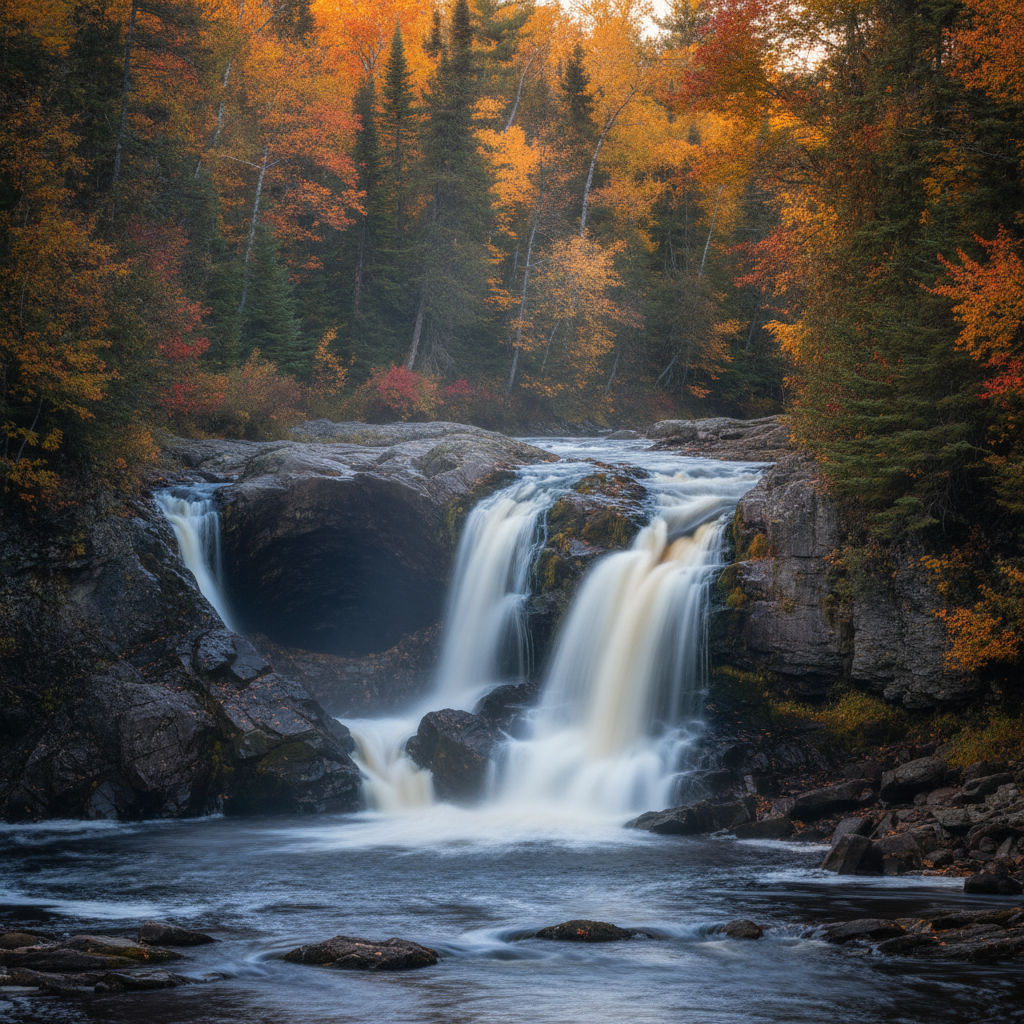
In Judge C.R. Magney State Park, near Grand Marais on Minnesota's North Shore, the Brule River performs a trick that has unsettled visitors for more than a century. A short distance before the river reaches Lake Superior, a knuckle of volcanic rock splits the current in two. The eastern half tumbles about fifty feet down an ordinary waterfall and rolls on toward the lake. The western half pours into a gaping pothole known as the Devil's Kettle — and simply vanishes.

Where does it go? Generations of visitors tried to find out the obvious way: they threw things in. Sticks, logs, ping-pong balls, colored dye — according to local lore, none of it was ever seen again. Legend added GPS trackers and even a car to the list of the swallowed, and the theories grew grander with every retelling: a hidden underground river draining to Lake Superior, or an ancient lava tube carrying half the Brule beneath the forest.

Geologists were never comfortable with those stories. The bedrock here is rhyolite and basalt — volcanic stone in which lava tubes of that scale do not form — and the region has no limestone caves that could conceal a secret river. A void big enough to swallow half a river, they argued, should betray itself somewhere in the landscape. Yet if the water was not going underground, the disappearing objects still demanded an explanation.

Ad

In the fall of 2016, hydrologists Heather Emerson and Jon Libbey of the Minnesota Department of Natural Resources tried the simplest experiment of all: they measured the river. Above the falls, the Brule carried about 123 cubic feet of water per second. A few hundred feet downstream, it carried about 121 — effectively the same figure, within the tolerance of their instruments. If the kettle were piping water off to Lake Superior or anywhere else, the downstream flow should have been roughly half. The river was not losing a drop.

The conclusion, announced in early 2017, was elegantly simple: the lost water resurges in the riverbed just below the falls. The plunge pool beneath the kettle is a ferociously powerful system of recirculating currents — strong enough to shred sticks, grind debris, and hold it underwater until it is released, unnoticed, far downstream. As University of Minnesota geologist Calvin Alexander pointed out, even dye simply dilutes below the threshold of visibility. The DNR planned a follow-up trace with fluorescent dye, but the flow numbers had already told the story.

The Devil's Kettle turned out to be a magic trick performed by turbulence: the river swallows itself and reappears a few steps later. All that remains for science is a detail — the exact path the water threads through the churning rock. The mystery itself is solved, and the answer was hiding in two nearly identical numbers.


Share this story:

Reader comments (0)