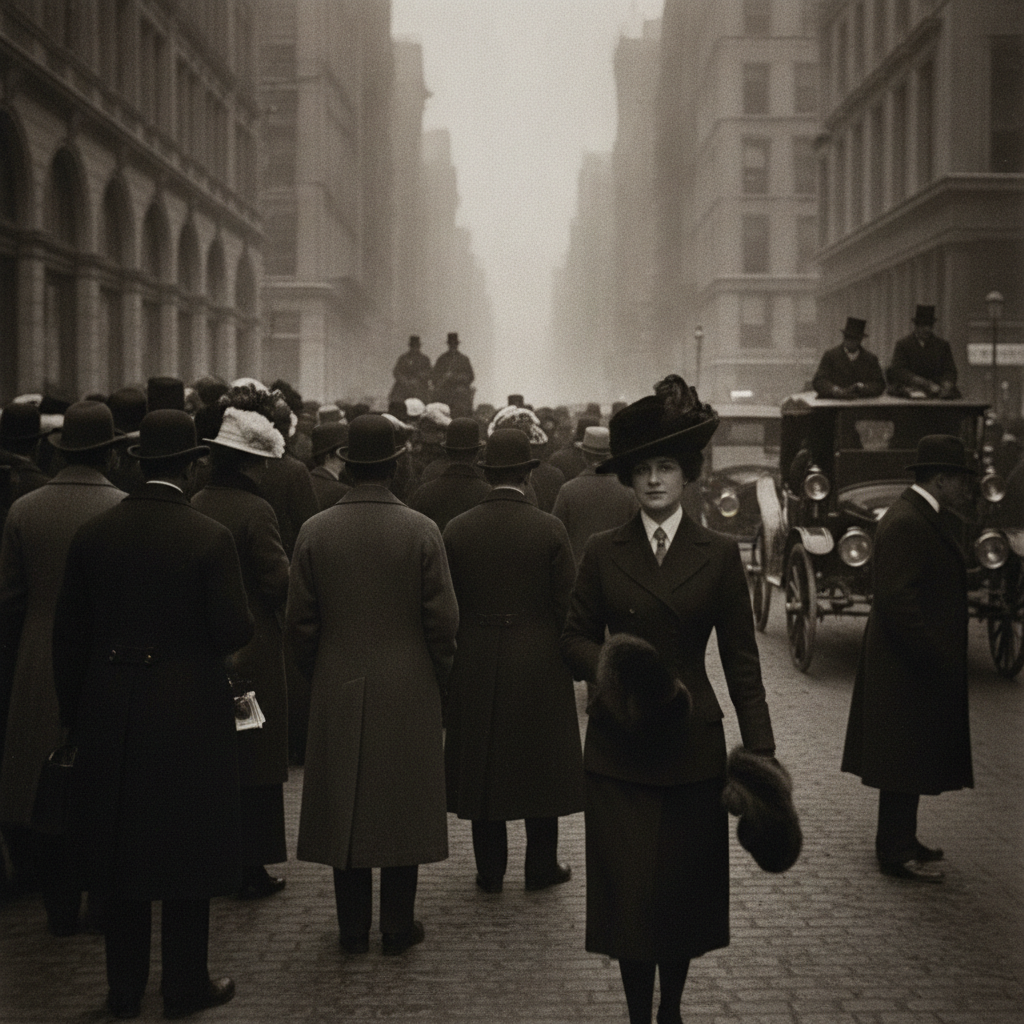
Dorothy Arnold: The Heiress Who Walked Down Fifth Avenue in 1910 and Never Came Home
On Monday, 12 December 1910, at about 11 in the morning, a young woman left her parents' house on the Upper East Side of New York, USA.
Her name was Dorothy Arnold. She was 25.
She wore a blue suit, a black velvet hat, and carried a fur muff. In her purse she had about 25 or 30 dollars.
Her mother offered to come with her. She said no. She was going shopping for a dress, she said, for her younger sister's coming-out party.
Who she was
Dorothy Arnold came from money. Her father was a wealthy importer of perfumes and luxury goods. Her uncle by marriage sat on the Supreme Court of the United States.
She had graduated from a respected women's college in 1905. Since then she had lived at home, with her parents, and tried to become a writer.
It was not going well. In the spring of 1910 a major magazine rejected one of her stories. In November 1910 the same magazine rejected another one.
Two months before she vanished, she asked her father to let her rent a small flat of her own downtown, so she could write. He refused.
So this is the case: a young woman from a rich and careful family walked out of the house on an ordinary shopping errand, in the middle of a busy city, in daylight. She was never found, alive or dead, and no one has ever proved what happened to her.
The last walk
Her route that day can be followed almost step by step, because she paid for things.
Around midday, she walked into a famous sweet shop on Fifth Avenue at 59th Street. She bought a box of chocolates of about 230 grams and charged it to the family account. She put the box in her muff. One source places this purchase later, at 1:45 in the afternoon. The sources do not agree on the time.
From there she walked south down Fifth Avenue for 32 blocks. That is about 2.5 kilometres.
At 27th Street she went into a well-known bookshop. She bought a book of short sketches about the life of a young engaged woman. She charged that to the account too.
No record shows that she ever bought a dress.
At about 2 in the afternoon, just outside the bookshop, she met a friend by chance. The friend had just received an invitation to the sister's party.
Dorothy Arnold told her friend that she planned to walk home through Central Park.
Then the friend left. From the far corner of 27th Street, the friend turned and waved.
**That is the last confirmed sighting. From that moment, no one can say with certainty where she went.**
One source adds a detail of its own: that she was supposed to meet her mother for lunch at a grand hotel that day, and never arrived. Other accounts of the case do not mention it.
A family that kept silent
She did not come home for dinner. According to one account, she had never missed dinner before without warning.
The family did not call the police.
Instead they quietly telephoned close friends, and asked each of them not to mention the call to anyone.
Shortly after midnight, a friend called the house to speak to Dorothy. Her mother answered. She said that Dorothy was in bed with a headache.
The next morning, the family called a young lawyer they trusted. He went through her room.
Everything was there except the clothes she had worn. He also found letters with foreign stamps, 2 brochures for ships that crossed the Atlantic, and burned paper in the fireplace. He believed it was her rejected manuscripts.
The lawyer then searched quietly for weeks. He went through hospitals, jails and morgues in 3 cities, including New York and Boston. He found nothing.
The family hired a famous private detective agency. It sent out a description to police departments, and a reward of 1,000 dollars was offered.
The New York police were not told officially until 22 January 1911. That was 6 weeks after she walked away from the bookshop.
Why the delay? The family said later they feared publicity. Reportedly, they had in mind another wealthy New York family, whose missing daughter had become a newspaper scandal the year before. Every trail was cold by the time detectives started.
The secret trip
Once the press had the story, it found the part the family had hidden.
For some time Dorothy Arnold had been in a relationship with a much older man. Different sources give his age as 40 or 42. He came from a wealthy family in the state of Pennsylvania and lived with his parents. Her parents did not approve of him.
In September 1910, she told her parents she was going to visit a college friend near Boston.
She did not visit the friend. She went to Boston and spent about a week there. The man was staying at one hotel. She registered at another, under her own name. To pay for the trip, she pawned jewellery, again under her own name. According to one detailed account, she received 60 dollars for pieces worth about 500.
Her parents found out. They ordered her to end it. She did not. The 2 kept writing to each other.
When she disappeared in December, the man was not in New York. He was on holiday in Florence, Italy, with his parents.
On 16 December, the family lawyer sent him a telegram. He replied that he knew "absolutely nothing".
In January 1911, her mother and her older brother sailed to Italy and confronted him. They came back with her letters to him. The brother said later that he destroyed them.
The man said he would marry her if she was found and if her mother agreed. Her mother said she never would.
In February 1911, hotel clerks in Italy reported seeing a veiled woman with him. Some newspapers suggested it was Dorothy Arnold. But a month earlier, a heavily veiled woman who had visited him with the brother had turned out to be her own mother. Whether the February sighting was a similar mix-up was never established.
The father's theory
On 25 January 1911, her father faced the press.
He said he believed his daughter was dead. In his view, robbers had attacked her as she crossed Central Park, killed her, and thrown her body into the park's reservoir.
The police rejected this. That week the reservoir was frozen. In the spring, it was searched anyway. No body was found.
A postcard arrived, signed "Dorothy", that said "I am safe". Her father believed it was a forgery.
In early 1911 the New York police stopped actively investigating. They said they believed she was dead.
The claims that came after
Over the following years, claims kept arriving. None of them held.
In 1916, police raided an illegal clinic in Pennsylvania. A rumour spread that Dorothy Arnold had been pregnant and had died there during an illegal abortion. Her father called this "ridiculous and absolutely untrue". No evidence ever linked her to that clinic.
Also in 1916, a prisoner in another state claimed he had been paid 250 dollars to bury a young woman's body in a cellar. Police dug in cellars. They found nothing.
In 1921, a senior New York police captain was quoted as saying that the police knew what had happened to her. The next day he said he had been misquoted.
Her father reportedly spent about 250,000 dollars on the search. He died in 1922. In his will, he left nothing to her. He wrote that he was satisfied she was not alive.
Her mother still hoped. She died in 1928. Her will said the same thing.
Only after the mother's death did the family lawyer say in public what he believed: that Dorothy Arnold had taken her own life.
Here is what is known for certain: she walked south on Fifth Avenue, bought chocolates and a book, said goodbye to a friend at 27th Street at about 2 in the afternoon, and turned toward home. Everything after that is a theory.
Conclusions and Open Questions
There are 4 main explanations. Each one has a problem.
**She took her own life.** This was the view of the family lawyer, of the man she loved, and of some of her relatives. She had just been rejected twice as a writer, forbidden to live alone, and forbidden to see the man. The burned manuscripts in her fireplace fit this view. The problem: no body was ever found. And on her last walk she was buying chocolates and a book, which is not what most people expect of someone in despair.
**She was killed by a stranger, in or near Central Park.** This was her father's view. It would explain why she never came home, and why she never contacted anyone. The problem: there was no witness, no body, no clothing, and no trace. The reservoir was searched and was empty.
**She died after an illegal medical procedure, and the body was hidden.** This would explain the secret trip, the family's silence, and why nobody could find her. It was a popular theory in the press. The problem: it rests on a rumour from a 1916 raid. Her father denied it strongly, and no document has ever supported it.
**She left on purpose and started a new life.** The ship brochures in her room point that way. So does the fact that she had a man abroad, and a family that blocked her at every turn. The problem: she took about 25 dollars and no luggage. She never wrote to the people she loved, and no sighting of her was ever confirmed. Her parents searched for years, with large sums of money, and never found a single real trace.
What remains open is simple to state and impossible to answer: where did Dorothy Arnold walk after she said goodbye on 27th Street? And why did a family that could afford any search wait 6 weeks to begin one?