Documented

The Desert's Perfect Polka Dots: Who Draws the Fairy Circles?

2026-06-12 · Enigmatic Places · 9 min read

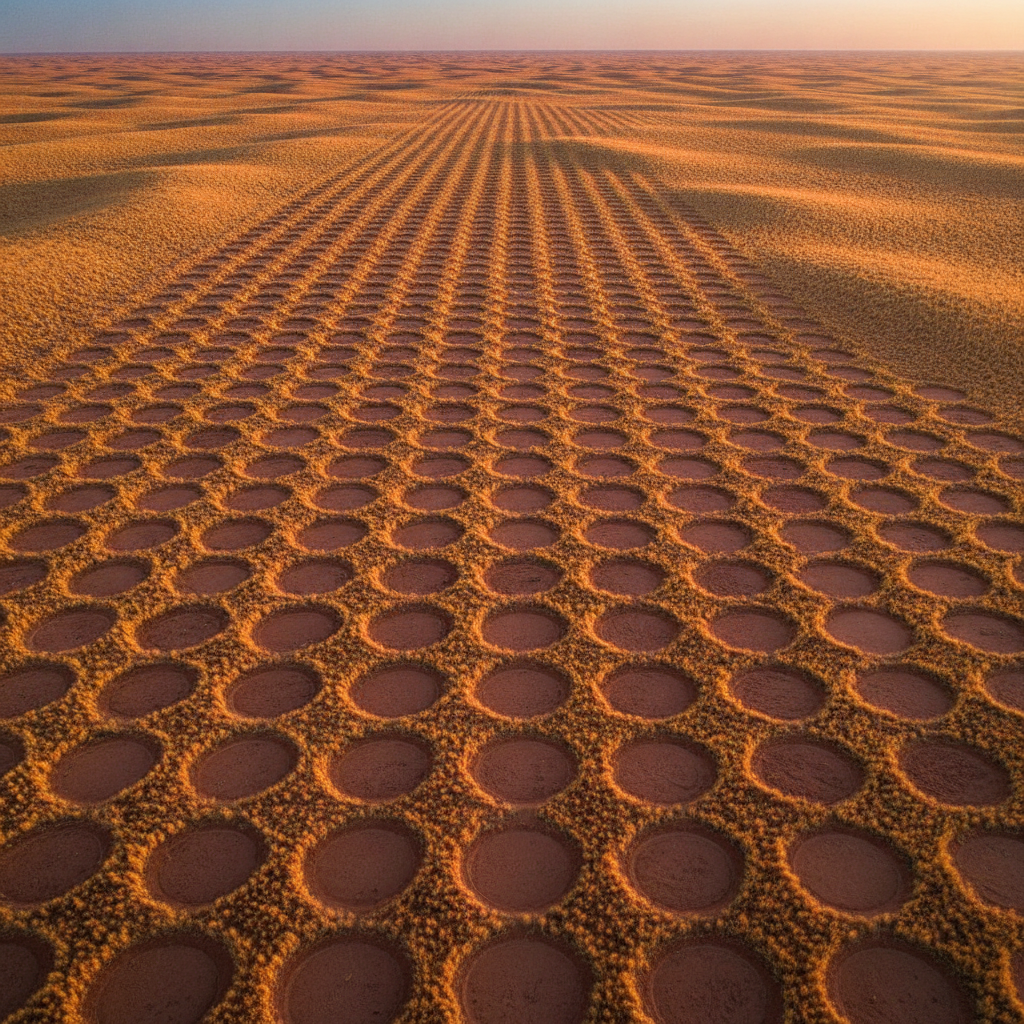
Fly low over the grasslands at the edge of the Namib Desert and the ground looks stitched by hand. Millions of bare, reddish circles pepper a sea of golden grass, each ringed by a fringe of taller stalks, each held apart from its neighbors with almost mathematical regularity. From the air the effect resembles the hide of some vast, spotted animal. On the ground it is stranger still: step inside a circle and the earth is simply, stubbornly bare, while the grass beyond the rim grows thick and tall. There is no fence, no rock, no visible reason for the line where life stops and the bald red disk begins. And yet the line is sharp, and it holds, year after year, through drought and flood alike. Stand among them at dawn, when the low sun throws each ring's shadow east, and it is almost impossible not to feel that some hand has been at work, that this is design and not accident.

The circles run from about two to fifteen meters across, and they are not fleeting. Researchers estimate that an individual circle can persist for decades, being born, maturing, and fading over the span of a human life, only to have a new one open elsewhere in the field. They march across the landscape in a band that keeps to a narrow window of rainfall, too dry and they vanish, too wet and they vanish, as if the pattern can only exist on the knife's edge of scarcity. That alone is a clue worth sitting with: whatever makes the circles is exquisitely tuned to how little water there is, so finely that a few extra millimeters of annual rain wipes them off the map. A mystery that lives only where life itself is barely possible is telling you something about the rules of that place, if only you could read it. The local Himba long held that they were the footprints of gods, the tread of a great serpent under the sand, or the breath of a subterranean dragon. Science wanted a mechanism, and, embarrassingly, for years could not agree on one.

Want to read the full story?

Sign up and get your first month completely free — unlimited access to the entire archive, ad-free for subscribers. Cancel anytime.

Subscribe — first month free

Share this story:

Reader comments (0)
Only active subscribers with verified payment can post comments. Subscribe — first month free