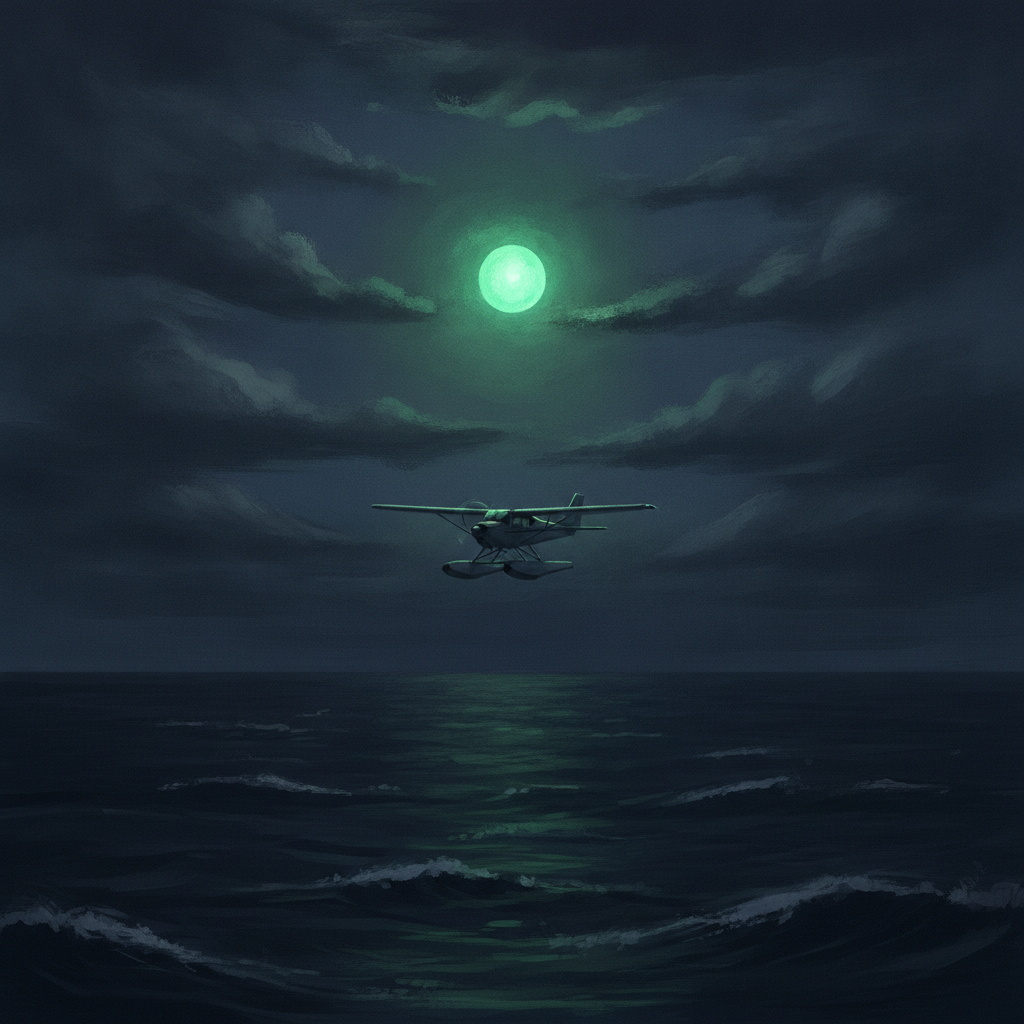
Frederick Valentich: The Pilot Who Vanished in Mid-Sentence
The southern sky over Bass Strait was clear that Saturday evening. There was a light quarter moon, no cloud to speak of, and the lights of Melbourne fading behind the tail. At 6:19 pm on 21 October 1978, a twenty year old named Frederick Valentich climbed out of Moorabbin Airport in a rented Cessna 182L, single engine, registration VH-DSJ, and turned south toward King Island. It was a night navigation exercise, a little over 125 nautical miles across open water. He had logged around 150 hours, held a class four instrument rating, and had flown the leg before. He had radioed ahead to arrange for friends on King Island to have the runway lights switched on, and he had asked them to reserve four crayfish for the trip home.
Nothing about the plan was unusual. The route was one of the standard night training legs out of Melbourne, and the flight plan had him returning to Moorabbin the same evening. For the first forty-seven minutes after takeoff, Valentich made no radio call to suggest that anything was wrong.
He was a young man set on a flying career. He served as a cadet in the air force reserve and was working toward a commercial licence, and the King Island run was exactly the kind of hour building night trip that stood between him and it. The leg took him southwest along the coast, out past Cape Otway and then over open water, cruising at 4,500 feet.
At 7:06 pm he keyed his radio and reached Steve Robey, the flight service officer on duty in Melbourne. His first question was oddly specific: was there any known traffic below 5,000 feet in his area? There was none, Robey told him. Valentich replied that a large aircraft was passing about a thousand feet above him, showing four bright landing lights. Over the next six minutes his transmissions changed by the sentence. The thing had begun to orbit him. It was approaching from the east. It seemed, he said, to be playing some sort of game, flying over him at speeds he could not estimate, two, three, four times. It was long, he reported, with a shiny metal surface and a green light on it. Then it was gone. Then it was back. His engine, he added, was rough idling and coughing.
Robey, who would be asked about those minutes for the rest of his life, said the young pilot's voice never quite tipped into panic. It was the voice of a man genuinely frightened and confused by something he could not name. Robey kept the exchange procedural, asking for the aircraft's position and its fuel state, and Valentich answered him each time.
At 7:12 pm Valentich reported that the object was again hovering and that it was not conventional traffic. His last intelligible words were, in substance, that it was hovering and it was not an aircraft. The transmission ended at about 7:12:49 pm. But the carrier did not simply cut. For seventeen seconds the channel stayed open, and across it came a sound that has never been convincingly explained: a metallic, scraping, pulsing noise, described by some who have heard the tape as like a car struggling to start. Then Bass Strait went quiet, and stayed quiet.
The whole exchange, from first contact to silence, lasted about six minutes and forty seconds. It survives in full, and it remains the only direct evidence of what happened to Frederick Valentich.
A search began that same night and ran until 25 October. Aircraft, ships and a Royal Australian Air Force P-3 Orion swept thousands of square kilometres of Bass Strait, one of the roughest and least forgiving stretches of water in the region. They found nothing that could be tied to VH-DSJ. Bass Strait swallows wreckage well: its water is cold, its weather changes fast, and an aircraft that breaks up on impact leaves little that floats and less that stays on the surface long enough to be seen from the air. No oil slick was located, no floating debris and no body. In May 1982 the Bureau of Air Safety Investigation closed its file with a sentence that has fed the story ever since: the reason for the disappearance had not been determined. The result was recorded as presumed fatal.
Two further pieces of the record belong to that night. People on the ground in the area reported scattered lights over the strait, though none of them described a machine. And the Mount Stromlo Observatory logged a meteorite stream that evening running at ten to fifteen sightings an hour, enough burning debris to be visible to anyone looking up. No radar station recorded a second aircraft near VH-DSJ, and no other pilot reported one. Nothing has been added to the file since. No wreck site has ever been located, and the seventeen seconds on the tape remain the last known moment of the flight.
Five years later the strait gave back a single object. In 1983 an engine cowl flap washed ashore on Flinders Island, at the eastern mouth of Bass Strait. The Bureau confirmed that it had come from a Cessna 182 within a range of serial numbers that included VH-DSJ. A drift analysis judged it plausible that the part had floated there from the area where the aircraft was last heard. It remains the only physical object ever associated with the case. It establishes the make and model of an aircraft that went into the water somewhere in the right region, and it cannot establish that the flap was his rather than another aeroplane's from the same batch.
Guido Valentich, the pilot's father, told investigators and reporters that his son had been an ardent believer in unidentified flying objects and had genuinely feared being attacked by them one day. He never accepted that the file should be closed, and he died still waiting for word of his son. Steve Robey carried the last conversation for decades and never claimed to know what had happened inside it. The official documents rest today in the National Archives of Australia: the transcript, the search reports, and the note on one salvaged cowl flap.
Conclusions and Open Questions
The most quoted sober explanation came from the Department of Transport itself. It suggested that Valentich, a relatively inexperienced pilot flying at night over black water with no horizon, became spatially disoriented and slipped, without realising it, into a graveyard spiral, seeing his own navigation lights reflected in the sea and reading them as a second aircraft. The theory does something no rival does: it accounts for the crash, the lost aircraft and the failure to find wreckage in a single stroke, because a spiral into Bass Strait at night would produce exactly that. Its weakness is the detail of the transmission. A man in a fatal spiral is normally fighting his instruments, not calmly narrating the colour of a hull.
In 2013 James McGaha, a retired United States Air Force pilot, and the investigator Joe Nickell developed the sceptical case in the Skeptical Inquirer. They argued that the bright lights above him were most likely the planets Venus, Mars and Mercury together with the star Antares, low in the sky, and that a disoriented pilot in a banking turn could easily have read them as an object circling him. It is testable. It also asks a great deal: planets do not have a shiny metal surface, do not carry a distinct green light, and do not vanish and reappear on cue.
A third mundane reading points at the furniture of the strait itself. One theory holds that the lights Valentich chased were a lit oil platform or one of the vessels crossing Bass Strait in 1978, distorted by darkness and by his own motion. It has the same virtue as the disorientation account, a real light source in a real place, and the same problem: rigs and ships do not orbit an aircraft.
Investigators also looked hard at the possibility that the flight was not what it seemed. Some argue that Valentich staged his own disappearance and flew off to start a new life elsewhere; others that the whole episode was an elaborate hoax built around his known fascination with the subject. Suicide was considered too. Each of these needs something the record does not supply. A staged escape needs a landing, a hidden aircraft and a second life, and none was ever traced. A hoax needs a hoaxer who could fake seventeen seconds of unexplained sound and then agree to die for the joke. Suicide sits badly against a pilot who arranged runway lights and reserved crayfish for the trip home.
The extraordinary reading, the one that made Valentich a permanent fixture of UFO literature, takes his words at face value: something intelligent, metallic and self lit shadowed his Cessna, and then his Cessna was gone. Its strength is that it is the only theory which honours the actual content of the transmission rather than explaining it away. Its weakness is everything else. There is no radar return, no physical proof and no second aircraft, and an unproven claim, however vivid, remains unproven. His father's statement that the young man feared such an encounter cuts both ways, and both camps use it.
What no theory has closed is narrower than the legend. The engine trouble is mentioned twice, almost in passing, and it is the most ordinary and most lethal thing on the tape: was it a symptom of the emergency, its cause, or unrelated to it? No laboratory has matched the seventeen seconds of scraping metal to a known source. And the cowl flap proves a make and a model, not a man. Until something more is recovered from Bass Strait, the ordinary explanation remains the one the evidence leans toward, and it does not close cleanly.