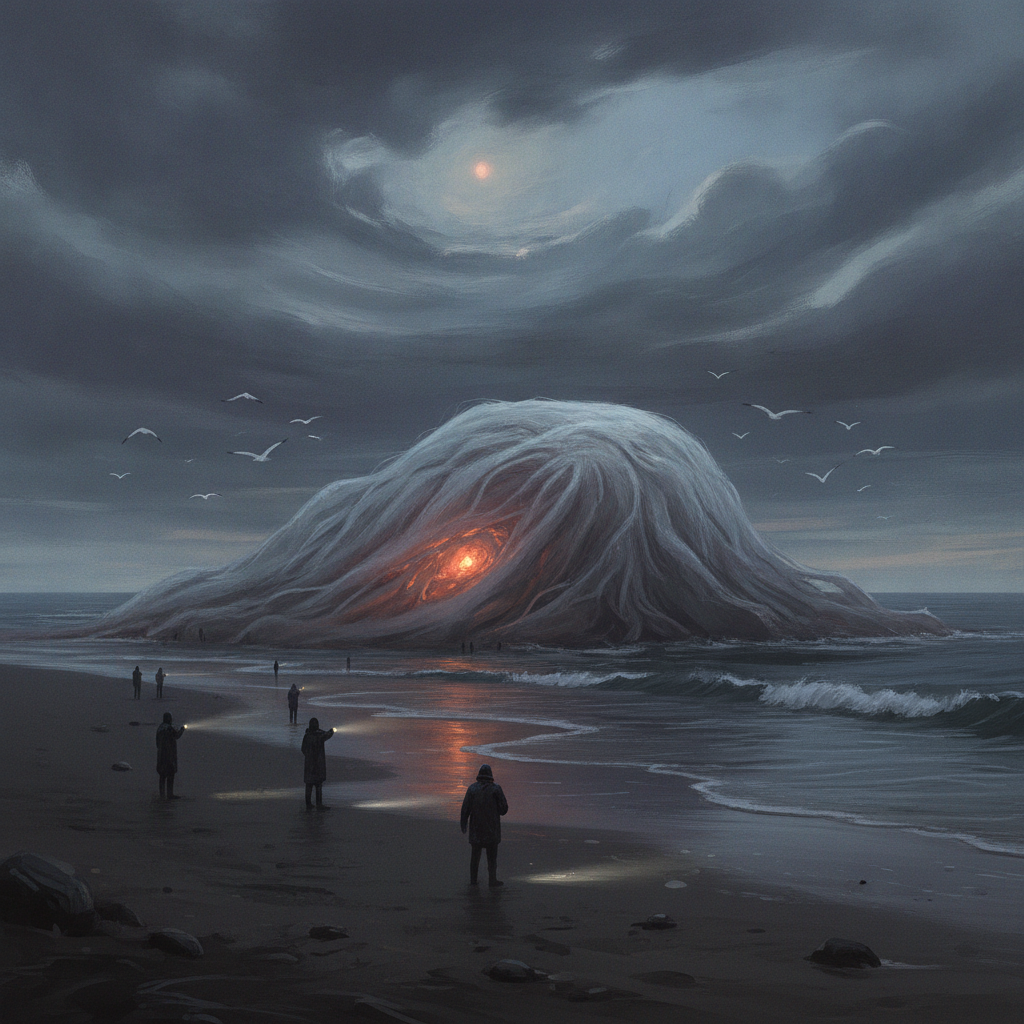
Globsters: The Beach Monsters That Turned Out to Be Whales
On the morning of November 30, 1896, two boys named Herbert Coles and Dunham Coretter were riding their bicycles along the sand of Anastasia Island, just south of St. Augustine on the Atlantic coast of Florida, when the beach in front of them stopped making sense. Half-buried in the dune line lay a pale mountain of flesh, vast and rounded and utterly still, the color of old ivory. It had no head they could find, no eyes, no fins, nothing that told them which end was which. The boys pedaled back into town, and by the next day their story had reached the one man in St. Augustine with the training to test it.
That man was Dr. DeWitt Webb, founder of the St. Augustine Historical Society and Institute of Science, and, as it happens, the only person of any academic training who would ever examine the carcass where it lay. When he reached it on December 1, he found that the exposed portion alone measured roughly eighteen feet long and seven feet wide. He estimated its weight at "nearly five tons, if not more." The flesh was tough, pale and rubbery. Where the sand had drifted away there were blunt stumps, projections that Webb read as the severed roots of enormous arms. He photographed the mass, measured it, and concluded that what had washed onto his beach was the body of a colossal octopus, far larger than any known to science.
Studying it was a physical battle. The carcass was so heavy that Webb assembled a team with horses, ropes and tackle to drag it higher up the beach, away from the surf, so that it could be photographed and measured before the sea took it back. The tides shifted the mass and reburied it, and within weeks the Atlantic had begun pulling it apart. By the time the wider scientific world grew curious, the great pale hill on Anastasia Island was largely gone. Almost everything later generations would argue over came down to the handful of preserved fragments Webb had thought to cut away and save.
Webb mailed samples north to the most eminent authority he could think of, the Yale invertebrate zoologist Addison Emery Verrill. In February 1897, in the pages of the American Journal of Science, Verrill gave the thing a formal Latin name: Octopus giganteus. For one extraordinary moment, the American coastline had a monster on the scientific books. Then, as more tissue reached him and he studied it more closely, Verrill reversed himself. The creature, he wrote, "cannot be an Octopus, but is of cetacean nature," most likely the upper part of the head of a sperm whale. The preserved fragments were placed in the collections of the Smithsonian Institution, where the naturalist William Healey Dall helped see them into storage, and there they sat in jars of preservative while the world moved on.
They did not stay unique for long. In 1924 a white, furry-looking carcass came ashore near Margate in South Africa, later nicknamed Trunko, after witnesses claimed to have watched it battling killer whales offshore before its body washed in. In August 1960 an even larger mass, roughly twenty feet across and matted with stiff, hair-like bristles, appeared on a remote beach in western Tasmania. More followed, from Bermuda in the 1980s and 1990s to Nantucket in 1996. In 1962 the zoologist Ivan T. Sanderson gave the whole class of apparitions the name that stuck: the globster, a blob with no recognizable front or back, no bones, no organs, no face.
The reports differ in size and place, but the anatomy is consistent. A globster has no skeleton anyone can identify, no eyes, no mouth, no limbs in any ordinary arrangement. It is pale, rubbery and stringy, often sheathed in what looks like coarse white hair. It rots slowly, resists the pull of the tide, and smells appalling. To anyone standing over one on a beach, it resembles nothing in any field guide.
Through most of the twentieth century, laboratory work on the surviving St. Augustine tissue pointed back toward Webb rather than toward Verrill's retraction. In 1971 the biologist Joseph Gennaro examined the preserved sample under a microscope, compared its connective-tissue fibers with those of octopus and squid, and reported a structure "similar to, if not identical with, that in my octopus sample." In 1986 the zoologist Roy Mackal ran an amino-acid and mineral analysis and concluded that the mass was consistent with "a gigantic cephalopod, probably an octopus." Two credentialed scientists, working fifteen years apart with real laboratory data, had studied the same century-old flesh and reported that it was not a whale.
The question was settled only when fresh material reached a modern laboratory. In July 2003 a grey mass some twelve meters wide, estimated at thirteen tonnes, washed ashore at Los Muermos in southern Chile. This time samples were taken before decomposition could finish its work. A team led by the biologist Sidney Pierce examined the tissue and published its findings in 2004 under a subtitle that left no room for poetry: nothing but whales. Under the electron microscope the Chilean Blob proved to be almost pure collagen, the tough structural protein that fills the blubber of a large whale, and DNA recovered from its mitochondrial genes matched the sperm whale, Physeter macrocephalus. Pierce's group had already done the same work on the older material: in 1995 they returned to the original St. Augustine sample and found the very same masses of collagen, with, as they put it, no evidence to support the existence of Octopus giganteus.
The explanation lies in how a large whale comes apart at sea. When a sperm whale dies and drifts for weeks, its bones and soft organs rot and sink away first, while the skin and the dense collagen matrix packed beneath the blubber hold together far longer. What remains is a boneless, shapeless bag of connective tissue, sometimes turned inside out, often bleached bone-white by sun and salt and frayed at its edges into coarse fibers. A globster, in this account, is not a creature at all. It is the wreckage of one, a whale reduced to the single most durable material it was made of. Every globster that has been sampled and tested to date has returned the same result, and on that basis the file is formally closed.
Conclusions and Open Questions
Two hypotheses competed over this material for a century, and the losing one was not foolish. The giant cephalopod reading began with Webb on the beach in 1896 and was formalized by Verrill's original naming of Octopus giganteus. It was then revived twice by working scientists: by Gennaro's histology in 1971 and by Mackal's biochemistry in 1986. Its weakness is that all of it was indirect. Both later studies compared the structure and chemistry of degraded, century-old tissue that had spent decades soaking in preservative, and neither could establish identity rather than resemblance. The hypothesis also demanded an animal no one has ever caught. If Webb had been right, the living creature would have been a cephalopod many times larger than any giant or colossal squid on record, with arms perhaps a hundred feet long, and the ocean has never surrendered a second specimen to confirm it.
The whale hypothesis holds the card its rival never played: mitochondrial DNA that matches a living species. Its weakness is quieter but real. Only a handful of globsters have ever actually been sampled and tested, and some of the most famous were never examined at all. Trunko lay on the South African sand for days and then was gone, and no one took a piece of it for a laboratory. The verdict of whale rests on the specimens that were tested and assumes the untested ones would say the same.
Some argue that the assumption is safe but the category is not, and that "globster" was never a single phenomenon with a single answer. On this reading the word describes a state of ruin rather than a kind of animal: it is the label we hang on any large sea creature the ocean has battered past recognition. A decomposed basking shark can end up as a pale, hairy mass on a beach much as a decomposed sperm whale can, and the resemblance says more about the limits of visual identification than about the species involved. One theory holds, accordingly, that at least some historical globsters were sharks, and that the whale result is true of the tested cases without being true of all of them.
What remains genuinely unexplained is narrower than the legend but harder to dismiss. Nobody has fully accounted for how two trained researchers, working independently and with real data, arrived at the same wrong identification from careful analysis. The condition of the samples is the usual answer, but the point has never been demonstrated experimentally on comparably aged tissue. Nor is there any way now to establish what the 1924 Margate carcass or the 1960 Tasmanian mass actually was, because neither was preserved.
The open questions are these. How many of the historical globsters were whales, and how many were something else that no one will ever be able to check? Could a future globster, sampled properly and read gene by gene, turn out to be an animal reduced past the point where even DNA gives a clean answer? Nothing in the record says a globster must always be a whale. It says only that every one anyone has bothered to test has been.