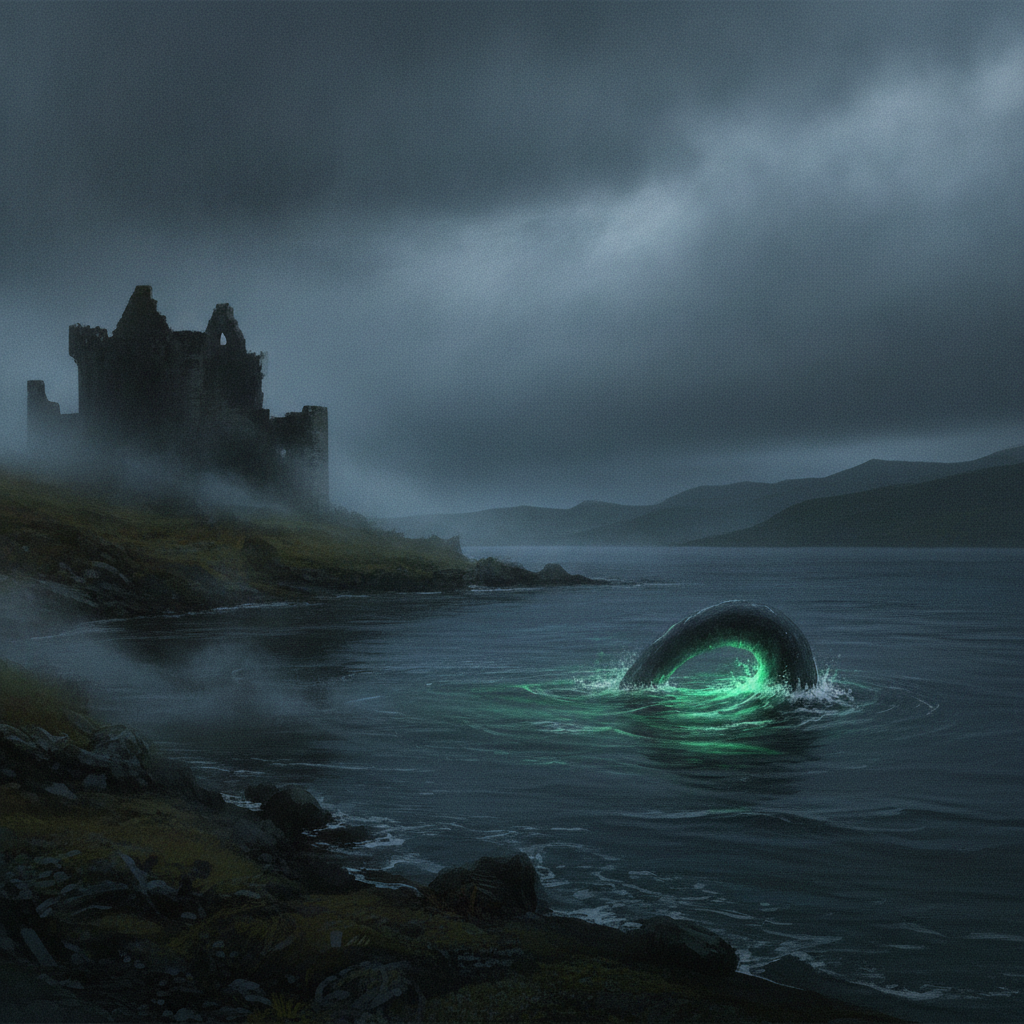
Loch Ness: What the Evidence Actually Says
Loch Ness lies along the Great Glen, the geological fault that cuts Scotland diagonally from coast to coast. The loch is twenty-three miles long, about a mile wide, and in places more than 750 feet deep. It holds more fresh water than every lake in England and Wales combined. The water is stained almost black by peat washed down from the surrounding hills, so that visibility below the surface is measured in inches rather than feet. On its western shore stand the ruins of Urquhart Castle, the most photographed vantage point on the loch and the setting of a large share of the reported sightings.
The loch itself is young. It was scoured out by ice and filled only after the glaciers of the last Ice Age retreated, roughly ten thousand years ago. It is cold year round, its depths are close to constant temperature, and biologists have long described it as poor in food compared with lochs of similar size. Salmon, trout, sticklebacks, pike and large numbers of European eels are the animals known to live in it.
The oldest surviving report of a creature in these waters is far older than the modern legend. In the seventh century an Irish abbot named Adomnan, writing a life of Saint Columba roughly a hundred years after the saint's death, described an encounter dated to around the year 565. Columba came upon Picts burying a man beside the River Ness who, they said, had been seized and mauled by a water beast while swimming. When one of Columba's monks, Lugne Mocumin, was sent into the river to fetch a boat, the creature surged at him with a roar and an open mouth. The saint raised his hand, made the sign of the cross and commanded the beast to go no further, and it withdrew. The account is set on the river, not on the loch, and it belongs to a genre of miracle writing intended to display a saint's power.
The modern story begins on 2 May 1933. The Inverness Courier reported that a local woman, Aldie Mackay, had seen something large rolling and churning the water as she drove along the shore road. The editor who handled the item chose the word monster, and the report was picked up by the national press within weeks. The same year, the road along the northern shore was completed and opened after major reconstruction. The blasting involved had stripped away trees and opened long, clear views of the water to passing motorists for the first time.
The Daily Mail sent a big-game hunter named Marmaduke Wetherell to find the animal. He returned with plaster casts of enormous footprints taken along the shore. The Natural History Museum in London examined the casts and concluded that the prints had been made with the dried foot of a hippopotamus, of the kind then mounted as an umbrella stand. Wetherell was publicly humiliated.
In April 1934 the Daily Mail published the photograph that would define the creature for two generations, the so called surgeon's photograph: a slender head and neck curving out of the water. It was credited to Robert Kenneth Wilson, a respected London gynaecologist with no obvious motive to deceive, and for sixty years it was treated as the single strongest piece of evidence in the case. In 1994 a dying man named Christian Spurling stated that he had helped fake it. His stepfather was Wetherell. Together, Spurling said, they had built the object from a toy submarine bought at Woolworths, fitted with a head and neck moulded from wood putty.
Not every episode was exposed as a hoax. In 1960 an aeronautical engineer, Tim Dinsdale, filmed a dark hump crossing the loch and leaving a broad wake behind it. Analysts at a Royal Air Force photographic interpretation unit later assessed the object as probably animate rather than a boat. The film brought a generation of amateur expeditions to the shore.
In 1972 the American patent lawyer and inventor Robert Rines lowered cameras and sonar into Urquhart Bay and recorded an image that appeared to show a large diamond shaped flipper moving underwater. In 1975 the naturalist Sir Peter Scott gave the animal a formal scientific name, Nessiteras rhombopteryx, in part so that a protected species could be covered by law if one were ever found. A member of Parliament soon pointed out that the name is an anagram of Monster hoax by Sir Peter S. In the 1980s sceptics obtained the original frames of the flipper image and showed that the published versions had been heavily retouched, an indistinct underwater blur tidied into a clean paddle shape.
The searches also grew larger and more methodical. In 1987 Adrian Shine organised Operation Deepscan, the largest sonar sweep attempted on the loch: a line of twenty-four boats moving in formation and trailing sonar across the full width and depth of the water. The sweep logged three contacts in deep water that were not identified and could not be relocated on a second pass. Nothing further was recovered from them.
The most decisive test used neither cameras nor sonar. In 2018 Neil Gemmell, a geneticist at the University of Otago in New Zealand, collected 250 water samples from the surface to the depths of Loch Ness and sequenced the environmental DNA they carried, the microscopic traces of skin, scale and waste that living things shed. The results were released in 2019. There was no reptile DNA of any kind, no plesiosaur and no unknown large animal. What the survey did find, in large quantities and at nearly every sampling point, was the DNA of European eels. Gemmell stated the limits of the method plainly: it could not distinguish a small eel from a very large one, and about a fifth of the DNA recovered could not be matched to any sequence in the reference databases. He declined to say that nothing was there, and described a very large eel as plausible.
Alongside the science, the record of what has never been produced is equally documented. No carcass has ever washed ashore. No bone or tissue has been dredged from the bottom. No clear, verified photograph or film has emerged in the decades since every visitor began carrying a camera. Steve Feltham has watched the loch from a van on the shore for more than thirty years, holding a record for the longest continuous vigil, and has not obtained one. The loch draws hundreds of thousands of visitors a year on the strength of a creature that has never been sampled, caught, or filmed at close range.
Conclusions and Open Questions
The evidence supports one firm negative and very little else. The 2019 environmental DNA survey rules out any reptile in the loch, which removes the explanation the legend was built on. Beyond that, the record consists of one hoax proved by confession, one hoax proved by anagram and retouching, a handful of films and sonar traces that were never resolved either way, and a great many sincere reports from people looking at black water.
The plesiosaur, the theory embraced by the early enthusiasts and by most of the popular press from 1933 onward, fits the long necked silhouette of the classic sighting almost perfectly, which is its main appeal. Its weakness is decisive. A plesiosaur was an air breathing reptile that would have to surface constantly, in water far colder than such an animal is thought to tolerate, which would make it the most photographed animal in Britain rather than the least. The eDNA survey found no reptile DNA at all.
The giant eel, favoured by Gemmell after his survey and long before him by the biologist Roy Mackal, has the strongest positive evidence: eels genuinely swarm the loch and their DNA is present almost everywhere. Its weakness is that no eel on record approaches monstrous size, and eels do not raise a long neck out of the water, so the theory explains the traces without explaining the classic sighting.
The Wels catfish, championed by Steve Feltham, is large, was introduced to Britain by Victorian stocking, and would be a plausible tenant of a deep lake. Gemmell's survey found no catfish DNA at all. A wandering Atlantic sturgeon, a huge armoured fish that could stray up the river, has been offered as a rare visitor that might explain a spiny back and sudden appearances, but sturgeon are extremely scarce in Scottish waters and none has ever been caught in the loch.
The misidentification case, argued patiently by Adrian Shine and by the writer Ronald Binns, accounts for the bulk of sightings: swimming deer with only their heads visible, otters travelling in line, diving cormorants, floating logs, and the loch's own behaviour, including the standing humps thrown up where boat wakes cross and the slow surface oscillations known as seiches. Its weakness is not scientific but human. It cannot satisfy the sincere witness who is certain that what they saw was alive.
What remains genuinely unexplained is narrower than the legend but not empty. About a fifth of the DNA Gemmell recovered matched nothing in the databases, which is a real gap rather than a hint of a monster, but a gap nonetheless. The three deep Deepscan contacts of 1987 were never identified. The Dinsdale film has never been conclusively resolved. And the open questions are worth stating without decoration. Why did the modern sightings begin in the same year the shore road opened the view? If sightings span fifteen hundred years, how large a breeding population would be required, and how would it feed in a cold, food poor loch? Why, in an age of constant cameras, has the photographic evidence become worse rather than better? Some argue that the real subject here is not an animal but the loch itself, a rare combination of depth, black water, sudden calm and deceptive light that reliably shows a hopeful observer the shape they came to find. That is a theory too, and like the others it cannot be proved.