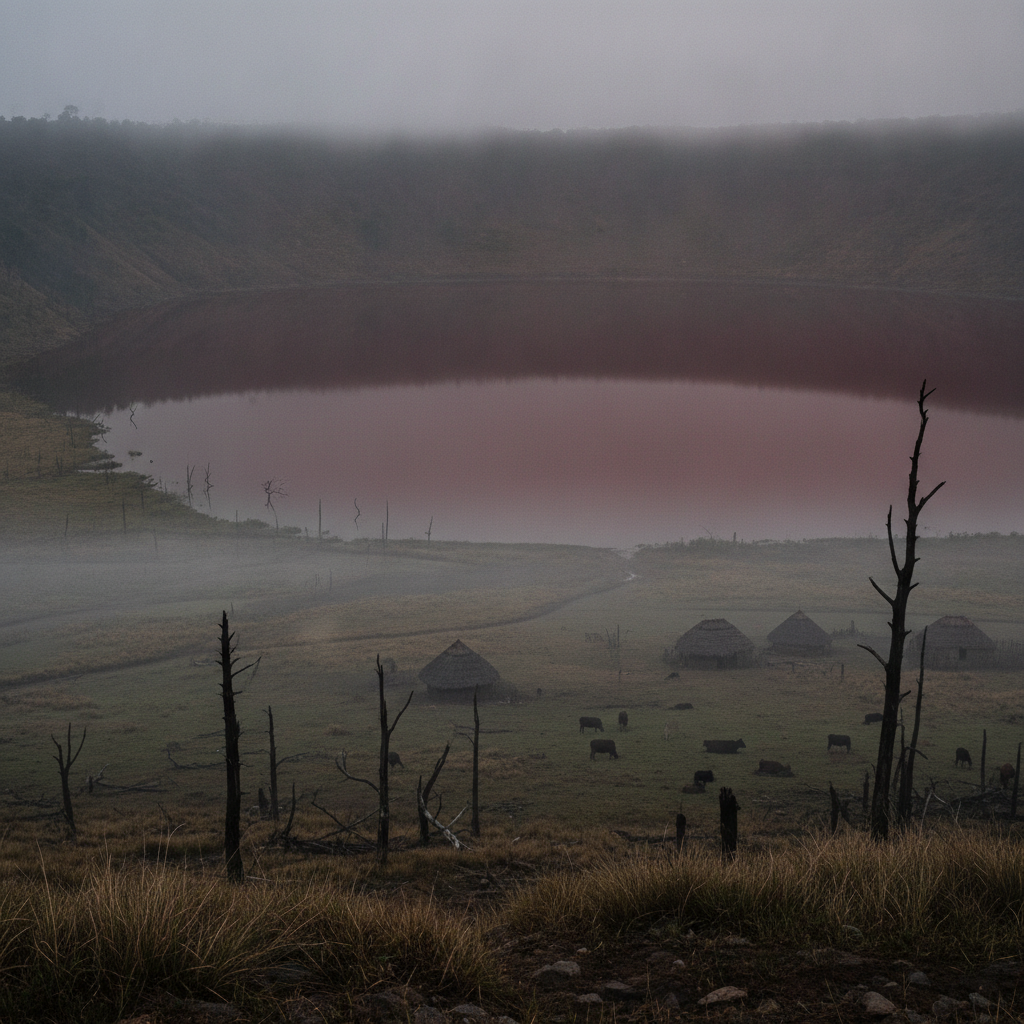
The Night the Lake Breathed Out: 1,746 Dead in One Hour
It began with a sound.
On the evening of 21 August 1986, people living around a small lake in the north-west of Cameroon, in West Africa, heard a noise come out of the water. Some said it was a rumble. Some said it was a distant explosion. A few of them walked outside to look.
There was a smell in the air. Some described gunpowder. Some described rotten eggs.
Then, in the valleys below the lake, people began to fall down where they stood.
Within about an hour, 1,746 people were dead. So were 3,500 cattle, and the goats, the dogs, the chickens, the birds in the trees and the insects in the grass. There was no fire. No water reached the houses. There was not a mark on the bodies.
Here is the whole thing in plain words. The lake sits inside the crater of an old volcano and is about 200 m deep. For many years carbon dioxide had been seeping up from below and collecting in the deep water, held down there by the weight of the water above it. On that evening it all came out at once, the way the fizz comes out of a bottle that has been shaken. Carbon dioxide is heavier than air, so the cloud did not rise and drift away. It ran downhill, filled the valleys where people were sleeping, pushed the ordinary air out, and everything that breathed there suffocated.
That much is now agreed by everyone. What is still argued about is what set it off.
The morning after
The first outsiders reached the area on 22 August 1986, the day after.
They found four villages in the low ground with nobody moving in them. Cattle were lying in the fields in groups, as if they had gone down together. Dogs lay in doorways. In some houses whole families were dead in their beds.
Then the survivors began to wake up.
About 5,000 people in the wider area had been caught by the edge of the cloud and had lived. Nearly all of them had been unconscious. The shortest blackouts lasted about 6 hours. The longest lasted 36 hours. People woke on the floor of their own houses, too weak to stand, unable to speak for a while, with a burning feeling in the throat and no idea what day it was.
One farmer from one of the villages later described waking, finding that he could not speak, and then finding his daughter dead beside him.
Many survivors had open sores on their skin. The first doctors on the scene took these for chemical burns and assumed an acid gas had been released. Later examination of 845 people treated in hospital pointed somewhere else: the sores matched what happens to a body that lies unmoving on hard ground for a day and a half. They were pressure sores, not burns. It was one of the first clues that the killer had not been an acid or a poison, but plain suffocation.
About 4,000 people left the area in the days that followed and did not come back.
The lake had changed colour
Anyone who had seen the lake before knew it as blue.
Now it was a deep rust red. The reason turned out to be simple: water from the bottom of the lake, which is rich in dissolved iron, had been thrown up to the surface, and the iron had reacted with the air.
There were two other marks on the landscape, and both mattered.
The plants along the shore had been stripped bare to a height of about 25 m above the normal water line. Something had swept the shoreline. And the lake itself was standing about 1 m lower than before.
Put together, these said that a huge volume of water and gas had come up from the bottom in a rush, thrown a column of foam into the air, and pushed a wave across the shore.
It had already happened once, and nobody had listened
On 15 August 1984, two years earlier, 37 people had died in a single night beside another crater lake about 100 km to the south-east.
At the time there was no agreement on what had killed them. One idea in circulation was that somebody had poisoned the water, or that a chemical weapon had been tested. A scientist who examined the smaller lake in 1985 concluded that the deaths had been caused by carbon dioxide coming out of the water itself.
That conclusion was published. Nothing was built, nothing was drained and nobody was moved. Two years later the larger lake did the same thing, and killed 47 times as many people.
Why a lake fills up with gas
The mechanism is now well measured, and it is not exotic.
Underneath the crater, the old volcano is still leaking carbon dioxide. The gas seeps upward into the water at the bottom of the lake. In a cold country, lakes turn over every year: the surface water chills, becomes heavy, sinks, and the bottom water comes up and releases whatever it is holding. In the tropics that does not happen. The deep water stays at the bottom, year after year, and the pressure of 200 m of water above it keeps the gas dissolved.
Over decades the deep water becomes loaded far beyond what it could hold at the surface.
At that point the lake behaves like a bottle of fizzy water that has been shaken and not opened. It is stable as long as nothing lifts the bottom water upward. But if a parcel of that water is raised far enough, the pressure on it drops, bubbles form, the bubbles make the water lighter, the lighter water rises faster, and more gas comes out. The process feeds itself and runs away in minutes.
The measurements taken afterwards gave the scale. Somewhere between 100,000 and 300,000 tonnes of carbon dioxide left the lake that night. A column of water and foam rose roughly 100 m into the air. The cloud that came down the valleys was about 50 m thick and moved at between 20 and 50 km/h. It killed people as far as 25 km from the water.
From here on, the record stops. Nobody knows what lifted that first parcel of deep water on that particular evening.
What was done about it afterwards
The fix that was chosen is almost embarrassingly simple.
If you lower a pipe from the surface to the bottom of the lake and start the water moving upward, the water begins to fizz inside the pipe. The bubbles make the column lighter, and the column then keeps itself going without a pump, like a fountain that will not switch off. The gas is released slowly and harmlessly at the top instead of all at once.
Testing began in 1995. The first permanent pipe was installed in 2001. Two more followed in 2011. By 2019 the assessment was that the pipes could hold the gas level down on their own, without outside power.
Survivors were moved into camps after the disaster, and it was years before people were allowed to settle near the lake again.
One worry has not gone away. The lake is held in place at one end by a natural wall of loose volcanic rock, and engineers have repeatedly warned that it is weak. If that wall failed, the water would pour downstream towards neighbouring Nigeria, where thousands of people live in the path it would take.
Conclusions and Open Questions
Nobody disputes what killed the 1,746 any more. The argument is about the moment the lake turned over, and about the future.
One theory holds that a landslide did it. The slopes above the lake are steep and unstable, and the disaster happened in the rainy season, when the ground is heavy with water. A mass of rock falling into deep water would push bottom water upward. The problem: no clear landslide scar was ever matched to that night.
One theory holds that there was a small eruption on the lake bed. It is a volcanic crater, the volcano is not dead, and some survivors described a smell of sulphur that plain carbon dioxide does not produce. The problem: the water and the sediment were examined and showed no fresh volcanic material.
One theory holds that cold rainwater cooled the surface and started an overturn. Cooled surface water becomes heavy and sinks, and something has to come up to replace it. The problem: the rainy season arrives every single year, and the lake did not erupt every year.
One theory holds that nothing set it off at all. The measurements showed the deep water so heavily loaded that it was close to unstable on its own. On this reading the lake did not need a push. The problem: this cannot be tested, and a theory that cannot be tested cannot be checked against the next event.
Two larger questions remain open.
The first is the rate of refill. The pipes are designed against an estimate of how fast the volcano is putting new gas back in. If that estimate is wrong, the safety margin is wrong with it.
The second is how many other lakes are in the same condition. A much larger lake in central Africa holds an enormous quantity of dissolved gas, and it has millions of people living around it. A study in 2005 warned that its gas levels were rising dangerously. A reassessment in 2020 found errors in how those earlier measurements had been converted and calibrated, and concluded that the risk was not in fact increasing. The two papers still sit side by side in the literature.
For 40 years the place has carried a sentence that fits very few disasters: the water did not drown anyone, and the air did not burn anyone. The lake simply breathed out, and everything that was breathing in the valley below stopped.