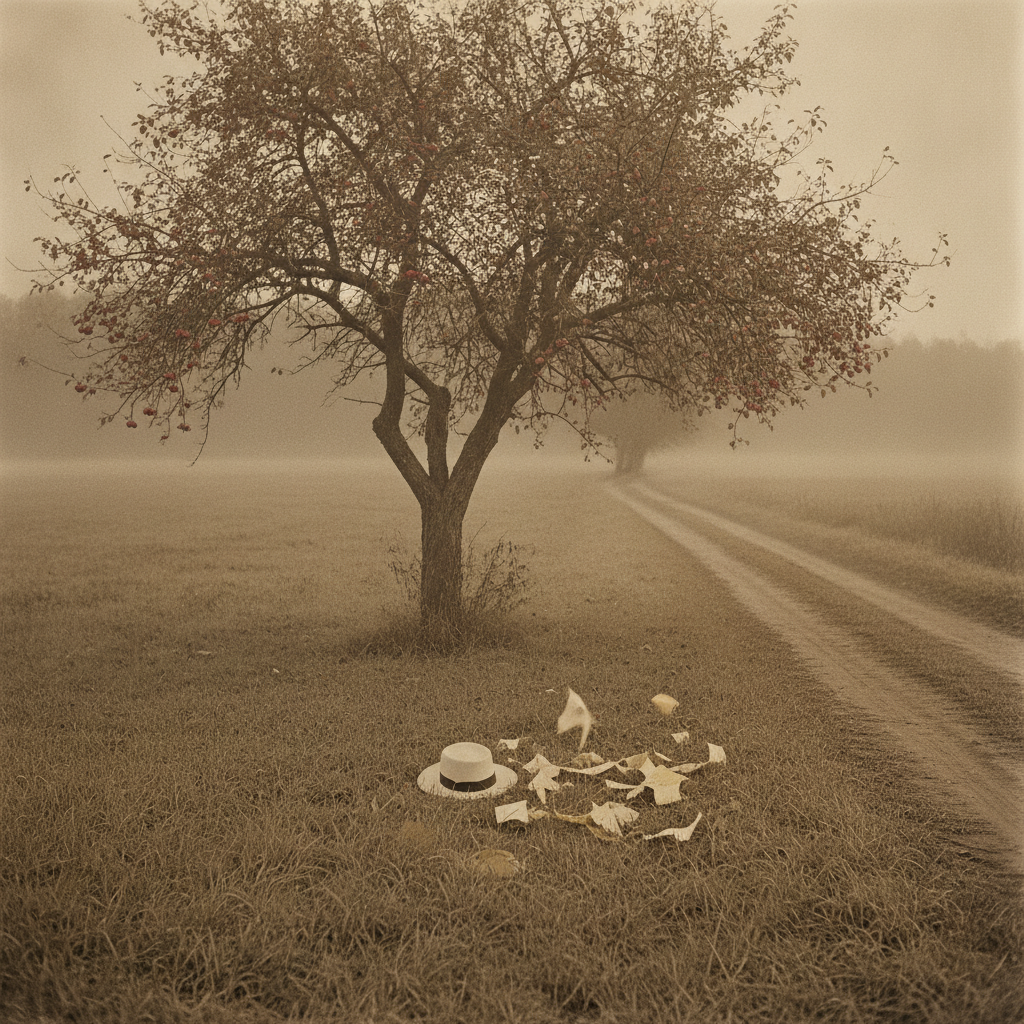
The Hall-Mills Murders: A Minister, a Choir Singer and a Crab Apple Tree
On Thursday, 14 September 1922, a minister in the town of New Brunswick, New Jersey, told his wife he was going out.
New Brunswick is a university town in the north-east of the United States, between New York and Philadelphia. The minister was Edward Hall. He was 41 years old and led the Episcopal Church of St. John the Evangelist, one of the respectable churches of the town.
According to the account later given by his wife, a telephone call had come for him that day from a woman in his congregation. Another call came at about 7 in the evening. At about 7:40 he said he was going to look into a medical bill of that woman, and he walked out of the house.
The woman was Eleanor Mills. She was 34 years old and sang soprano in his choir. Her husband worked for the same church as its sexton, the man who looks after the building. The Mills family lived in a small apartment and had no telephone of their own.
That evening Eleanor Mills also left her home. Neither she nor the minister came back that night.
The night of the search
The minister's wife lived with him in a large house in the best part of town. Her brother lived with them. He was about 50, an unusual man who could not live on his own, and the newspapers would later be cruel about him.
According to her own account, the wife went to bed. At about 2:30 in the morning she got up and dressed, because her husband had still not come home. Together with her brother she walked to the church. It was dark. They walked past the building where the Mills family lived. That was dark too. They went home.
The next morning, Friday 15 September, the wife and the husband of the choir singer met at the church. Each was looking for someone. The two of them later gave different times for that meeting: she said it was at 7 in the morning, he said 8:30. It is a small difference, but in this case nothing small was ever settled.
What two young people found on a dirt road
On the morning of Saturday, 16 September 1922, a young man of 23 and a girl of 15 were walking along a dirt road just outside New Brunswick. The road was called De Russey's Lane. It was known in the town as a lovers' lane.
Under a crab apple tree, at the edge of a field, they saw a man and a woman lying on their backs.
The two were side by side, their feet pointing toward the tree. The woman's head rested on the man's arm. A Panama hat covered the man's face.
They were the minister and the choir singer. They had been dead for some time.
The bodies had been arranged. Someone had laid them out like this. Between them, and scattered over them, lay torn letters. A small white calling card, the kind a man of standing carried in his pocket, leaned against the minister's left foot. It was his own card.
Later the pieces of one letter were put back together. It was in the choir singer's handwriting. One line read: "There isn't a man who could make me smile as you did today."
What the bodies showed
Both had been shot with a .32 calibre pistol. A spent cartridge case lay nearby.
The minister had been shot once. The bullet entered above his right ear and came out through his neck. There was a small bruise on his ear, scratches on two fingers, and a wound on his right calf. His gold watch was missing. The coins in his pocket were still there.
The choir singer had been shot 3 times: under the right eye, at the right temple and above the right ear. Her throat had been cut. A brown silk scarf was wrapped around it. She wore a blue dress with red polka dots. There was a bruise on her arm and a small cut on her lip.
A police officer noticed that insects had already begun their work on her body. That meant she had been dead for at least 24 hours. Everything pointed to the night of Thursday, 14 September: the night both had walked out of their homes.
So the case was clear in one way. Two married people, each married to someone else, had been meeting secretly. Their letters lay around them. Someone had shot them both, and had wanted everyone to know why.
It was not clear at all who that someone was.
The investigation that began in the wrong way
The first mistake was made in the first hour.
The dirt road lay just across a county line. The town police of New Brunswick arrived first, but the field belonged to the neighbouring county. For hours the two counties argued over whose case it was. Nobody took control of the scene.
Meanwhile crowds came. The news spread fast, and people walked out from the town to see the place. They trampled the ground. They took away souvenirs. They passed the calling card from hand to hand. In the months that followed, visitors stripped the crab apple tree itself. By the time of the trial, 4 years later, it was gone.
The second mistake was medical. The first doctor who looked at the choir singer did not perform a real autopsy. The first reports said she had been shot once. Only a second examination, made a few weeks later, found 3 bullet wounds. The coroner admitted publicly that he had not made a real autopsy on her body.
The third mistake was a lead that was never followed. On the day the bodies were found, a driver from a nearby town went to the police in New Brunswick. He said that on the night of the murders he had seen a small Ford car with no number plates, carrying 3 men. Nobody acted on his report.
Letters and telephone calls also reached the prosecutors, saying the Ku Klux Klan was behind the killings. The Klan was strong in New Jersey at that time, and it presented itself as a guardian of public morals. None of those tips was followed up either.
Who the police looked at
The investigators looked first at the people closest to the dead.
The choir singer's husband was questioned. He was a quiet man, and the newspapers described him as weak and obedient. He was soon set aside as a suspect.
The minister's wife drew far more attention. She came from a rich and well-known family. She was 48, 7 years older than her husband. If the affair was known in the town, it was hard to believe it was unknown to her. Her younger brother, the one who lived in her house, owned a .32 calibre revolver. The family also had a cousin, a man of the same circle.
The case against them, though, was only a shape. There was no weapon that matched. There was no witness who had seen them at the field. The wife's night walk to the church could be read 2 ways: as the search of a worried woman, or as something else. There was nothing more.
The pig farmer
In the middle of October 1922 a new witness appeared.
She was a woman who kept pigs on a small farm near the dirt road and lived in a converted barn. The newspapers named her "the Pig Woman", and the name stuck.
She said that on the night of 14 September, at about 9 in the evening, her dog began to bark toward the field. She thought someone was stealing her corn. She climbed onto her mule and rode out to look.
Near the crab apple tree, she said, she saw a group of people quarrelling. She heard a shot. She rode away. Then she heard more shots.
She named the minister's wife, the wife's 2 brothers and their cousin.
Her account had a problem from the start. It changed. What she told the police, what she told the newspapers and what she later said under oath were not the same story. Parts of it did not fit the medical findings. Each version had more detail than the one before.
The grand jury says no
In late November 1922 the case went before a grand jury: the panel that decides whether there is enough evidence to charge anyone at all.
It heard 67 witnesses over 5 days. It did not believe the pig farmer. It decided there was not enough evidence to charge anyone.
The minister's wife left for Europe.
**This is where the case of 1922 ended. Two people had been shot and laid under a tree, and the official answer was that nobody could be charged.**
The case then lay untouched for almost 4 years.
How a divorce reopened a murder
In July 1926 a man went to court in New Jersey to end his marriage.
His wife had worked as a maid in the minister's house in 1922. In his petition the husband made a startling claim. He said his wife had kept back what she knew about the night of the murders, and that she had been paid 5,000 dollars to stay silent.
He said more. He said that on the night of 14 September his wife had told the minister's wife that the minister planned to run away with the choir singer. And he said that the minister's wife, her younger brother and the maid herself had then driven to the field.
The former maid denied all of it. She called her husband's story "a pack of lies".
None of it was ever proved in court. But it was exactly the kind of story a new kind of newspaper was hungry for.
A newspaper takes over
In 1924 one of the most powerful press owners in America had bought a New York tabloid called the Daily Mirror. Tabloids were then a new thing: small pages, big photographs, crime on the front page.
The Daily Mirror took the maid's story and ran with it. It reported "new evidence" against the minister's wife and her family. Day after day it demanded that the case be reopened.
The governor of New Jersey ordered a new investigation. At the end of July 1926 warrants were issued. The minister's wife, her 2 brothers and their cousin were arrested. All 4 pleaded not guilty.
The cousin was later given a separate trial, and in the end he was never tried at all. The other 3 would stand trial together.
The bodies are examined again
Before the trial both bodies were exhumed and examined again.
The new autopsy on the choir singer found something the doctors of 1922 had missed or never recorded. Her tongue had been cut out, and with it her larynx, the voice box. A historian of the case, writing for a university library journal, notes that the discovery was first made 4 years after the murder, on the exhumed body.
Sources describe the finding slightly differently: some speak of the tongue, others of the tongue and the larynx. All agree that it was not known in 1922.
For the prosecution it fitted a picture of rage aimed at one woman's voice: the voice that sang in the choir.
The trial
The trial opened on Wednesday, 3 November 1926, in the county courthouse in Somerville, New Jersey, a small town not far from the field.
More than 300 reporters came. The New York Times alone kept 4 stenographers in the courtroom, to take down every word. Over the weeks of the trial the press sent out more than 12 million words about it. Famous writers sat among the spectators. It was one of the first trials in the United States to be covered like a show.
The jury heard the love letters read aloud: the letters that had been scattered over the bodies.
The minister's wife took the stand. She was calm and controlled through hours of questioning, and the press named her "the Iron Widow".
Her younger brother took the stand as well. The newspapers had mocked him for 4 years as simple-minded. On the stand he gave clear and steady answers, and many who watched found him believable.
The fingerprint
The prosecution's main piece of physical evidence was the calling card from the minister's foot.
Experts for the prosecution testified that a fingerprint on it was the left index finger of the younger brother.
The defence attacked this hard. The card had lain outside, in the open air, for about 36 hours before it was found. It had then been passed from hand to hand by police officers and by curious people from the crowd. Nobody had treated it as evidence. Experts for the defence disputed the claim that the print was his.
There was a further problem. He had lived in the same house as the minister. A print of his on a card from that house would not by itself prove where he had been on the night of the murder.
The witness on a hospital bed
The prosecution's star witness was the pig farmer.
By the autumn of 1926 she was seriously ill. She was carried into the courtroom on a hospital bed and gave her testimony lying down.
She told the story of her dog, her mule and the crab apple tree once more. She said she had heard a woman cry out the name "Henry". Both the older brother and the cousin were named Henry. She pointed at the accused.
The defence then took her story apart: the dates, the versions, the details that had grown with each telling. It painted her as a woman nobody should believe.
And in the back of the courtroom sat an elderly woman: the witness's own mother. During the testimony she called out again and again: "She's a liar!"
At one point the witness raised herself on one elbow in her bed and said: "I have told the truth, so help me God, and you know it!"
The verdict
On 3 December 1926 the jury went out to decide. It deliberated for about 5 hours.
It found all 3 not guilty: the minister's wife and both her brothers.
It is important to say this plainly. In law the 3 were innocent. They were tried, and acquitted. Nobody else was ever charged with the murder of Edward Hall and Eleanor Mills.
After the verdict the family sued the Daily Mirror and its owner for libel. Sources give different sums for the claim. The suits were settled out of court, for an amount that was never published.
Where it stands
The case was never solved.
The reasons are on the record. The scene was lost in the first hours, under the feet of a crowd. The first autopsy was not a real autopsy. The calling card, the best physical clue, was handled by strangers before anyone thought to protect it. A report of a car with 3 men was never followed up. The gold watch never turned up.
By the time a court heard the case, 4 years had passed, the tree was gone, and the main witness was dying.
Today nobody is left who could know. The pig farmer died in a hospital in February 1930. The cousin died in 1934. The older brother died on 3 December 1939, exactly 13 years after the acquittal. The minister's wife died on 19 December 1942. Her younger brother died 11 days later.
A retired police chief from the area has said that only a confession written down somewhere, such as a diary, could solve the case now. No such document is known to exist.
The theories
All of these are theories. None was proved.
**The family.** This was the prosecution's case: that the wife, betrayed, and her brothers killed the couple. A 1999 book on the case, Fatal Tryst, concluded the family was guilty. The evidence: the motive, the revolver of the right calibre, the night walk, the fingerprint claim. The problem: a jury heard all of it and acquitted all 3. The fingerprint was disputed, and the main witness was not believed.
**The Ku Klux Klan.** A 1964 book by a well-known American lawyer, The Minister and the Choir Singer, argued that the Klan killed the couple as punishment for their affair. The evidence: the tips sent to the prosecutors in 1922, the staged scene that looked like a message, the Klan's strength in New Jersey at that time. The problem: the author himself admitted that the Klan had never killed anyone in New Jersey before.
**Hired men.** In 1969, 47 years after the murders, a man came forward and said that the younger brother had asked him to pass 6,000 dollars from the widow to 2 hired killers. The problem: investigators could not confirm any part of his story, and everyone he named was long dead.
Someone laid two bodies under a crab apple tree, set a hat over a face and a calling card at a foot, and walked away. More than 100 years later, nobody knows who.