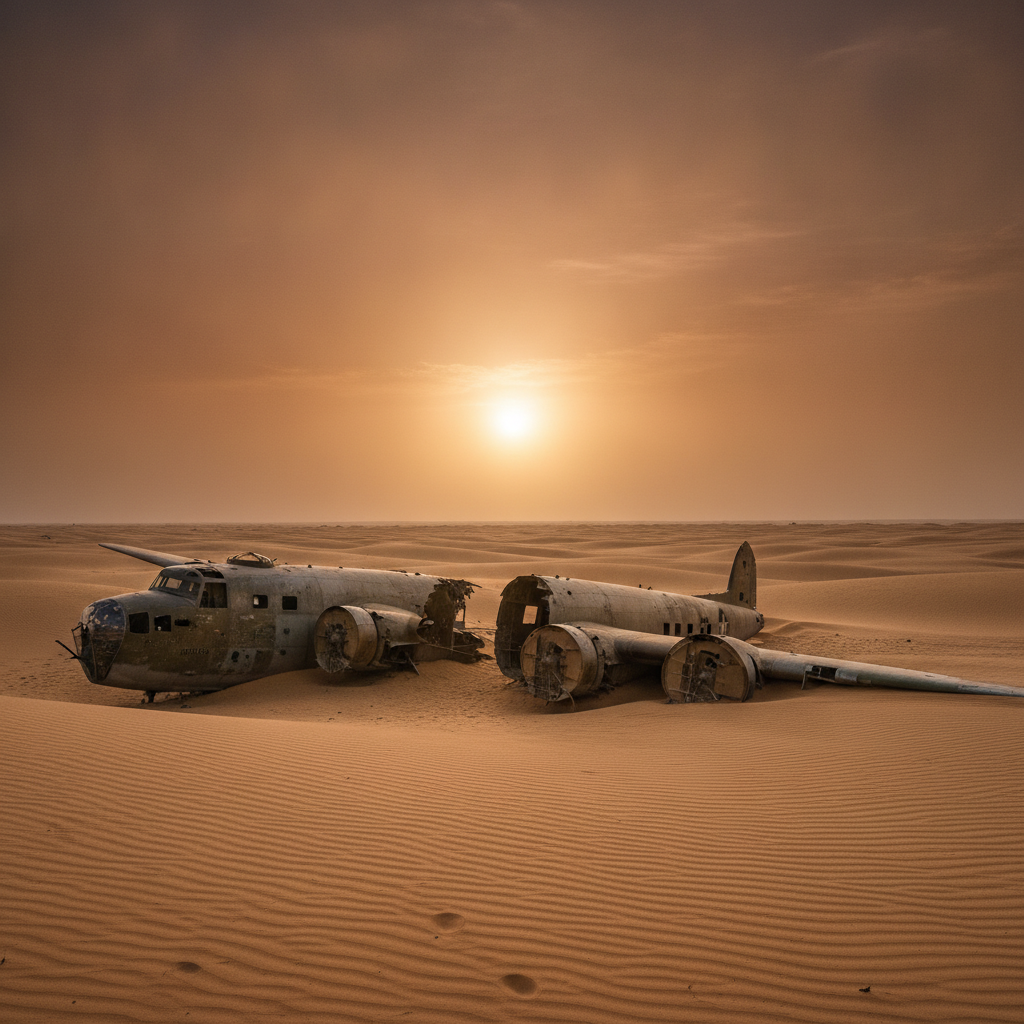
Lost at Sea, Found in the Sand: The Bomber That Flew Past the Coast
In February 1959, a small team of British oil surveyors drove across one of the emptiest places on Earth, the deep desert of eastern Libya, in North Africa.
In front of them, on a flat plain of gravel at the edge of a sea of sand dunes, lay a large aircraft.
It was an American bomber from the Second World War, broken into 2 pieces but otherwise almost whole. The machine guns still worked. The radio still worked. There was a flask with tea inside it, and the tea could still be drunk.
There was nobody inside, and no sign of any parachute.
The nearest coast was hundreds of kilometres away. The plane had been missing for 16 years, and until that moment nobody had known it was in the desert at all.
In short: a bomber with 9 men on board disappeared in April 1943 on its way home from a raid, everyone assumed it had gone down in the Mediterranean Sea, and instead it was found deep in the Sahara. The question was what had happened to the 9 men.
The first mission
The story begins on 4 April 1943. The bomber was a B-24, a big 4-engine American plane. It was brand new, and so was its crew. It was their first combat mission. The crew had painted a name on the nose: Lady Be Good.
Their airfield was in the desert near Benghazi, a city on the coast of Libya. From there, 25 bombers were sent north across the sea to attack the harbour of Naples, in southern Italy.
Lady Be Good took off at 2:15 in the afternoon, in the last group.
A sandstorm blew across the airfield. Some bombers could not keep formation. Several turned back. In the end, only 4 planes reached Naples.
They arrived at 7:50 in the evening, flying at about 7,600 metres. The city below was hidden by cloud. They could not see the target.
2 of the 4 bombers attacked other targets on the way back. Lady Be Good and one other plane dropped their bombs into the sea to save fuel, and turned for home.
A voice on the radio
At 12:12 after midnight, the base heard the pilot of Lady Be Good on the radio.
He said that his direction finder was not working. This was the instrument that pointed toward the base's radio beacon. He asked the base to tell him which way to fly.
The base sent him a bearing. On the ground, officers fired flares into the sky to help the lost plane find the airfield.
Nobody on the ground ever heard from Lady Be Good again.
The bomber never landed. The crew were declared missing. As far as the records showed, it had simply been lost somewhere over the sea.
**For 16 years, that was all anyone knew.**
What the wreck showed
When the oil surveyors reported the wreck, American teams from an air base in Libya went out to it. They began in May 1959.
The bomber had not gone down in the sea. It had flown right over the coast in the dark, over its own base, and kept going south into the desert for about 2 more hours.
The most likely reason is a weakness in the direction-finding radio of the time. It used a single antenna, and it could not always tell whether the plane was coming toward the base or had already passed it. A reading taken the wrong way round would point the plane in the opposite direction: the base would seem to be ahead when it was actually behind.
Below them there was only darkness. The crew seem to have believed they were still over the sea.
The investigators worked out that at about 2 in the morning the fuel was running out, and all 9 men jumped with parachutes. The empty plane flew on by itself for another 26 km, and then slid down onto the gravel and broke apart.
But where were the men?
The searchers combed about 1,165 square kilometres of gravel around the wreck. They found nothing.
Then, on 16 June 1959, they found a pair of flying boots, about 30 km north of the wreck.
After that they found more things, laid out in a line: pieces of parachute cut into the shape of arrows, more boots, life jackets. The men had been leaving a trail for rescuers to follow. The arrows pointed north.
The searchers followed the trail for 82 km. Then it ran out, among the dunes.
On 2 September 1959, the search was called off.
The diary
In February 1960, a year after the wreck was found, another oil exploration team came across human remains, half buried in the sand, far to the north of the plane. Sources disagree about whether it was the oil team or an American army team that found them first.
There were 5 men. They were lying close together.
One of them was the co-pilot. He had kept a small diary, and it was still with him.
The diary filled in what nobody had known.
After they jumped, 8 of the 9 men found each other in the dark. The ninth, the bombardier, never joined them.
The 8 men did not know they were deep in the desert. They thought the coast must be near. So they began walking north.
They had almost no food, and a single canteen of water for all 8 of them.
In the daytime the temperature on that plain can reach 54 degrees Celsius. At night it drops close to freezing. Army doctors had estimated that a man without water could walk about 40 km in the desert before he died, and that he would live about 2 days.
These men walked 125 km together, in 5 days.
Then most of them could not go on. The diary describes their eyes failing in the blowing sand, and their bodies weakening every day.
On the fifth day, the 3 men who were still strongest set off ahead to find help. The 5 others stayed behind to wait.
The last entry in the diary is dated 12 April 1943, 8 days after the mission. It reads: "No help yet, very cold nite."
The men who went ahead
In May 1960, the army came back with a larger search. It had one goal: to find the 3 who had gone ahead.
On 12 May, the searchers found one of them, about 60 km into the sea of sand. From the place where the crew had jumped, he had walked about 186 km.
On 17 May they found the second, 42 km further on, almost completely buried by the sand. He had also carried a small diary.
The sources give different distances. One says the second man was more than 320 km from the wreck.
In August 1960, an oil team found the bombardier, the man who had never joined the others. He was about 19 km from the wreck, still in his parachute harness. His parachute had not opened properly, and he had died when he hit the ground. His canteen was almost full.
**That makes 8 of the 9 men. The third man who went ahead has never been found.**
What happened afterwards
Parts of the wreck were taken away and fitted into other aircraft. Some of those aircraft later had accidents, and stories grew up about a curse. Those stories are legend, not evidence.
In 1994, what was left of the bomber was moved to a Libyan military base near the coast. It is still kept in Libya.
In 2001, a man who had served with a British army patrol in the Libyan desert in 1953 came forward with a memory. His patrol had found human remains in the same area where the 2 men who went ahead would later be found. They took photographs, buried the remains, and moved on.
Experts later studied those photographs. They thought the remains might have belonged to the missing man. But the grave was never marked, and the remains have never been found again.
So the documented story is complete, except for 2 things: exactly why the crew flew past their base, and where the last man lies.
Conclusions and Open Questions
The wreck and the diaries solved the main mystery. What remains open is smaller, but it has never been settled.
**A radio reading taken the wrong way round.** The evidence: the direction-finding radio of the time could not always tell whether a plane was approaching the base or had passed it. A reversed reading would put the base ahead of the plane when it was already behind, and would explain why the crew kept flying south. The problem: the pilot had reported that the plane's own direction finder was not working. No surviving record shows exactly what bearing the crew used, or how, and nobody survived to explain it.
**An inexperienced crew in the dark.** The evidence: it was their first mission, at night, after a long flight over the sea, with the ground hidden in darkness. A new crew might not notice that they had already crossed the coast. The problem: the base fired flares to guide them. Nobody knows whether the crew saw them, or why they did not turn back.
**The last man was found in 1953.** The evidence: a former soldier described remains found in exactly the right area, and experts who studied the photographs thought they might fit. The problem: it depends on one man's memory, almost 50 years later, and on photographs of unknown remains. The grave has never been located.
**The last man is still under the dunes.** The evidence: he was one of the 3 strongest, and he may have walked further than either of the others. The sand sea moves and covers everything. The other 2 men were found almost buried. The problem: nothing has been found in more than 60 years.
What remains open is simple. We know how the 8 men died. We know that they walked further than anyone thought possible, north toward a coast they never reached. What we do not know is where the last of them stopped walking.