The Chair, the Slipper and the Ashes: The Death of Mary Reeser
At about eight o'clock on the morning of 2 July 1951, Pansy Carpenter walked across to the apartment she rented out at 1200 Cherry Street NE in St. Petersburg, Florida. She had a telegram in her hand for her tenant. When she reached for the door, the metal knob was too hot to hold.
Carpenter went for help. Two painters working nearby forced the door. What they found inside became one of the most examined death scenes of the twentieth century, and it has never been fully agreed upon.
The tenant was Mary Hardy Reeser, born on 8 March 1884, a widow of sixty-seven. Her husband, Dr. Richard Reeser, had died some years earlier in Pennsylvania. In the autumn of 1950 she had sold their home and moved south to St. Petersburg to be near her son, Dr. Richard Reeser Jr., his wife and their three young daughters. She had been in Florida less than a year.
The night before, on 1 July, her son had visited her. So had her landlady. Both later described her as she had been all evening: sitting in a large overstuffed armchair in a nightgown and a housecoat, smoking a cigarette. She was known to take sleeping pills. Nothing about the evening struck either visitor as unusual. Her son left. The landlady went to bed.
What was left
The apartment was not burned down. That is the fact that has kept the case alive for seventy-five years.
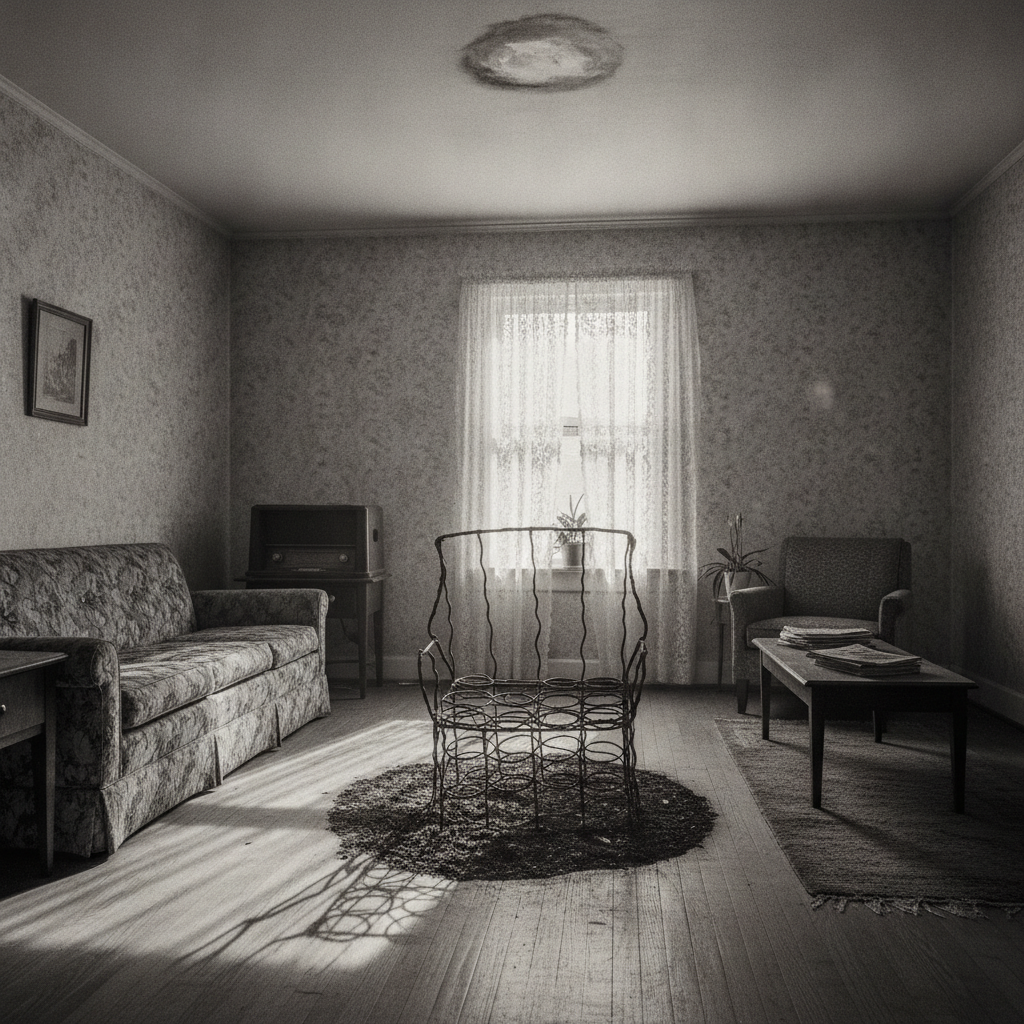
In the corner where the armchair had stood there was a blackened circle on the floor, roughly a metre across. The chair itself was gone except for its coil springs. A small side table and a section of rug had also been consumed. Within the ash were the physical remains of Mary Reeser: a piece of her spine, a portion of her left foot still wearing a black satin slipper, and her skull.
Beyond that circle, the damage fell away sharply. The ceiling above was darkened with smoke and greasy soot. Plastic objects some distance from the chair had softened and lost their shape, which told investigators the air in the room had reached a high temperature at some point. But the walls stood, the furnishings beyond the immediate area survived, newspapers in the room were not consumed, and the building itself was intact. A human body had been almost entirely reduced to ash inside a room that had not burned.
One detail from that morning became famous and is also the most contested. Press reports described the skull as having shrunk to the size of a teacup. That description has been disputed: a fire researcher who happened to be attending a conference in nearby Bradenton and was able to view the scene rejected it. Sources have never reconciled on this point, and it matters, because a shrunken skull is anomalous while a fire-damaged one is not.
The letter to Hoover
St. Petersburg police chief J.R. Reichert did not attempt to close the case locally. On 7 July 1951, five days after the death, he packaged up physical evidence from the apartment and sent it to the Federal Bureau of Investigation in Washington, addressed to Director J. Edgar Hoover.
The parcel contained fragments of glass, sections of the carpet, the surviving shoe, and six small objects believed to be teeth. Reichert's covering letter set out the problem in plain language, asking for any information or theories that could explain how a human body could be so destroyed while the fire remained confined to such a small area and did so little damage to the structure of the building. He was reported to have described it as the most unusual case he had encountered in almost twenty-five years of police work, and, in a line often quoted since, to have told the Bureau that the fire was too puzzling for a small-town force to handle.
The FBI examined the material. Its conclusion, recorded in the file, was that this was not a mysterious death at all. Mary Reeser had most likely fallen asleep or lost consciousness while smoking, having taken sleeping pills. Her clothing caught. Once the body began to burn, the Bureau noted, there is enough fat and other flammable material present to allow varying degrees of destruction to occur. The file also recorded a general position on the wider question: there is no evidence in any recorded case that burning of this nature happens except where the body has been ignited by some external means.
That should have ended it. It did not.
The anthropologist
Reichert also consulted Wilton M. Krogman, a physical anthropologist at the University of Pennsylvania and one of the most respected forensic specialists of his generation. Krogman had considerable experience with burned human remains, including work on cremation temperatures.
His reaction, as it has come down to us, was scepticism. He is reported to have said that in his experience it took sustained heat of a kind not present in an ordinary domestic fire to destroy a body to that degree, and that even in a crematorium the bones do not simply vanish. He also questioned how the surrounding room could have survived.
Here the record becomes unsatisfying. Krogman's own notes on the case have not been located. Accounts of what he concluded rest on secondary reporting, and it has been noted that in later years he moderated the position he had taken earlier. Anyone writing about the case is therefore relying on a paraphrase of a paraphrase, which is a poor foundation for the argument that has been built on it for seven decades.
The newspapers named her the cinder lady. The case became, and remains, the single most cited example in the literature of spontaneous human combustion, the claim that a human body can ignite from within without an external source of flame.
Conclusions and Open Questions
The mainstream explanation for what happened at 1200 Cherry Street is the wick effect, and it is a genuinely good one.
The mechanism works like a candle turned inside out. A body that catches fire while clothed does not burn like petrol. Sustained low heat splits the skin, and subcutaneous fat melts and seeps outward into the fabric of clothing or upholstery. The fabric then acts as a wick, drawing liquefied fat up into a flame that sits directly against the body and burns very slowly, for hours, at high temperature in a very small space. Fire scientists including the American investigator John DeHaan have demonstrated the effect experimentally for BBC documentary teams, using a clothed pig carcass in a mocked-up room. In those tests the carcass burned for several hours; the temperature at the flame reached figures comparable to a crematorium, while the air in the room stayed far cooler.
This accounts for most of what puzzled the police in 1951. It explains the near-total destruction of the body. It explains why the destruction stayed inside a circle little more than a metre wide. It explains the greasy soot on the ceiling, which is the signature of burning body fat. It explains why plastic at a distance softened while paper survived, because radiant heat rises and disperses. And it explains the long, quiet burn overnight that nobody heard or smelled.
It also supplies the ignition source that spontaneous combustion does not require and cannot produce: a woman who had taken sleeping pills, sitting alone in an armchair, holding a lit cigarette.
The weaknesses of the wick explanation are narrower than its advocates sometimes admit, but they are real. The effect normally leaves more than was found here; complete consumption of the spine and skull is at the extreme end of what has been documented. The chair's coil springs survived, which some have argued sets an upper limit on the temperature reached. The disputed condition of the skull remains unresolved seventy-five years later, and no photograph settles it. And the timeline is not tightly established: nobody knows exactly when the fire started, which makes it impossible to say whether the duration matches what the wick effect requires.
The case against spontaneous human combustion as an explanation is much stronger. It has no proposed mechanism. Nothing in human biochemistry can raise tissue to ignition temperature. Every documented case, including this one, has occurred where a plausible external ignition source was present and where the victim was elderly, alone, immobile, or sedated. The FBI's position in 1951 was that such fires always have an external cause, and no case since has changed that.
What is left of the mystery is not the physics. It is the record. The death of Mary Reeser is a case where the scene was disturbed before it could be photographed properly, where the single most quoted piece of evidence about the skull is contradicted by the one specialist who saw it, where the notes of the consulted expert are missing, and where a paraphrase of his opinion became the foundation of a legend. The fire probably has an answer. The documentation does not.