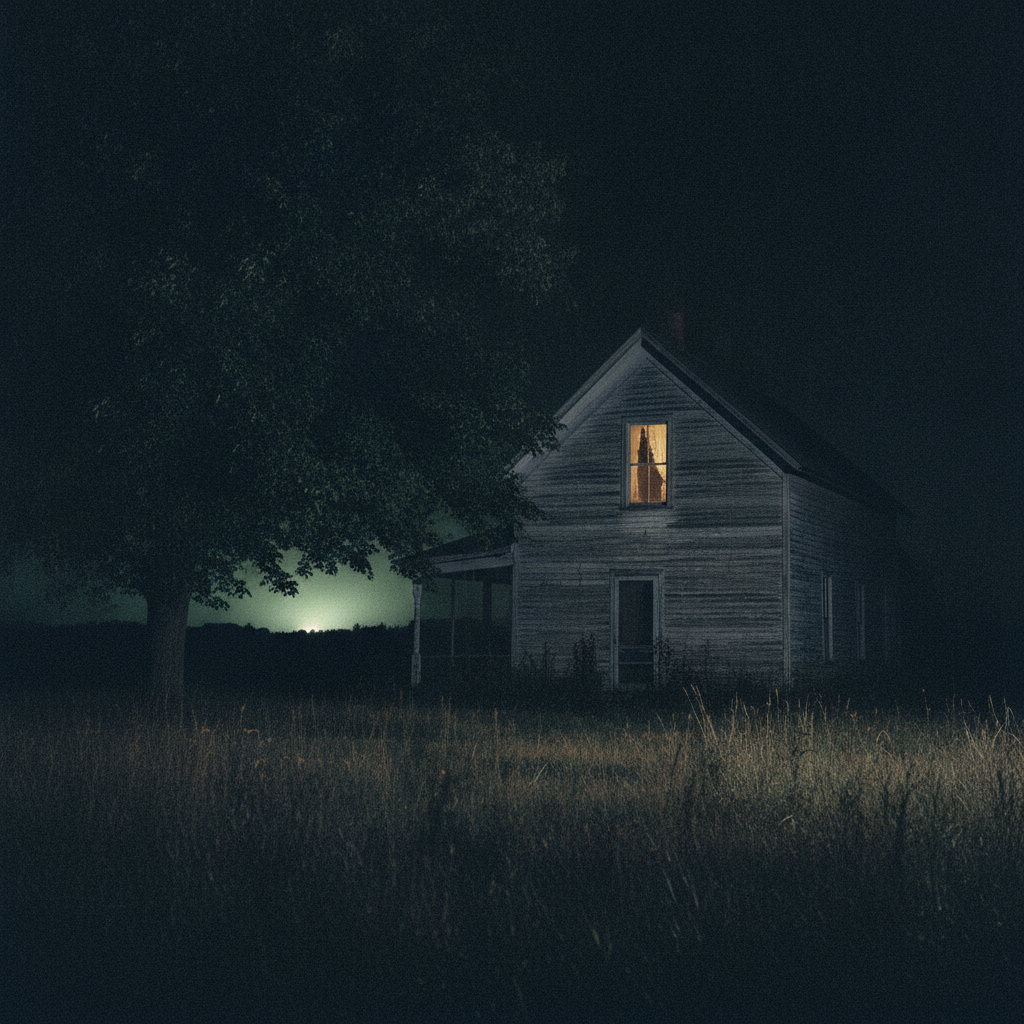
Twelve Witnesses and Four Hours of Gunfire: The Night at the Kelly Farmhouse
The farmhouse stood on a rise outside Kelly, a scattering of houses in Christian County, Kentucky, about twelve kilometres north of Hopkinsville. It belonged to Glennie Lankford, a widow who lived there with her three youngest children. On the evening of 21 August 1955 the house was full. Her grown sons Elmer, known to everyone as Lucky, and J.C. Sutton were there with their wives Vera and Alene. So was a family friend from Pennsylvania, Billy Ray Taylor, with his wife June. In all, eleven people were in the house that night, five adults and six children, with one more relative present at various points.
At around seven in the evening, Billy Ray Taylor went out to the well behind the house to draw water. He came back saying he had seen a bright object cross the sky, trailing colour, and settle into a gully beyond the treeline. Nobody in the house took him seriously. Lucky Sutton told him it was a shooting star. The subject was dropped.
About an hour later, the family dog began barking at something in the yard and then bolted under the house and stayed there.
Taylor and Lucky Sutton went to the back door and looked out. What they described seeing was a small figure coming across the open ground toward the house, perhaps ninety centimetres tall, with its arms raised above its head. In the darkness it appeared to give off a faint silvery glow.
The siege
The two men went back inside, took a .22 calibre rifle and a shotgun, and fired at it through the screen door.
By their account the figure did not fall. There was a sound, which several witnesses later compared to a bullet striking a metal bucket or a tin can, and the thing flipped over backwards, righted itself and scrambled away into the dark.
What followed lasted, by the family's estimate, close to four hours. Small figures appeared repeatedly at the windows. One was reported on the roof; Taylor stepped out under the overhang and said a clawed hand reached down and touched his hair, and that the others dragged him back inside. Another was reported in a maple tree in the yard. Every time one appeared the men fired at it, and every time it responded the same way: a metallic impact sound, a tumble, and a retreat that looked less like running than gliding.
The witnesses described the figures consistently, and their descriptions did not match anything they could name. Estimates of height ranged from about sixty centimetres to a little over a metre. The heads were large and round, the ears oversized and pointed. The arms were long, reaching nearly to the ground, and ended in hands with claws. The eyes were large and glowed yellow. Their bodies looked to the witnesses as though they were made of a dull metal. They did not appear to walk normally. Glennie Lankford, who saw one at a window, later gave a written statement in which she put its height at about a metre and described the enormous head and long arms.
One detail matters for what came later: nobody in the house described the figures as green. That colour was introduced by newspapers afterwards and has been attached to the case ever since.
The drive to Hopkinsville
At around eleven o'clock the families gave up. Eleven people packed into two cars and drove to the Hopkinsville police station, where they arrived in a state that the officers on duty found impossible to dismiss as a prank. The desk called Chief Russell Greenwell at home.
The response was substantial. Roughly twenty men went out to the Lankford farm that night: city police from Hopkinsville, Kentucky State Police troopers, Christian County deputies, and four military policemen from nearby Fort Campbell who had been in town and joined the convoy.
They searched the house, the outbuildings and the surrounding fields. They found the physical evidence the family had described creating: bullet holes in the walls, holes punched through the window screens, spent cartridges. They found no bodies, no blood, no tracks that anyone could identify, and nothing alive except the family's own animals.
There was one moment during the search that entered the record. A press photographer's flashbulb went off unexpectedly and the entire search party reacted, several of them reaching for weapons. A state trooper also reported seeing a patch of luminescence in the field, which was later suggested to have been foxfire, the pale glow of certain fungi on rotting wood.
The officers left around two in the morning. The families said the figures came back about ninety minutes after that, and this time they did not shoot. By the following day the household had packed up and left the farm.
What happened next
The story ran on the front page of the Kentucky New Era on 22 August 1955 and moved quickly onto the wires. Photographs were taken of Lucky Sutton and Billy Ray Taylor demonstrating where they had stood and which guns they had used. No photograph was ever taken of anything else.
Within days the witnesses were interviewed separately by Bud Ledwith, an engineer at the local radio station WHOP, who took down descriptions from each of them independently and produced sketches based on what they said. The independent accounts agreed closely with one another. Ledwith's notes and drawings became the primary documentary record of the case and were later used by the investigator Isabel Davis, whose detailed study of the incident was eventually published as a monograph by the Center for UFO Studies.
The United States Air Force, through Project Blue Book, listed the case as a hoax. The file records that conclusion without supporting analysis.
The family did not profit from the attention. Lucky Sutton was reported to have turned down offers to appear at fairs and shows, and members of the household said afterwards that the ridicule they received was worse than the night itself. None of them ever withdrew the account. Kelly now holds an annual festival named after the incident, which the descendants of the witnesses have described as an uncomfortable joke made out of a bad night.
Conclusions and Open Questions
The strongest natural explanation, argued in detail by the investigator Joe Nickell and independently by the French ufologist Renaud Leclet, is the great horned owl.
The fit is better than it first sounds. Great horned owls stand up to sixty centimetres tall, have prominent pointed ear tufts, and have large yellow eyes that reflect light back at a torch or a headlamp with a bright glow. They fly almost silently. They are fiercely territorial around a nest and will attack a person who comes too close, striking with talons at head height, which would account for Taylor's report of something touching his hair from above. In poor light, an owl with wings half spread and legs extended can present a strange upright silhouette. Birdshot at night, fired at a small moving target, frequently misses. And Kelly in August is exactly the kind of place where owls hunt.
The owl hypothesis has real weaknesses. It does not comfortably explain how a household including several adults, all of whom had grown up in rural Kentucky and would have known an owl on sight, failed to recognise one over four hours at close range. It does not explain the reported metallic sound of impacts, or the consistent description of arms reaching to the ground, or why the accounts collected separately by Ledwith agreed with one another on details that owls do not supply. It also does not explain the number: the witnesses described figures appearing at more than one point of the house at once.
The hoax verdict recorded by Project Blue Book is the second option, and it is the weakest documented one, because the Air Force never published any reasoning for it. Against a hoax stands the behaviour of the witnesses. They shot up their own house. They drove eleven people to a police station at night. They abandoned the property. They cooperated with a radio engineer who separated them and cross-checked their statements. They were reported to have refused money afterwards. People running a hoax rarely absorb that much cost for it.
A third line of explanation, offered by psychologists writing decades later, is that alcohol and then collective suggestion did the work: one person sees something, fear spreads through a crowded house, and every subsequent shadow becomes another creature. Contemporary reports state that the officers who dealt with the family that night found no evidence that anyone had been drinking, and Glennie Lankford was known locally as a religious woman who did not permit alcohol in the house. The suggestion element is harder to dismiss. Panic in a dark house full of frightened people is a documented multiplier.
What remains is a case with unusually good documentation of everything except the thing itself. There are police records, a large official response, independent same-week interviews, sketches, and eleven witnesses who never changed their story. There is no photograph, no physical trace, no injury and no body. The Kelly encounter is not a mystery about what was seen. It is a mystery about how so many people, questioned separately and immediately, produced the same description of something that nobody has ever been able to produce.