Four People in Two Barrels: The Forty Years It Took to Learn Their Names
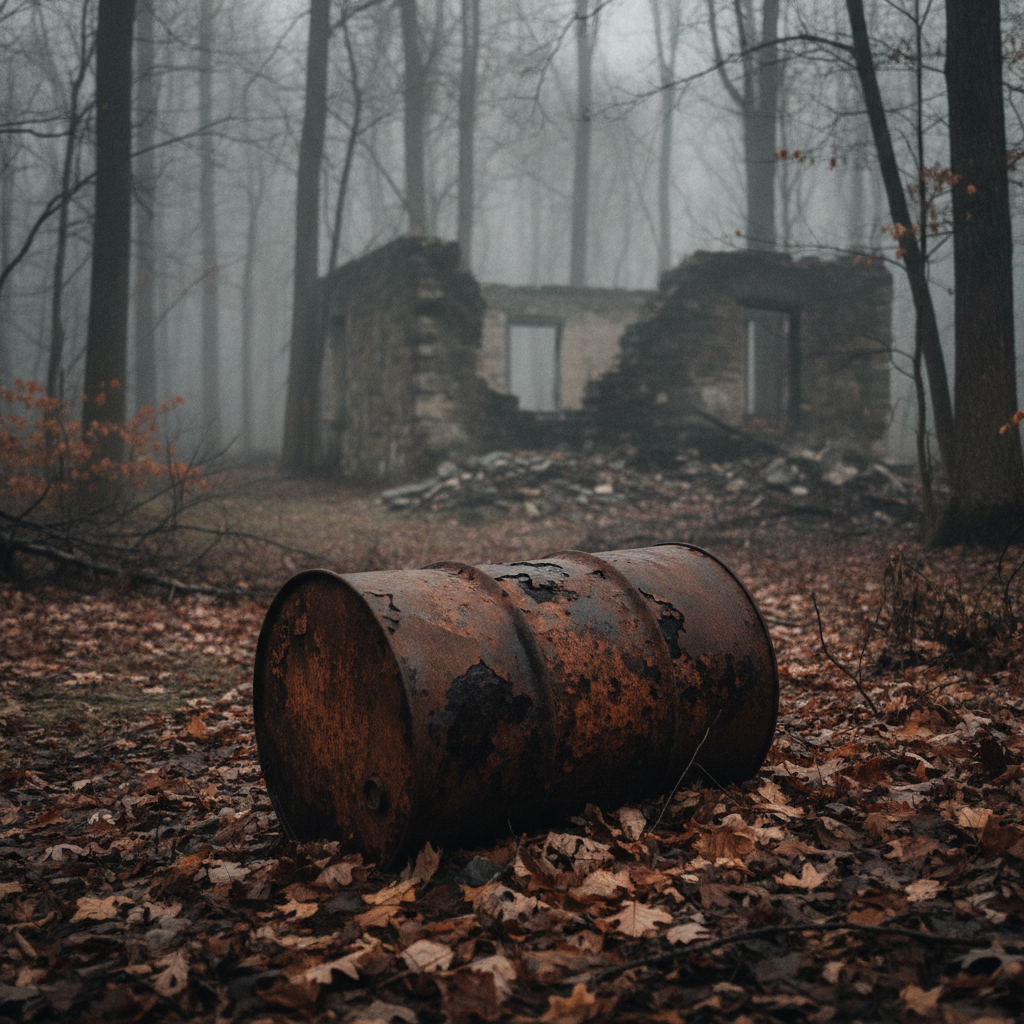
The drum was lying on its side in the brush, about thirty metres from the burned-out shell of a general store on Route 28, just outside the boundary of Bear Brook State Park in Allenstown, New Hampshire. It was a standard 55-gallon steel barrel, the kind that carries oil or industrial solvent, and it had been there long enough for leaves to bank against it. On 10 November 1985, a hunter walking the treeline noticed it and looked inside.
What he found were skeletal remains wrapped in plastic sheeting: an adult woman and a young girl. They had been put into the barrel together. The autopsies established that both had died of blunt force trauma. Beyond that, the state of New Hampshire could establish almost nothing at all.
There was no wallet, no identification, no clothing that could be traced, no dental records anywhere in the country that matched. The medical examiner estimated the woman was between twenty-three and thirty-three years old and the child between eight and ten. Investigators canvassed missing persons files in New Hampshire and then beyond it, and found nobody who fit. In the end the two of them were buried in a cemetery in Allenstown under a stone that carried no names, only a description: here lie the mortal remains known only to God of a woman aged 23 to 33 and a girl child aged 8 to 10.
That is where the case sat for fifteen years.
The second barrel
On 9 May 2000, investigators returned to the site to look again. It was routine work, the kind of periodic re-examination that cold case files sometimes get when a new detective inherits them. About ninety metres from where the first drum had been found, well outside the perimeter that had been searched in 1985, they found a second 55-gallon barrel. Inside it were the remains of two more girls.
One was estimated at one to three years old. The other was between two and four. Both had died the same way as the first two victims. Both had been in the ground, in that barrel, for as long as the others.
Four people. Two barrels. One patch of woods. And still not a single name.
For the investigators who inherited the file, the case acquired a label that was really just an address. It was the Allenstown case, or the Bear Brook murders, after the state park across the road. Neither name belonged to anyone inside the barrels. Facial reconstructions of all four were commissioned and circulated. Tips came in and went nowhere. Every few years a detective would pull the boxes, read them from the beginning, and put them back.
The 1985 investigation had been hobbled by a problem that is hard to explain to anyone who did not work a case in that era. There was no national DNA database for unidentified human remains. There was no national missing persons database that the public could search; NamUs, the system that finally provided one, did not go online until 2007. A body found in New Hampshire and a family filing a report in California existed in two separate universes, and nothing connected them except a telephone call that nobody thought to make. The Allenstown victims were, in the literal bureaucratic sense, invisible.
What the bones could say
By the 2010s the remains themselves had become the only available witness, and forensic science had improved enough to start taking a statement.
In 2014, mitochondrial DNA testing established that the adult woman, the oldest girl and the youngest girl were maternally related. In 2015, further analysis confirmed that the woman was the biological mother of two of the three children. The middle child, the girl aged two to four, was not related to any of them.
Isotope analysis of the bones and teeth added a geography. The chemical signature of the water a person drinks is laid down in their tissue, and it varies by region. The results indicated that this family group had been living in the northeastern United States for only weeks or months before they died. They had come from somewhere else. That single finding reframed the case: investigators had spent decades looking for a New England family that had gone missing, and the family had not been from New England at all.
Still, none of this produced a name. What produced names was a different case entirely, three thousand miles away.
The girl called Lisa
In 1986, a man calling himself Gordon Jenson left a small girl at a trailer park in Scotts Valley, California, and did not come back for her. She was around five. She could not tell anyone her surname. She entered the California child welfare system as Lisa, was eventually adopted, and grew up.
Years later, a man was arrested in California for abandoning a child and gave the name Curtis Mayo Kimball. Fingerprints later tied Kimball and Jenson to the same person. DNA testing in 2003 established that he was not Lisa's biological father, which meant that somewhere there was a woman who was her mother, and nobody knew who she was either.
Detective Peter Headley of the San Bernardino County Sheriff's Department kept working the question of who Lisa actually was. Around 2015 he brought in Barbara Rae-Venter, a retired patent attorney who had taken up genetic genealogy as a hobby and had become unusually good at it. The method she used was new: upload a DNA profile to a public consumer genealogy database, find the distant cousins who share segments of it, build their family trees backward until the trees intersect, and identify the person sitting at the intersection. It had been used to help adoptees find birth families. It had never been used to solve a criminal investigation.
It worked. Lisa was identified as Dawn Beaudin, born in New Hampshire. Her mother was Denise Beaudin of Manchester, New Hampshire, who had left the state around Thanksgiving 1981 with her infant daughter and a boyfriend she had introduced to her family as Robert Evans. Denise Beaudin had never been reported missing. Her relatives had assumed she had moved away and stopped calling. It was 2016 before anyone opened a missing persons file on her, thirty-five years after anyone had last seen her.
The Bear Brook victims had been found in Allenstown, a twenty-minute drive from Manchester. In January 2017, New Hampshire authorities announced publicly that they were connecting the two cases through the man who called himself Robert Evans.
The man with five names
In June 2017, investigators announced that they had established who he was. Y-chromosome DNA obtained from one of his biological children from a first marriage confirmed that Robert Evans, Gordon Jenson, Curtis Kimball and Larry Vanner were all the same man: Terry Peder Rasmussen, born in Denver, Colorado, in 1943.
Rasmussen had married in 1968, fathered four children between 1969 and 1972, and lived in Arizona and northern California. His wife left him in the mid-1970s. His family last saw him around Christmas 1974. After that he moved through the country under a rotating set of identities for more than a quarter of a century, working ordinary jobs, forming relationships with women who had children, and moving on.
The aliases were not sophisticated. He did not forge documents or build elaborate cover stories. He simply gave a different name, took work that did not check it, and relied on the fact that in the 1970s and 1980s nothing in the United States automatically compared one identity against another. Each time a relationship ended or a place became difficult, he became someone else, and the person he had been stopped existing in every record that mattered.
He was already in prison when investigators worked out who he was, and he was already dead. In 2002 the body of his wife, a California chemist named Eunsoon Jun, was found concealed in the home they shared in Richmond, California. He was arrested under the name Larry Vanner and convicted of her murder. He died in prison in December 2010, having never been asked a single question about four bodies in two barrels in New Hampshire, because nobody yet knew to ask him.
The librarian
Knowing the killer's name did not give the victims theirs. That came from Rebekah Heath, a librarian in Connecticut who had been following the case as a private research project.
Heath went hunting through old genealogy message boards, which are essentially digital bottles thrown into the sea by people looking for missing relatives. She found a post left on Ancestry.com in 1999 by a man searching for a half-sister named Sarah McWaters, who had disappeared as an infant along with her mother and older sister. Heath began tracing the mother, Marlyse Honeychurch, and found a reference connecting her to a man with the surname Rasmussen. She took it to investigators.
On 6 June 2019, the New Hampshire authorities held a press conference and, for the first time in thirty-four years, said three of the victims' names out loud. The woman was Marlyse Elizabeth Honeychurch, born in 1954. The oldest girl was her daughter Marie Elizabeth Vaughn, born in 1971. The youngest was her daughter Sarah Lynn McWaters, born in 1977. All three had last been seen around Thanksgiving 1978 in La Puente, California, after a family argument. Honeychurch had left with a man she had not known long. No one in the family had heard from her again, and no one had filed a report.
The middle child, the girl who belonged to none of them, still had no name. DNA had already shown that Rasmussen was her father.
The last name
In early 2024 the New Hampshire State Police Cold Case Unit brought the DNA Doe Project into the case to work on her specifically, using genetic genealogy techniques that had advanced considerably since 2017. On 5 September 2025, the identification was confirmed through DNA and documentary records, and New Hampshire Attorney General John Formella announced it publicly.
Her name was Rea Rasmussen. She was born in 1976 in Orange County, California. Her mother was a woman named Pepper Reed, born in 1952, who has not been seen since the late 1970s and whose disappearance was never reported either.
Forty years after the first barrel was opened, all four of the Allenstown victims have names. And the identification of the last one immediately produced a fifth missing person.
Conclusions and Open Questions
The Bear Brook case is now formally closed as to who committed the murders. Terry Rasmussen is the only suspect New Hampshire authorities have ever named, the DNA establishes his relationship to one victim, and his documented pattern of attaching himself to women with young children and then vanishing alone matches the shape of the crime. He cannot be tried, because he has been dead since 2010.
What is not closed is almost everything else.
The first open question is how many people he killed. Investigators have stated publicly that they believe Rasmussen was responsible for at least five homicides and probably more, across multiple states and multiple identities. The known count is Marlyse Honeychurch, her two daughters, his own daughter Rea, and Eunsoon Jun. Denise Beaudin has never been found. Pepper Reed has never been found. Neither disappearance was reported at the time, which is precisely why they went unexamined for decades, and which raises the uncomfortable possibility that the same is true of others. The counter-argument is that no physical evidence links him to any further victim, and that a man who used at least five names over twenty-five years is an easy figure onto which to project unsolved cases. Both positions are currently unfalsifiable.
The second question is the chronology of the barrels. If Honeychurch and her daughters disappeared in California in late 1978, and Rea Rasmussen was born in California in 1976, and the isotope evidence says the group was living in the northeast only weeks or months before death, then the murders happened within a fairly narrow window after their arrival in New Hampshire. But the second barrel was found fifteen years after the first, less than a hundred metres away, and no one has publicly explained why the bodies were separated into two containers or whether they were placed there at the same time. The remains gave no answer to that, and the only person who knew is dead.
The third question is one the case forced on the entire justice system rather than on New Hampshire alone. Bear Brook was where investigative genetic genealogy was first used to attack a criminal case, in the work Barbara Rae-Venter did to identify Dawn Beaudin. Two years later the same technique was applied to the Golden State Killer and became national news. Supporters point out that it has now identified dozens of victims and offenders in cases that were otherwise permanently dead. Critics point out that it works by searching the DNA of people who never consented to be searched, most of whom uploaded their profiles to find a grandparent. The technique's founding case is also the strongest argument on both sides: without it, four people in the New Hampshire woods would still be numbers.
The last question is the simplest and the hardest. For nearly forty years, four human beings lay in a state park with no names, and during all those years, not one missing persons report existed that would have matched them. Marlyse Honeychurch's family believed she had cut them off after an argument. Denise Beaudin's family believed she had moved. Pepper Reed's disappearance went unremarked entirely. The case was not unsolvable because the evidence was poor. It was unsolvable because nobody had reported that anyone was gone.