Nineteen Minutes on a Frozen Road: The Vanishing of Maura Murray
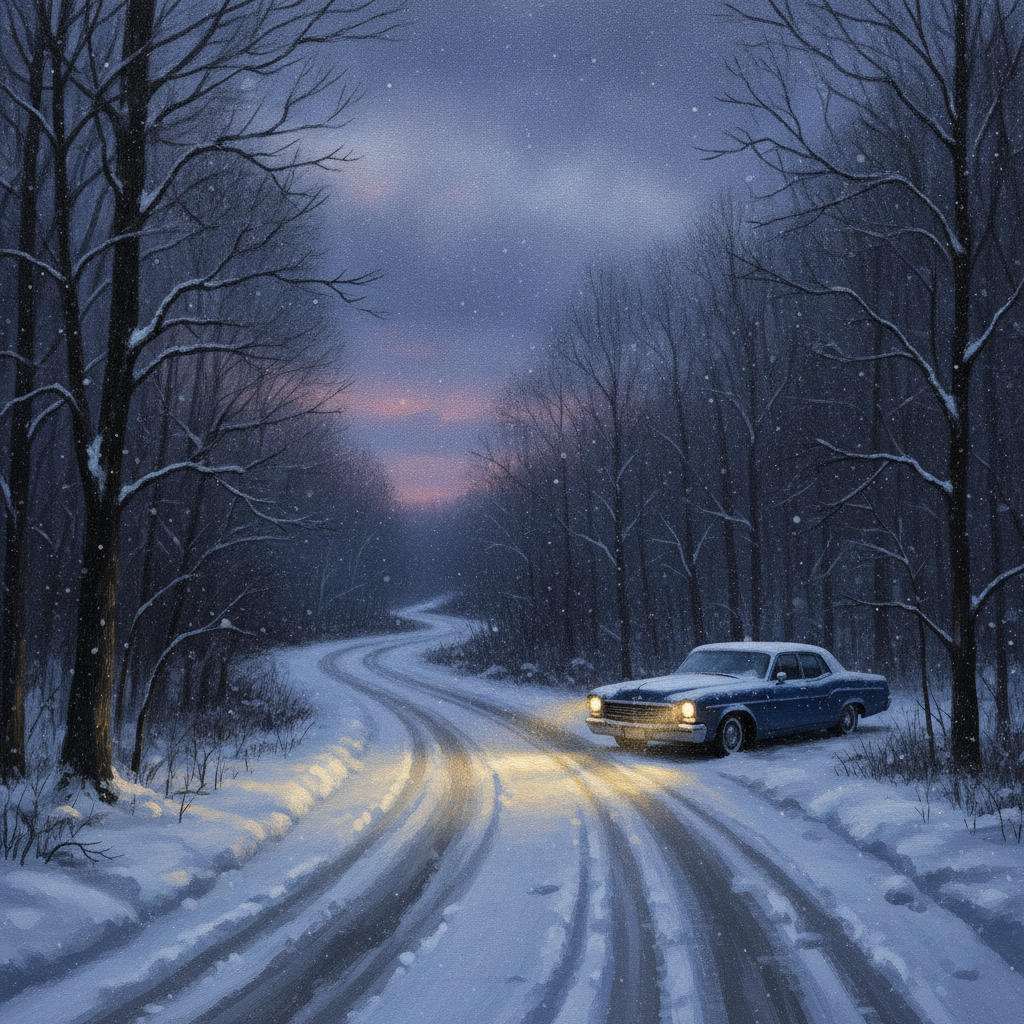
At 7:27 on the evening of February 9, 2004, a woman living along a dark stretch of New Hampshire Route 112 heard a thump outside her house. She looked out and saw a car resting against the snowbank on the wrong side of the road, pointing west in the eastbound lane, and telephoned the Grafton County Sheriff's Department. Nineteen minutes later a Haverhill police officer walked up to that car and found it locked and empty. The driver, a 21-year-old nursing student named Maura Murray, has never been seen again.
That section of Route 112, the Wild Ammonoosuc Road, runs west out of the White Mountains toward the village of Woodsville, past scattered houses and long walls of trees. The temperature was below freezing. Murray was more than three hours from her dormitory at the University of Massachusetts Amherst, in a place she had never told anyone she was going.
She was born in Brockton, Massachusetts, in 1982, the fourth of Fred and Laurie Murray's children. A distance runner in high school, she was accepted by the United States Military Academy at West Point and studied chemical engineering there for three semesters. Her sister Julie later explained that Maura had been referred to an honor board over an allegation of theft at a post exchange and chose to withdraw rather than appear before it. She transferred to UMass Amherst, switched to nursing, and by early 2004 was working night shifts as a campus security guard.
The week before she vanished was a difficult one. On the night of February 5 her supervisor found her sobbing at her post after a phone call with her older sister Kathleen. A colleague described her as completely zoned out and unresponsive, and she was walked back to her dormitory. Asked what was wrong, she said only, "My sister." Kathleen, the family later disclosed, had relapsed into alcoholism after leaving rehabilitation.
On February 7 her father Fred drove up to visit. They looked at cars, had dinner, and Maura borrowed his rented Toyota to go to a dormitory party. She left at about 2:30 in the morning, and an hour later, driving toward her father's motel on Route 9 in Hadley, she struck a guardrail hard enough to cause roughly ten thousand dollars in damage. There is no record that any sobriety test was administered. Fred arranged a replacement car and reminded her that Sunday night to pick up the state accident report forms. They agreed to talk through the paperwork on Monday.
That conversation never happened. Shortly after midnight on February 9, Murray used MapQuest to look up directions to the Berkshires and to Burlington, Vermont. At one in the afternoon she emailed her boyfriend, an Army officer stationed in Oklahoma: "I got your messages, but honestly, I didn't feel like talking too much of anyone, I promise to call today though." She made a three-minute call about renting a condominium in Bartlett, New Hampshire; the owner did not remember the call and rented her nothing. At 1:24 p.m. she emailed her work supervisor to say she would be away for a week because of a death in the family. No one in her family had died. At 2:05 p.m. she called a recorded hotel line for Stowe, Vermont.
Classes were cancelled that day for a snowstorm. At about 3:30 she drove off campus in her black 1996 Saturn, having packed clothing, toiletries, textbooks and her birth control pills. Ten minutes later a bank camera recorded her withdrawing 280 dollars, alone. At a nearby liquor store she bought roughly 40 dollars of alcohol, including Baileys, Kahlua, vodka and a box of Franzia wine, again alone on camera. She collected the accident report forms from the Registry of Motor Vehicles. Her last recorded use of her cell phone was at 4:37 p.m., when she checked her voicemail. When campus police later opened her room, most of her belongings were boxed and the art had been taken down from the walls.
The next confirmed trace of her is that thump on Route 112. Around 7:30 a passing motorist who lived nearby and drove a school bus stopped at the wreck. He saw a young woman walking around the car, shivering, not visibly injured. He offered to call for help, and she asked him not to call the police, saying she had already contacted roadside assistance. AAA had no record of any such call. He drove home and telephoned the police himself at 7:43 p.m. Several cars passed in the minutes that followed.
At 7:46 p.m. the officer arrived. The Saturn had struck a tree on the driver's side hard enough to push the radiator into the fan and crack the windshield, and both airbags had fired. It was locked, with no one in it or near it. Inside were red stains that appeared to be wine, an empty beer bottle, a damaged box of Franzia, Murray's AAA card, the blank accident report forms, compact discs, makeup, jewelry, printed directions toward Burlington, her favorite stuffed animal, and a book about the dangers of climbing in the White Mountains. A rag believed to have come from her roadside kit had been pushed into the exhaust pipe.
What was not there mattered more. Her debit card, her credit cards and her cell phone were gone, and none of them has ever been used or found. So was the black backpack she carried. The car was towed at 8:49 p.m. Murray was not formally listed as missing until 5:17 the following afternoon, roughly twenty-two hours after she was last seen alive.
Searches began on February 11. A tracking dog worked a scent from her glove about a hundred yards east of the crash and then lost it, which investigators took as a sign that she had left in another vehicle. Three months later a contractor came forward to say that between eight and half past that evening he had seen someone in jeans, a dark coat and a light hood moving quickly eastward along Route 112, four or five miles from the wreck. The FBI joined ten days in. Thermal imaging helicopters, cadaver dogs and, in July 2004, nearly a hundred searchers found nothing conclusive.
In 2009 the file moved into New Hampshire's new Cold Case Unit and was reclassified as a suspicious disappearance the state was treating as a potential homicide. An excavation in 2019 beneath a house near the crash site, where cadaver dogs had reacted years earlier, turned up only old piping. Bone fragments found on Loon Mountain in 2021 were not hers. The FBI issued a national alert in 2022. In February 2026, twenty-two years on, the Cold Case Unit said it was applying facial recognition and LiDAR ground scanning to the case and that its determination had not diminished.
Conclusions and Open Questions
The New Hampshire attorney general's office has never publicly named a suspect, and the competing explanations remain almost exactly as they were in the first month.
The earliest official position, stated by Haverhill police within days, was that Murray had either run away or come north intending to harm herself. She was listed as endangered and possibly suicidal, and a police report called her intoxicated at the scene, though the bus driver said she did not appear impaired. The weakness in that reading is what she took with her: textbooks, birth control pills and a stuffed animal, while jewelry and cash stayed in the car. She had also withdrawn money and bought alcohol without any attempt to conceal her movements. Her family rejected the suicide theory immediately and no note was ever found.
A related theory, set out in a 2004 press release, holds that she was travelling to an unknown destination and simply accepted a ride to continue there. That fits the tracking dog losing the scent a hundred yards from the car. Its weakness is that in twenty-two years no driver has come forward, no confirmed sighting has been recorded anywhere, and not one of her bank cards has been used.
Fred Murray argued for years that his daughter was abducted and killed near the crash site, and pressed both the FBI and the state to treat the case as a homicide. He drew on a story from late 2004, when a local man handed him a stained knife and said his own brother had claimed it was used to kill her; the brother's family called the account an invention aimed at the reward money. Cadaver dogs reacted in 2006 inside a house about a mile from the crash, but the 2019 excavation of that basement found nothing.
The author James Renner has argued at different times for a tandem driver, for a voluntary disappearance and for a killing by someone Murray knew. In 2025 he reported that an unidentified fingerprint taken from a CD or CD case in her car had been matched to a former West Point classmate. That man has denied any involvement in her disappearance. He has not been charged with anything connected to the case and is entitled to the presumption of innocence; the attorney general's office has not confirmed the fingerprint report, and a print on a disc proves only contact with the disc.
Some argue that the disappearance of Brianna Maitland in Vermont five weeks later, 66 miles away and in similar circumstances, points to one offender in the region. Police in both states dismissed the link in 2004.
What remains unexplained is narrower and stranger than any of the theories. Why did Murray email her supervisor about a death that had not occurred? Where was she going, when her searches covered the Berkshires, Burlington and Stowe? Why did she ask a stranger not to call the police, and does the unresolved crash of the night before explain it? Who put the rag in the exhaust pipe? What became of a phone and two bank cards that have never once registered anywhere since? And how did a young woman in freezing weather, on a road with houses on it, cross the minutes between the bus driver leaving and the officer arriving without being seen by any of the cars that passed?