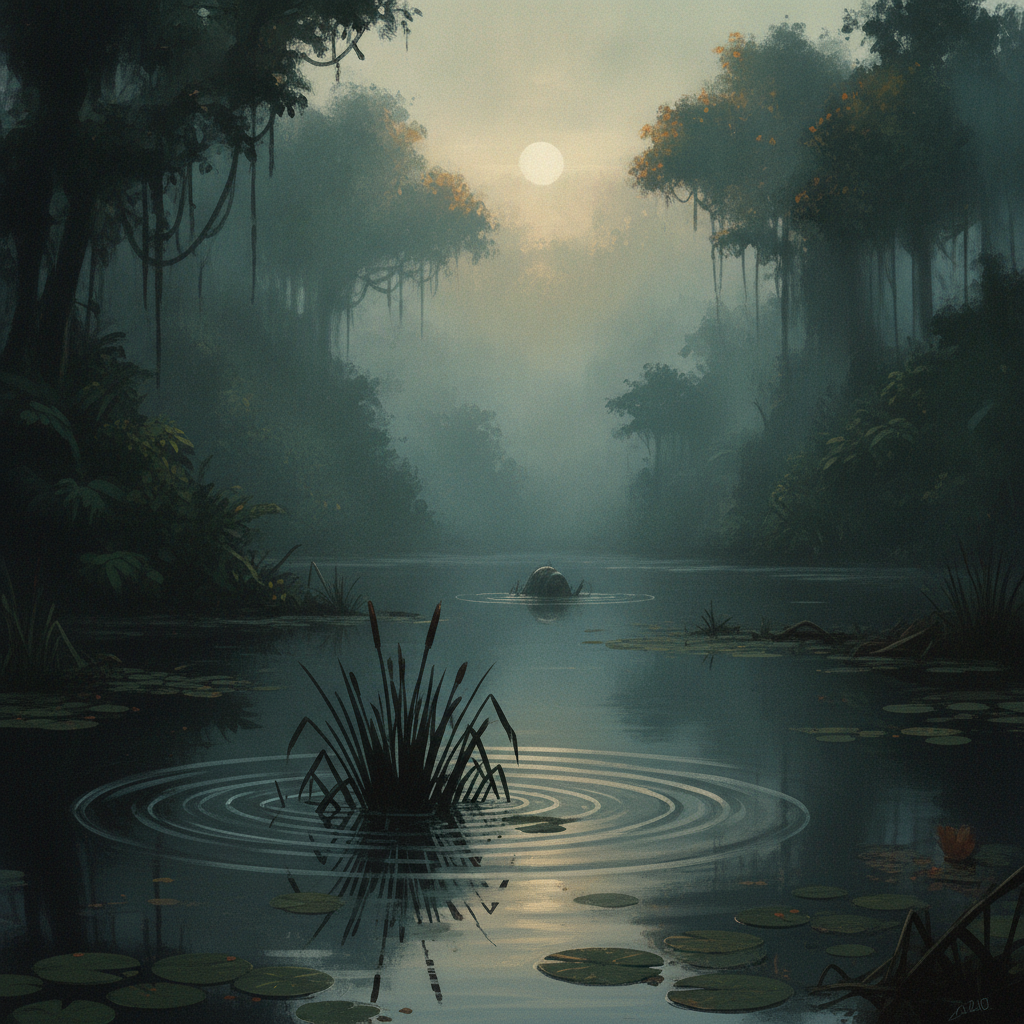
Mokele-mbembe: A Century of Searching the Congo Swamps for an Animal Nobody Can Produce
The Likouala region in the north of the Republic of the Congo is one of the least travelled places on the planet. It is a low basin of flooded forest and black-water swamp roughly the size of a small country, drained by slow rivers and cut by almost no roads. Somewhere near its centre lies Lake Tele, a shallow body of water about five kilometres across, ringed by forest that stands in water for much of the year. Getting there means a river journey followed by days of walking through swamp. The village of Boha, whose people are regarded as the custodians of the lake, controls the approach to it.
For well over a century, people living across this basin have described a large animal in the deep pools and channels. In Lingala the name usually given to it is mokele-mbembe, generally translated as one who stops the flow of rivers. The accounts are not uniform, but several elements recur: an animal much larger than a hippopotamus, living in water, dangerous to canoes, said by many to feed on plants rather than fish or meat. In parts of the region it is spoken of with the caution reserved for things that are genuinely hazardous, and in others it carries prohibitions and meanings that have nothing to do with zoology.
The first written traces in Western sources are indirect. In 1909 the German animal dealer Carl Hagenbeck published Beasts and Men, in which he relayed second-hand reports of a creature described to him as half elephant, half dragon living in central African swamps, and speculated openly that some kind of dinosaur might have survived there. In 1911 Lieutenant Paul Gratz recorded accounts of an animal called the nsanga. Then, in 1913, a German colonial officer, Ludwig Freiherr von Stein zu Lausnitz, was sent to survey Cameroon and wrote down what people told him about an animal of brownish-grey colour and smooth skin, roughly the size of an elephant, with a long and very flexible neck, a long muscular tail, and a habit of sheltering in caves washed out of riverbanks. His report was not widely known until the writer Willy Ley quoted it in The Lungfish and the Unicorn in 1941, and it has been the anchor text of every search since.
The modern search began in the 1970s. James Powell, an American herpetologist working on crocodiles in Gabon, started collecting local accounts and took them to Roy Mackal, a biochemist at the University of Chicago. Mackal and Powell mounted two expeditions into the Likouala, in 1980 and again in 1981. They travelled the rivers, interviewed villagers at length, and reported that a number of people, shown cards depicting various animals, selected an illustration of a sauropod dinosaur. They came back with testimony and with no photographs, no tracks that could be independently checked, and no specimen. Mackal set out the case in his 1987 book A Living Dinosaur? In Search of Mokele-Mbembe.
The same year as Mackal's second trip, a rival expedition went in. Herman Regusters, an American engineer who had fallen out with Mackal, led his own team of about thirty people, most of them men from Boha, and reached Lake Tele. Regusters and his wife Kia reported watching a long-necked animal move across the open water. They returned with audio recordings and photographs. The recordings were submitted for technical analysis, which concluded that the sounds could not be matched to any known animal of the region but could not identify them either. The photographs were too indistinct to show anything decisive. None of the other members of the expedition reported having seen what the Regusters described.
In the spring of 1983 the Congolese biologist Marcellin Agnagna, working for the Ministry of Water and Forests, spent two months at Lake Tele with a Congolese team. He reported that on one occasion an animal was visible for roughly twenty minutes, mostly submerged, with only head and neck above the surface. He described a narrow reddish head with oval eyes and stated that the animal was a reptile but not a crocodile, a python or a freshwater turtle. He had a camera. The film produced nothing usable, and over the years he gave more than one explanation for why, at one point the lens cap and at another the camera setting. Critics have pressed him on the inconsistency ever since.
In 1992 a Japanese television crew flying over the region filmed a shape moving through the surface of a lake, leaving a wake. The sequence lasts seconds. It is still routinely described as the best footage ever obtained of mokele-mbembe, which is a measure less of its quality than of everything else. It is too brief and too coarse to establish the size, shape or nature of what it shows, and nothing recorded in the thirty years since has improved on it.
Expeditions continued. William Gibbons ran trips in 1985 and 1992 and returned repeatedly in the following decades. From the 2000s the French explorer Michel Ballot made a long series of journeys into southern Cameroon and the Congo border region, work that became the subject of the 2011 documentary L'hypothese du Mokele-Mbembe. Ballot has been notably unwilling to commit to the dinosaur reading and has floated other possibilities, including a very large aquatic animal related to the pangolins. Other teams, American and European, have gone in through the 2010s.
The balance sheet after all of this is easy to state. What the expeditions have produced is plaster casts of disputed footprints, sound recordings that analysts could neither match nor name, a handful of photographs and one short film sequence that no specialist regards as identifiable, and several hundred interviews. What they have never produced is a bone, a tooth, a scale, a piece of skin, a dropping, or an animal. There is no mokele-mbembe specimen in any museum or university collection anywhere in the world.
The testimony itself is also less uniform than the popular version suggests. Many accounts from the basin describe something closer to a rhinoceros or an elephant than to anything reptilian. When a documentary team working in the region in 2001 showed photographs of various animals to local people, some identified a picture of a rhinoceros as mokele-mbembe. The name travels across a wide area and several languages, and it does not always attach to the same animal, or to an animal at all.
Conclusions and Open Questions
The best known theory is the one that made mokele-mbembe famous: that a small population of sauropod dinosaurs survived in the Congo basin. Mackal argued for it, Powell collected the interviews that supported it, and Gibbons has defended it for decades. Its weaknesses are severe. No sauropod appears in the fossil record for the past sixty-six million years. The Likouala is remote but it is not sealed, and a breeding population of animals the size of elephants would leave carcasses, bones and consistent close-range sightings from the many people who live and fish there. The physiology is also a problem: an animal of that mass would need an enormous and continuous food supply in a swamp forest that does not obviously provide it.
The mainstream zoological answer is misidentification. Donald Prothero and others have pointed to the black rhinoceros, which was formerly present across much of central Africa and which fits a striking number of the descriptions, and to swimming elephants, whose raised trunks can read as a long neck at a distance, as well as to large pythons and to floating vegetation. The weakness here is that no single candidate covers every account, and rhinoceros are not documented in the Likouala swamps in recent times.
The most consequential modern critique concerns the framing itself. Daniel Loxton and Donald Prothero, in Abominable Science! (2013), argue that the sauropod identification was carried into the Congo by outsiders rather than drawn out of it. Hagenbeck was speculating about surviving dinosaurs in 1909, decades before any expedition, and the picture-card method used to gather identifications is exactly the kind of procedure that can lead a witness. It also has to be said plainly that for several decades most of the sustained searching has been organised and funded by creationist ministries and organisations, some of them stating openly that a living dinosaur would overturn the accepted timeline of life on earth. Prothero has noted that the people going after mokele-mbembe in recent years have been ministers rather than field biologists. That is not proof that the accounts are worthless, but it does explain which claims were amplified, which were quietly dropped, and why the search has stayed outside normal zoology. The weakness of this critique is that it addresses what Westerners did with the reports rather than what people in the Likouala actually see.
That distinction matters. Communities along these rivers are describing dangerous water they know far better than any visitor, and their accounts have been repeatedly reshaped to fit arguments being conducted thousands of kilometres away. Recording what is actually said, in the language it is said in, is a different project from bringing a dinosaur to the swamp and asking people to confirm it.
The open questions are narrower than the legend but they are still open. What did the Regusters recordings capture, and could the original tapes be re-analysed with modern tools? Is there an unrecognised large animal in these waters, not a dinosaur but something genuinely unlisted, and would anyone notice if there were? Why do reports cluster at particular pools and channels rather than spreading evenly? And most practically: environmental DNA sampling, the technique used at Loch Ness in 2018, could now survey Lake Tele for the genetic traces of every vertebrate in it for a fraction of the cost of a single 1980s expedition. No one has done it. Whether it happens, and whether it happens with the agreement of the people of Boha, may be the only part of this story that is still in anyone's hands.