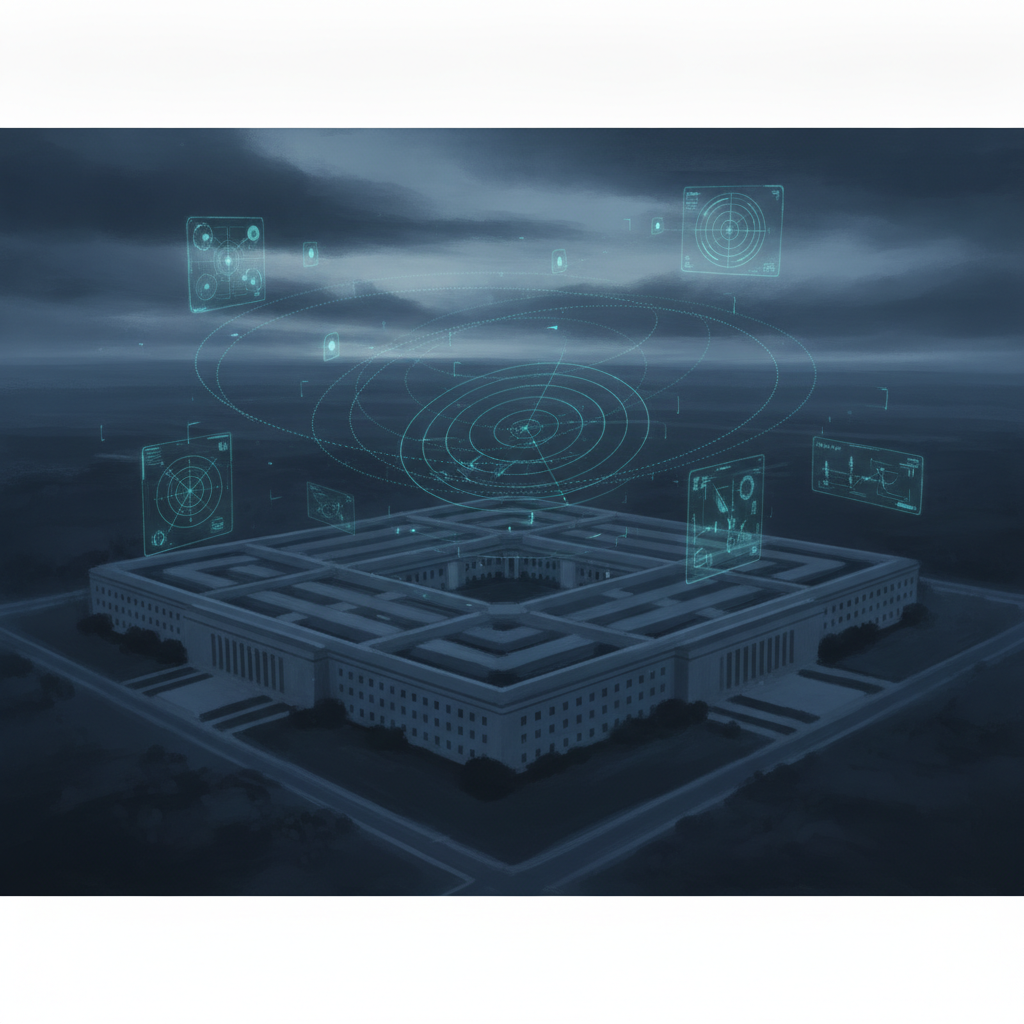
When the Pentagon Admitted It Doesn't Know
On a clear afternoon in November 2004, roughly a hundred miles southwest of San Diego, a U.S. Navy Super Hornet dropped out of a routine training flight toward something the radar crews aboard the cruiser USS Princeton could not name. For about two weeks the Princeton's advanced radar had been registering objects that appeared at around eighty thousand feet, descended toward the ocean within seconds, and then held position. Commander David Fravor, a senior pilot with the Nimitz carrier strike group, was directed to the coordinates. What he reported finding was a white, wingless oval roughly the size of his fighter, hovering above a churning patch of sea. It had no exhaust plume, no rotor and no visible control surfaces. When he spiraled down toward it, the object appeared to mirror his turn, then accelerated away and was gone. Minutes later the Princeton reacquired a contact about sixty miles off, near the point where the flight had been scheduled to rendezvous.
Because of its smooth white lozenge shape, the object acquired a nickname among aircrews: the Tic Tac. Infrared footage from a second aircraft that launched later the same day recorded a similar object. For more than a decade the encounter circulated mainly inside naval aviation, where pilots had learned that describing such sightings publicly was a reliable way to damage a career.
That changed in December 2017. The New York Times reported the existence of a little-known Pentagon effort called the Advanced Aerospace Threat Identification Program, funded quietly from 2007 onward, and published cockpit videos later known as FLIR1, GIMBAL and GOFAST. In them, Navy sensors track objects that rotate, accelerate or skim above the ocean while the aircrews recording them can be heard trying, and failing, to identify what they are seeing. The Pentagon subsequently confirmed that the footage was genuine Navy material and that it had never been formally cleared for public release. Within weeks the subject moved from the margins of the press to the front page, and members of Congress began asking for an official accounting.
That accounting arrived on 25 June 2021, when the Office of the Director of National Intelligence released a nine-page preliminary assessment of what it called Unidentified Aerial Phenomena. The document reviewed 144 reports filed by U.S. government personnel, the overwhelming majority of them Navy aviators, between 2004 and 2021. Its central finding was blunt. Of those 144 cases, investigators could confidently explain exactly one: a large, deflating balloon. The remaining 143 were left unresolved. Rather than offer a single answer, the assessment set out categories into which the reports might eventually fall: airborne clutter such as birds, balloons and plastic bags; natural atmospheric phenomena; classified U.S. government or industry development programs; systems fielded by a foreign adversary such as Russia or China; and a residual catch-all bin for anything left over. It stated that it had found no evidence of extraterrestrial origin, and equally no evidence of a foreign breakthrough. It also flagged 18 incidents in which objects appeared to remain stationary against strong winds aloft, to maneuver abruptly, or to move at speed with no discernible means of propulsion. Its stated reason for reaching no verdict was the quality of the underlying data: sparse, inconsistent, and frequently gathered by instruments designed to track aircraft rather than to characterize unknown objects.
Instead of closing the file, the government expanded it. In July 2022 the Pentagon established the All-domain Anomaly Resolution Office, known as AARO, and gave it responsibility for collecting and analyzing reports across the military and intelligence community. The vocabulary shifted with it. The word aerial was replaced by anomalous, formally extending the office's remit to objects reported in space and underwater as well as in the air. Congress also created legal protections for personnel who came forward with reports, removing part of the professional risk that had kept the subject quiet for decades.
NASA took a separate route. It convened an independent study team of sixteen scientists, engineers and data specialists, chaired by the astrophysicist David Spergel, and published their findings in September 2023. The report deliberately avoided speculation about origins and concentrated on the state of the evidence: blurred imagery, missing metadata, uncalibrated sensors, no rigorous chain of custody, and observations captured by equipment built for entirely different tasks. Its recommendation was that the field could only move from anecdote to science through systematic, purpose-built observation and better reporting pipelines, including civilian aviation. Administrator Bill Nelson summarized the outcome carefully: the team had found no evidence that the phenomena were extraterrestrial in origin, and it could not say what they were.
The following month brought the most public confrontation yet. At a congressional subcommittee hearing on 26 July 2023, Fravor recounted the 2004 encounter under oath. Former Navy pilot Ryan Graves testified that aircrews training off the Atlantic coast had encountered unidentified objects so regularly between 2014 and 2015 that reporting them became routine. The third witness drew the headlines. David Grusch, a former Air Force intelligence officer who had worked on UAP matters for two Pentagon bodies, told lawmakers that in the course of his official duties he had been informed of a multi-decade program to recover and reverse-engineer craft of non-human origin, and that the government held what he described as non-human biologics recovered from them. He said his conclusions rested on interviews with roughly 40 witnesses conducted over four years. He also stated plainly that he had not personally seen any craft or bodies, and he repeatedly declined to give specifics in open session, saying he could only elaborate in a secure setting. His allegations remain unverified.
In March 2024 AARO published the first volume of a historical review covering U.S. government involvement with the subject from 1945 to the present. Its conclusions were categorical. Investigators reported finding no empirical evidence that any UAP represented extraterrestrial technology, no concealed reverse-engineering program hidden from Congress, and no verified off-world material. A metal sample long rumored to be of alien manufacture was tested and found to be terrestrial and unremarkable. The report further argued that the recovery legend had been sustained in large part by circular reporting, a closed loop in which the same claims were repeated back and forth between a small number of people, and that executives and chief technology officers at the companies named by witnesses denied on the record ever having handled such material. Many sincere witnesses, AARO suggested, had encountered real but classified American programs and drawn the wrong conclusion about them.
AARO has continued to publish periodic reports since. Most new cases are resolved as balloons, drones, birds, aircraft, satellite constellations or sensor artifacts. A smaller number are closed without explanation, usually because there is too little data to work with. The three Navy videos released in 2017 have never been officially explained.
Conclusions and Open Questions
Several explanations compete for the residue, and each has a documented advocate and a specific weakness.
The most widely held position, argued by NASA's independent study team and by most working scientists, is that these events are ordinary objects and instrument effects misread under difficult conditions. Its strength is its record: case after celebrated case has fallen to it. Its weakness is that it performs worst precisely where the evidence is best, in the handful of incidents involving multiple independent sensors and experienced observers.
A more specific version of that argument comes from analysts such as Mick West, who has attributed the apparent rotation in the GIMBAL video to the movement of the camera's own gimbal mechanism, and the GOFAST object's apparent speed to parallax, calculating that it was moving relatively slowly. The strength here is that the analyses are reproducible from the released footage. The weakness is that footage alone cannot address the radar tracks and eyewitness accounts that accompanied some encounters.
The foreign adversary hypothesis was raised in the 2021 assessment itself and repeated by several members of Congress. Its strength is that it requires no unfamiliar physics. Its weakness is that no rival state has revealed such a capability in twenty years, and it is unclear why any would test it repeatedly over American carrier groups.
The classified program hypothesis is central to AARO's own findings: that American personnel have been misidentifying American hardware. Its strength is documentary, resting on archives and named interviews. Its weakness is that it does not easily account for the reported flight characteristics in the 18 flagged cases.
Finally, some argue, most prominently David Grusch, that a recovery and reverse-engineering program exists and has been concealed from Congress. One theory holds that the official denials are themselves part of that concealment. The strength of this reading is that it would explain the persistence of the claims among people with security clearances. Its decisive weakness is evidentiary: it rests on second-hand testimony that no outside party has been able to check, and the named companies have denied it on the record.
What remains unexplained is narrower than the headlines suggest, but it is real. Of 144 reviewed cases, 143 were left open. Eighteen of them involved reported movement that investigators could not match to any known aircraft. No public account has reconciled the sworn testimony of decorated aviators with archival investigations that found nothing.
The open questions follow from that gap. Why has a government with the most capable sensor network in existence not simply tasked it to collect deliberate, calibrated data on the problem? How should sworn eyewitness testimony from trained observers be weighed against documentary research that contradicts it? Does the classification of relevant material reflect genuine national security concerns, or does it also protect institutions from embarrassment? And if the answer turns out to be a mixture, mostly mundane with a stubborn anomalous remainder, will the tools ever exist to tell the two apart? The most defensible position is still the least satisfying one, and it is now the official one: nobody yet knows what they were.