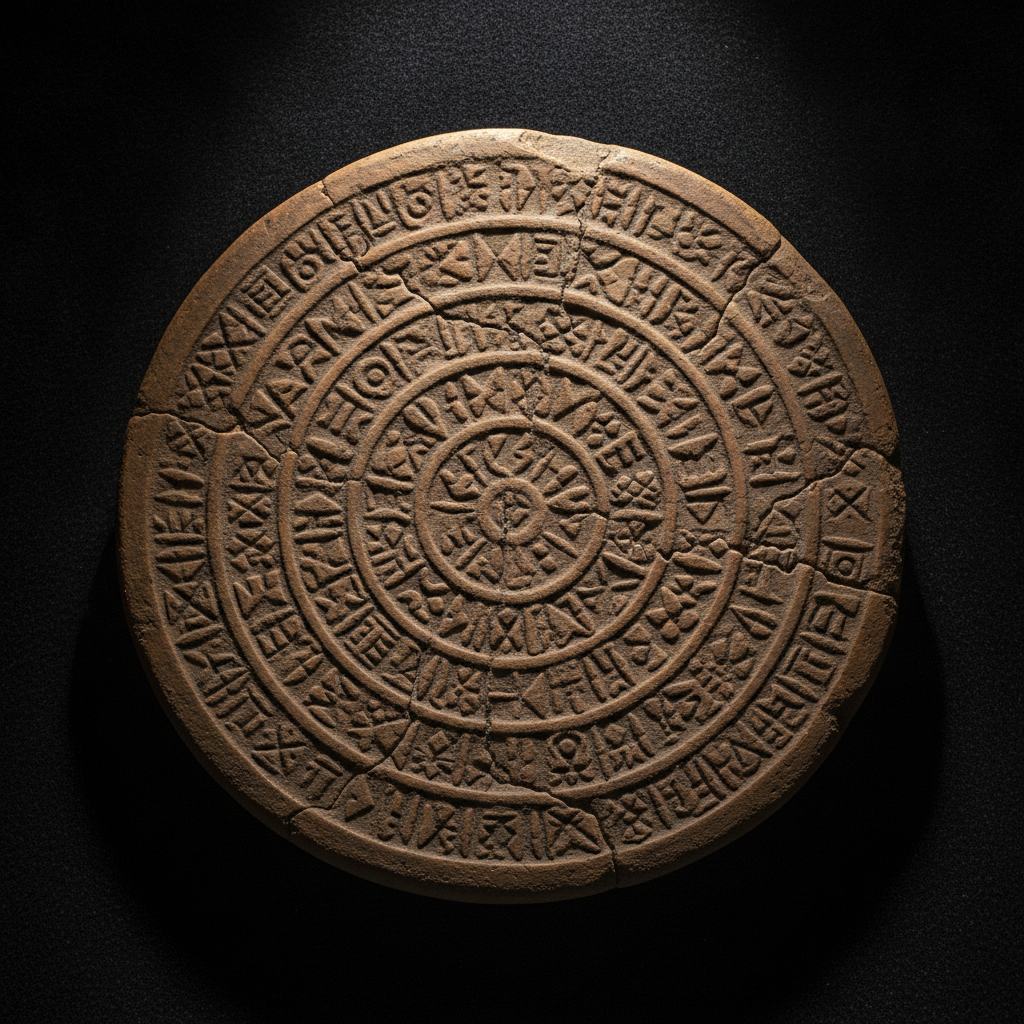
The Phaistos Disc: A Message Printed 3,000 Years Too Soon
On 3 July 1908, in the ruins of a Bronze Age palace on the southern coast of Crete, a young Italian archaeologist named Luigi Pernier reached into a small mud-brick chamber and lifted out an object that has never been explained. It was a disc of fired clay, roughly the size of a saucer, and it had lain in that basement storeroom of the palace of Phaistos, alongside a tablet inscribed in the Minoan script known as Linear A, for something like three and a half thousand years. Both faces were crowded with tiny pictures: a plumed head, a walking man, a fish, a branch, a shield, arranged in a spiral that wound inward toward the centre. Pernier had never seen anything like it, and neither, it turned out, had anyone else. More than a century later the Phaistos Disc remains one of the most famous unsolved puzzles in archaeology.
The disc measures about sixteen centimetres across and carries, between its two faces, 241 impressions drawn from a set of just 45 distinct signs. The detail that lifts it out of the ordinary is the way those impressions were made. The signs were not scratched or drawn by hand. Each was pressed into the wet clay with a small carved stamp, one punch per sign, before the disc was baked hard. Whoever made it was not writing in the usual sense but printing, composing a text from a reusable set of type.
You have used your free reads for this month.
Unlock all 208 documented mysteries - in 8 languages, ad-free.
Get full access