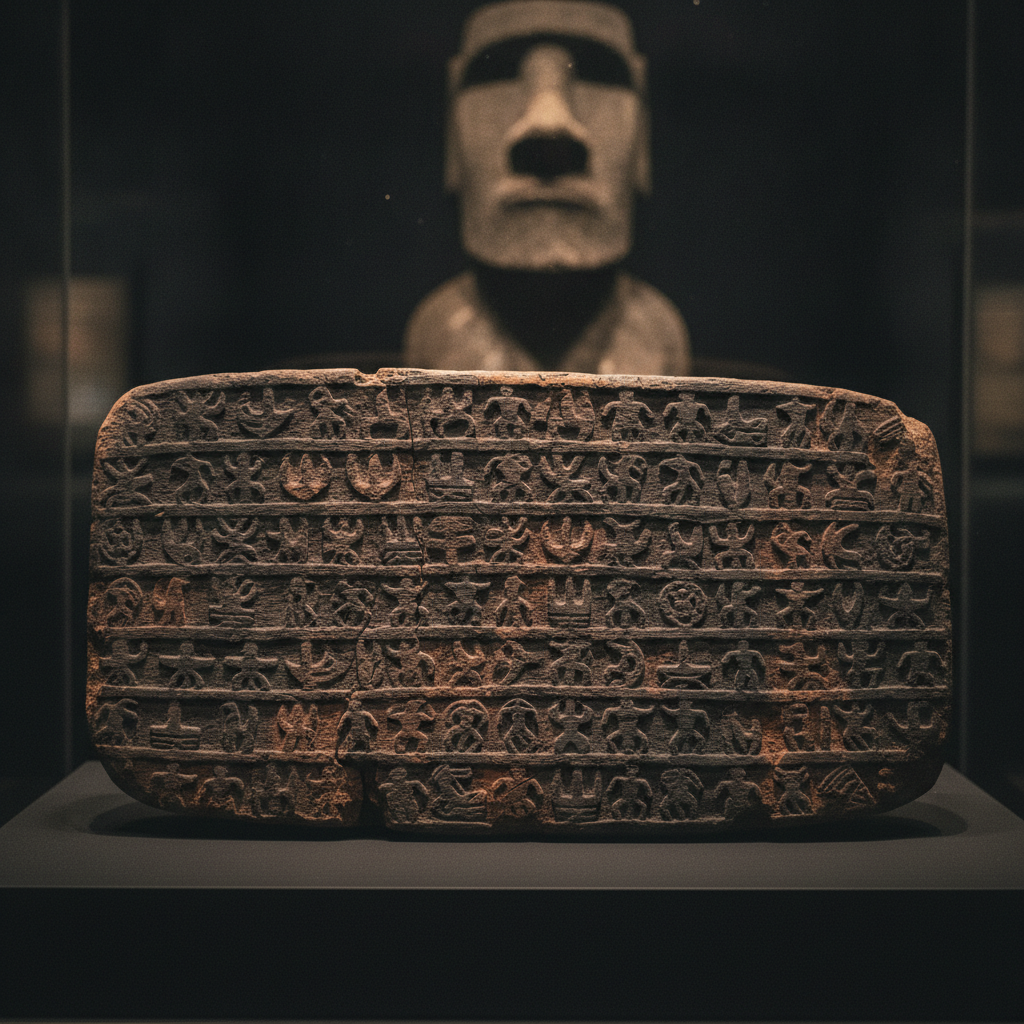
Rongorongo: The Script That Died With Its Readers
Rapa Nui, the island the outside world learned to call Easter Island, is a volcanic speck in the South Pacific, roughly 3,500 kilometres west of the Chilean coast and more than 2,000 kilometres from the nearest inhabited land. At some point before the middle of the nineteenth century, people there were carving rows of tiny figures into flat wooden boards: birds with human arms, fish, plants, seated men, crescents, spirals, and shapes that resemble nothing else on earth. The islanders called the objects kohau rongorongo, roughly the boards for reciting or chanting. About two dozen of them survive today. No living person can read a word of them.
The end of the reading tradition can be dated closely, and it was violent. In December 1862 and through 1863, Peruvian slave ships raided Rapa Nui and carried off something on the order of 1,500 people, among them the king, his heir, and much of the priestly and learned class. International protest forced a repatriation. Of the handful who survived the return voyage, several carried smallpox, and the epidemic that followed, layered on top of the abductions, hollowed out the island. By the 1870s the population had fallen to little more than a hundred people. Whatever chain of teachers and students had carried the script from one generation to the next was broken within a single decade.
You have used your free reads for this month.
Unlock all 208 documented mysteries - in 8 languages, ad-free.
Get full access