Documented

The Lead Masks Case: Two Men, a Hilltop, and a Note No One Can Explain

2026-07-05 · Unexplained Deaths · 8 min read

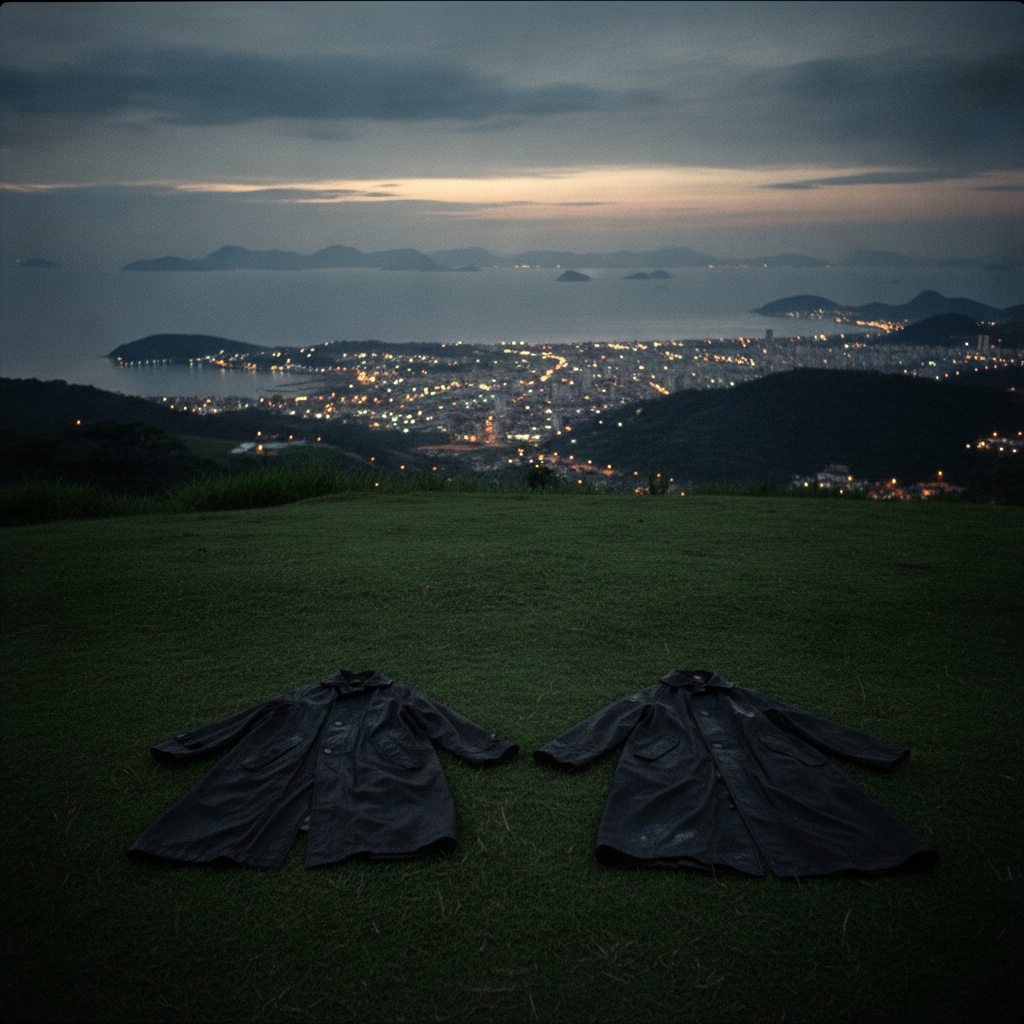
On the afternoon of August 20, 1966, a boy climbed Morro do Vintem, the steep scrub covered hill that rises over the Brazilian city of Niteroi, across the bay from Rio de Janeiro, in order to fly a kite. Somewhere in the undergrowth he found two men lying side by side, partly hidden by the grass, not moving. He went back down and reported what he had seen. The terrain was so difficult that the police and firemen who tried to climb to the spot could not reach it that day. Only on the following day did anyone stand over the bodies.

The dead men were identified as Miguel Jose Viana, thirty-four, and Manoel Pereira da Cruz, thirty-two, electronics technicians from Campos dos Goytacazes, a town several hours to the north. Both were dressed in formal suits and new waterproof coats, although the day had been dry. Over the eyes of each man, resting on the face, lay a mask crudely cut from solid lead, the kind of gray metal sheet a technician might shape with tin snips. There were no wounds and no signs of a struggle. Money was still in their pockets.

The recovery was itself difficult. The hill is steep, covered in dense scrub, and there was no path to the place where the men lay, so firemen had to cut their way up to it. The two bodies were side by side, and the surrounding vegetation showed no disturbance to suggest that either man had struggled or been dragged. Their clothing was in order. Nothing at the site indicated that anyone else had been there with them.

Beside the bodies the police found an empty water bottle, a packet holding two wet towels, and a spiral notebook. On one page of the notebook was a handwritten schedule. In the original Portuguese it read, in part, "16:30 estar no local determinado. 18:30 ingerir capsulas, apos efeito proteger metais aguardar sinal mascara", which is to say: be at the agreed place at half past four, swallow capsules at half past six, and after the effect, protect the metals and wait for the signal, mask. No capsules were found at the scene, and neither wrappers nor a container for them was ever recovered.

Investigators reconstructed the men's last days. On August 17 the two left Campos dos Goytacazes, telling their families that they were going to buy materials for their work, perhaps electronic parts, perhaps a car. They boarded a bus to Niteroi and arrived in the early afternoon. In a shop they bought the waterproof coats. In a bar they bought a single bottle of water. The waitress who served them remembered the visit afterward, and remembered one detail in particular: Miguel seemed nervous and kept looking at his watch. The two men then walked out of the bar in the direction of the hill. That is the last time anyone is known to have seen them alive.

Both men were known in their home town as competent electronics technicians who repaired radios and television sets. They worked together, they were regarded as sober and reliable, and neither had a documented history of illness. They had told their families that they were travelling to make a purchase, and the inquiry recorded that they carried money for it, although the sums given in different accounts vary and were never firmly established. What is documented is that cash remained in their clothing when the bodies were recovered, and that nothing appeared to have been taken.

When investigators searched the men's rooms in Campos dos Goytacazes, they reported finding books on spiritism, and in at least one account the passages concerning lead and lead masks had been marked. Friends and later researchers described the two as belonging to a small local circle of technicians who combined their trade with a belief that radio sets and homemade apparatus might reach something beyond the ordinary world, whether the spirits of the dead or an intelligence not of this earth. Read against those beliefs, the masks were consistent with improvised eye protection against a light the men expected to be blinding.

One witness statement entered the file early and has stayed in it ever since. A Niteroi resident named Gracinda Barbosa Coutinho de Souza told investigators and the press that on the evening of August 17 she and her children had seen an oval object hovering over Morro do Vintem, glowing and emitting beams of light before it moved away. Her account was recorded during the inquiry. No independent witness came forward to corroborate it, and it has been disputed ever since.

The medical evidence, which might have settled the case, was lost. The autopsies were delayed. The bodies had lain on the hill for days in the heat before they were recovered, and the morgue was overloaded, so that by the time toxicology was attempted the internal organs were too decomposed to yield reliable results. Whether the two men had swallowed poison, a stimulant, a hallucinogen, or nothing at all could no longer be determined. No trace of any capsule was recovered from the bodies. The case file recorded no wounds, no fractures, no evidence of violence and no chemical finding. The official cause of death was never established.

Ad

The timeline the inquiry assembled places the two men on the hill on the evening of August 17, three days before the boy found them. That interval, spent in the open in the Brazilian August heat, is what destroyed the toxicological evidence. The police investigation continued for months, questioning relatives, colleagues and members of the men's circle. It produced no suspect, no established motive and no cause of death, and the file was eventually shelved with the deaths recorded as unexplained. It has never been reopened on the strength of new physical evidence.

Sixty years later the documented record is exactly what it was in 1966: two dead technicians, two lead masks, one notebook page, one disputed light in the sky, and a set of autopsies that came too late to say anything at all. Morro do Vintem still rises, green and ordinary, over Niteroi. The families of Miguel Jose Viana and Manoel Pereira da Cruz buried two men whose cause of death was never written on any certificate.

Conclusions and Open Questions

Everything that follows is interpretation, and it is worth saying why. The one procedure that could have decided between the competing explanations, toxicology, returned nothing, because the organs had decomposed before they reached a laboratory. Without it there is no way to establish whether either man swallowed anything at all. Every theory below therefore rests on the same small set of objects: two masks, one page of a notebook, one contested sighting, and two bodies without a mark.

One theory, advanced from the first weeks by Brazilian ufologists and by writers close to the men's spiritualist circle, holds that the two climbed the hill to keep an appointment with something they expected to arrive from the sky, that the lead masks were shielding against its light, and that the capsules were meant to prepare them for the encounter. Its appeal is that it accounts for the objects: the masks, the timed note, the deliberate wait, the coats bought for a dry day. Its weakness is that it depends almost entirely on the statement of a single witness whose sighting was contested at the time, and on an inference about what two dead men believed that no one can now test.

Against this, police investigators and later skeptics argued a wholly earthbound explanation, in which the deaths involved money rather than lights. On this reading the men were poisoned by someone they trusted, the capsules were a story they had been persuaded to accept, and the isolated hilltop was chosen because no one would interrupt. The strength of this account is that it requires nothing unusual, and that it explains the secrecy, the lie told to their families and the nervous watching of the clock. Its weakness is that no suspect, no motive and no poison were ever produced, and that the cash in their pockets was not taken, which is difficult to reconcile with a killing for money.

A third theory, argued by those who take the notebook at face value, is that the men did this to themselves: that the capsules were real and self-administered, part of an experiment or a ritual of their own design that killed them. This requires neither a craft nor a murderer, only two sincere men and a substance stronger than they understood. Its weakness is the same absent evidence: nothing shows that a capsule was ever swallowed, no container was found, and the calm arrangement of the scene, two bodies laid out without any sign of distress, sits awkwardly with a poisoning that went wrong.

Some argue that the real failure in this case was administrative rather than mysterious, and that a laboratory result obtained a week earlier would have reduced the Lead Masks Case to a tragedy with a chemical name. That is a reasonable position, and it is also unprovable. It would not, in any event, explain the masks, which no toxicology report would have accounted for either.

What remains unexplained can be stated plainly. What signal were two employed, healthy men waiting for on that slope, and who told them that it would come? Why lead, and why cut to cover only the eyes? What were the capsules, and if they were taken, where did their container go? How does a note written in the flat language of an appointment book end with the bare word "mask"? And how do two men lie down within reach of each other and die without a wound, a mark or a struggle, in a manner that no autopsy could describe? Sixty years on, none of these questions has an answer, and the physical means of answering them was lost in the days after the bodies were found.

Free reads left this month: 0

Share this story:

Reader comments (0)
Only active subscribers with verified payment can post comments. Get full access