Five Days Missing, Four Days Dying: The Death of Edgar Allan Poe
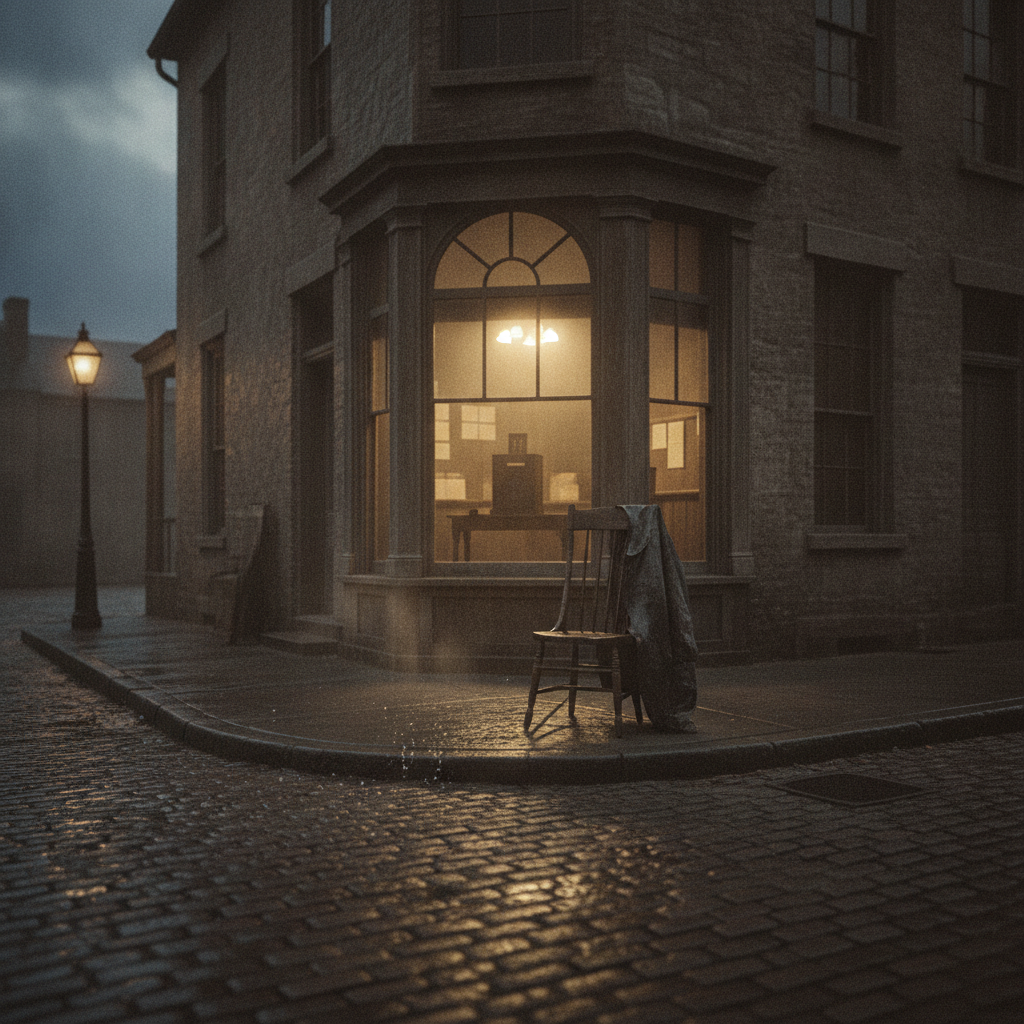
It was election day, and the tavern on the corner was being used as a polling station.
On the afternoon of 3 October 1849, a printer walking past the building in Baltimore, in the United States, noticed a man sitting outside in great distress. The man was barely able to hold himself up. His clothes were shabby and did not fit him: a stained, faded coat and worn shoes that nobody who knew him would have expected to see him in.
The printer recognised the face. It belonged to a writer who was, by then, well known across the country.
He did not call a doctor from the street. He sat down and wrote a note to a physician he knew the writer was acquainted with. The note survives, and it is one of the very few pieces of hard evidence in this entire story:
"There is a gentleman, rather the worse for wear, at Ryan's 4th ward polls, who goes under the cognomen of Edgar A. Poe, and who appears in great distress, and he says he is acquainted with you, and I assure you he is in need of immediate assistance."
Four days later Edgar Allan Poe was dead, at the age of 40.
Here is the mystery in one paragraph. He had boarded a boat in one American city intending to travel to two others, and he never arrived at either. Between the day he stepped off that boat and the afternoon the printer found him, there is a gap of 5 days in which nobody knows where he was, what he did, or who he was with. He died without ever explaining it. And the medical paperwork that might have said what killed him has vanished so completely that no cause of death has ever been established.
What he was supposed to be doing
In the summer of 1849 his life had turned upwards, which is one of the reasons the ending is so strange.
He had spent weeks in Richmond, a city about 240 km south of Baltimore, giving public lectures to full rooms and being paid for them. He had become engaged to a widow he had known as a young man. A wedding was being planned. In August he had joined a temperance society there and taken the pledge to stop drinking, in front of witnesses.
On 27 September 1849 he left Richmond by steamer, heading north. The plan was entirely ordinary. He would stop on the way to do a piece of paid editing work, continue to New York, collect his elderly aunt, and bring her back south for the wedding.
The boat's route took him to Baltimore. He arrived there on 28 September 1849.
That is the last confirmed sighting of him for 5 days. From here on, nobody knows what happened.
His cousin in that city later wrote that he had been unable to establish where his relative had spent those days, or under what circumstances. No landlord, no friend, no fellow passenger, no shopkeeper ever came forward with an account. In a city where his face was known, 5 days of a famous man's life simply do not exist in the record.
The hospital
The doctor who received the note came to the tavern and had him carried by carriage to the college hospital.
He was put in a room on an upper floor with barred windows. What happened there is known only from what that one doctor later wrote, and the reliability of those writings is itself part of the problem.
According to those accounts, the patient was not conscious in any normal sense. He sweated heavily. He talked at length to things on the walls of the room. He had short periods of something like lucidity, and in one of them he was asked how he had come to be in the city and by what means. The answer, the doctor wrote, was incoherent and unsatisfactory.
No visitors came. Nobody in the city seems to have been told until after he was dead.
On the last night he called out a name, over and over. The name has never been attached, with any confidence, to anybody in his life.
He died quietly before dawn on Sunday, 7 October 1849. Even the hour is uncertain: some accounts give 3 in the morning, others 5.
He was buried the following day. Fewer than 10 people came. The service lasted about 3 minutes. The grave was left without a stone for 26 years.
The paperwork that does not exist
This is the part that turns a sad death into an unsolved one.
A Baltimore newspaper reported the cause of death as "congestion of the brain". In 1849 that phrase was not a diagnosis. It was a polite formula that newspapers used when the real answer was thought to be drink, and it was also used for half a dozen genuine medical conditions. It settles nothing.
No death certificate has ever been found, and there is no evidence one was filed.
The hospital's records covering those days are gone.
And the one eyewitness, the treating doctor, is not a reliable narrator. His first written account, in a letter from November 1849, is brief and vague and says the patient died of "the malady" without naming it. By 1875, 26 years later, he was telling a far longer story. By 1885 he had published a book about it, in which the patient makes speeches, whole conversations are quoted word for word, and some of the dates contradict the doctor's own earlier letter and the known calendar. One documented example: he claimed he had contacted the family at once, when in fact he wrote to the writer's aunt only after she asked him to, more than a month later.
So the only person who watched him die produced three different versions of it, each fuller than the last, decades apart.
The obituary written by an enemy
Two days after the death, a newspaper in New York carried an obituary signed with a false name. It announced that few would be grieved by the news, and it presented the dead man as a drunk, unstable and friendless.
The author was a literary rival. He went on to become the writer's literary executor, and in that role he published a memoir of him that included letters later shown to have been altered and, in places, invented.
This matters for a practical reason. The very first public account of how this man had lived and died was written by someone who wanted to damage him, and it was repeated for generations. Any later attempt to work out what actually killed him has had to be dug out from underneath it.
Conclusions and Open Questions
There are more proposed causes of death here than in almost any comparable case. That in itself says something: a shortage of evidence lets every explanation fit.
One theory holds that it was drink. He had a documented history of it, the newspaper formula pointed that way, and it was the immediate assumption of most people at the time. The problem: it does not explain the borrowed clothes, the missing 5 days, or the 4-day course in hospital. The doctor claimed he found no smell of alcohol, though that doctor is the same unreliable witness.
One theory holds that he was the victim of election fraud. The practice known as cooping is documented in Baltimore newspapers of the period: gangs seized men off the street, held them in a back room, forced drink or drugs into them, changed their clothes, and marched them from one polling place to another to vote repeatedly. Those who refused were beaten. He was found at a polling place, on election day, in clothes that were not his own. The problem: not one witness, participant or victim ever connected him to it. The practice is documented; his involvement in it is not.
One theory holds that it was rabies. In 1996 an American heart specialist reviewed the recorded symptoms at a clinical conference and argued they fitted rabies: delirium with lucid intervals, difficulty with water, and death within 4 days. The problem: no bite was ever recorded, nobody at the time described the classic terror of water, and the diagnosis rests entirely on second-hand descriptions written by an unreliable witness.
One theory holds that a brain lesion or tumour killed him. When the remains were moved in 1875 for reburial, an account described a solid object inside the skull, and some have suggested a calcified tumour. The problem: a brain does not survive 26 years in the ground, nothing was kept for examination, and a single description is not a diagnosis.
One theory holds that he was beaten to death. An American writer argued in 1998 that the brothers of the woman he was to marry had him attacked to stop the wedding. The problem: there is no contemporary evidence of any assault, and no record of a threat. The case is built on circumstance alone.
One thing has been ruled out. A hair sample was tested in 2006, and the mercury found in it was far below a level that could have killed him. The traces are consistent with the documented fact that he had been treated during a cholera outbreak in July 1849, when mercury compounds were standard medicine. Slow metal poisoning can be set aside.
Three questions stay open, and they are the same three that were open in 1849.
Where was he between 28 September and 3 October? Whose clothes was he wearing? And what happened to the hospital record and the death certificate of the most famous American writer of his generation, in a city where such papers were routinely kept?
He wrote the first modern detective stories. He built them around a man who could reconstruct an entire crime from a handful of physical details. His own death left almost no details at all.