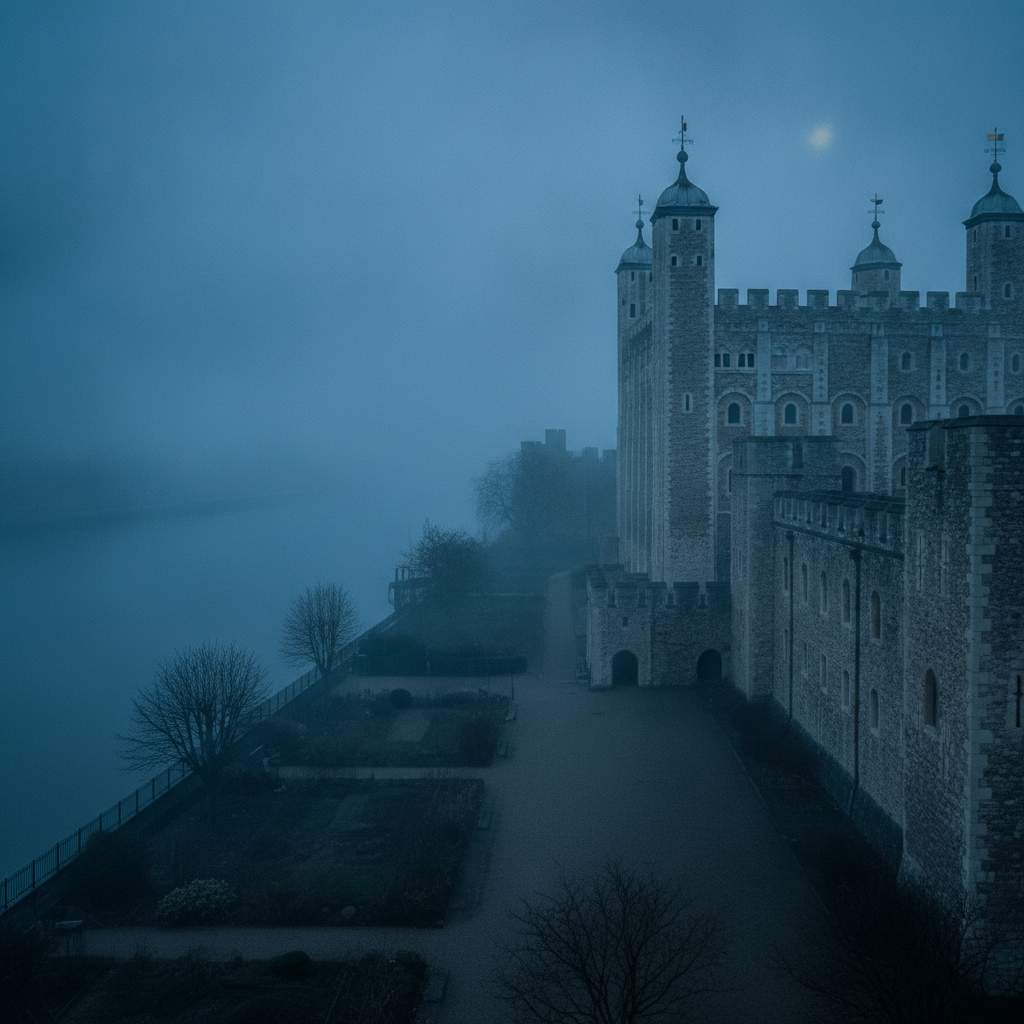
The Princes in the Tower: 2 brothers who went into a London fortress in 1483 and never came out
In the summer of 1483, people in London could sometimes see 2 boys playing in the gardens of the Tower, the great royal fortress on the river.
The older one was 12. He was the king of England.
The younger one was his brother, 9 years old.
As the weeks went by, they were seen less and less. First only behind the windows. Then behind the bars. Then not at all.
Nobody ever saw them again. They are remembered as the Princes in the Tower.
Here is the mystery in one sentence: 2 royal boys disappeared inside the most guarded building in England, nobody ever proved what happened to them, and the 2 small skeletons that may be theirs have not been examined with modern science.
How a boy became king
In April 1483 the king of England died suddenly, after an illness of about 3 weeks. His elder son was 12.
A boy cannot rule alone. The dead king had named his own younger brother, the boys' uncle, as protector of the kingdom until the child grew up. That uncle's name was Richard.
At the end of April the boy king was travelling to London for his coronation. His uncle met the party on the road. The next morning, the uncle had the boy's escort arrested. Among them were the boy's uncle on his mother's side and his half-brother. Both were executed in June.
The boy arrived in London under his uncle's control.
He was lodged in the Tower. At that time this was normal. The Tower was also a royal palace, where kings traditionally stayed before a coronation.
The boys' mother understood what was happening. She fled with her younger son and her daughters into sanctuary at Westminster Abbey, the great church in London, where by custom nobody could seize them.
On 16 June, with soldiers around the abbey, she agreed to let the younger boy go. He was taken to the Tower, to join his brother.
The crown changes hands
3 days later, the coronation was postponed.
On 22 June a preacher announced in a public sermon in London that the boys were not legitimate. The claim was that their father had been promised in marriage to another woman before he married their mother, so his marriage, and his children, did not count.
On 26 June the uncle took the throne. On 6 July he was crowned as King Richard III.
The last sightings
The best eyewitness we have is an Italian visitor who was in London that summer and left before the end of July. He wrote down what he saw and heard later that same year.
He described the boys being moved into the inner rooms of the Tower, and being seen less and less. He also recorded something chilling. The elder boy's doctor said the boy confessed every day and did penance, because he believed death was near.
At the end of July there was a failed attempt to break the boys out.
By the autumn, rumours across England said they were dead. A rebellion broke out in October. At first the rebels wanted to put the boy king back on the throne. Then, suddenly, they changed their goal and backed a different claimant: an exiled nobleman named Henry Tudor. Many historians see this as a sign that the rebels believed the boys were already dead.
In January 1484, a senior official of the king of France told a public assembly that the boys had been murdered.
Their uncle never answered by showing them alive.
**This is where the documented trail ends. After the summer of 1483 there is no reliable record of either boy, alive or dead.**
Battle, a new king, and young men who claimed to be the prince
In August 1485 the uncle was killed in battle, and Henry Tudor became King Henry VII. He married the boys' older sister.
Then the impostors came. In the 1490s, a young man appeared in Europe claiming to be the younger prince, saying he had escaped. The boys' aunt, the sister of their father, received him as her nephew. In 1497 he was captured. He confessed that he was not the prince but the son of an ordinary townsman in Flanders, in what is now Belgium, and was executed 2 years later.
The story that became the official version
In 1502, a knight who had served the uncle was executed for a different crime.
About 11 years later, a famous English writer and statesman wrote a history of those years. He said this knight had confessed before his death to murdering the boys on the uncle's orders. According to that history, 2 men smothered the boys with pillows at night and buried them at the foot of a staircase, under a heap of stones. Then, he wrote, a priest moved the bodies to a secret place.
This account became the famous version, and a century later it was put on the stage in the best-known English play about the uncle.
But no written confession has ever been found. The writer was 5 years old in 1483, and he was writing under the next royal family, the one that replaced the uncle.
The bones under the stairs
In July 1674, workmen were removing an old staircase next to the oldest tower in the fortress. About 3 metres below the ground, they found a wooden box. Inside were the skeletons of 2 children.
The king at the time ordered the bones placed in a white marble urn in Westminster Abbey. A Latin inscription on it says, as a fact, that these are the 2 princes, murdered by their uncle.
If the priest moved the bodies, as the famous history says, then the bones under the stairs should not be theirs.
The only examination
The urn was opened once, in July 1933. The abbey's archivist, an anatomist and a dental expert examined the bones.
They concluded that these were 2 children, one of about 12 to 13 and one of about 9 to 11. They believed the 2 were related, based on missing teeth in both jaws. The anatomist also pointed to a red stain on one skull, and suggested it came from suffocation.
Many of the bones were missing. 3 rusty nails were found among them.
Later experts criticised the work. The examiners started from the assumption that these were the princes. They did not try to establish whether the children were boys or girls. And in 1933 there was no way to date bones. They could, in principle, come from another century entirely.
The urn was sealed again the same day. It has not been opened since.
The other 2 coffins
In 1789, workers repairing the royal chapel at Windsor Castle, about 35 km west of London, broke by accident into the tomb of the boys' father and mother. In an adjoining vault they saw 2 coffins of children, without names. The tomb was resealed without examining them.
In the late 1990s, a request to look inside with a small camera was refused.
Conclusions and Open Questions
There are 4 main explanations. Each has evidence. None has proof.
**Their uncle had them killed in 1483.** This is the view of most historians. He had the motive: as long as the boys lived, they were a rallying point against him, as the rescue attempt in July showed. He controlled the Tower. Rumours of their death spread within months of his coronation. And when he was publicly accused, he never showed them alive, which would have ended the rumours at once. The problem: there is no direct evidence. No order, no body that has been identified, no confession that survives. The detailed story of the murder was written decades later, under the family that took his crown.
**A powerful ally of the uncle did it, perhaps without orders.** The uncle's closest supporter that summer was a duke who turned against him in the October rebellion and was executed. A Portuguese document and a later English record name this duke as responsible. The problem: the boys were guarded inside the Tower. Getting to them would have needed the uncle's help. And after the duke's betrayal, the uncle had every reason to blame him publicly. He never did.
**Henry Tudor had them killed after 1485.** He married their sister, and living brothers would have had a stronger claim to the throne than his own. He also never investigated their fate. The problem: he was in exile abroad from before 1483 until the battle of 1485. The rumours of their death were already circulating in 1483, long before he had any power. And none of his many enemies ever accused him of it.
**One or both of them survived.** For years, a British researcher, the same one who led the search that found the uncle's lost grave in 2012, has run a project looking for traces of the boys in European archives. In 2023 she published documents she says show both boys alive years later, among them a 1487 accounting record which mentions an invasion on behalf of a son of the boys' father. The problem: other historians say these documents are propaganda written by the boys' supporters, and that none of them proves who the young men really were. In 2024 a senior British historian published a detailed rebuttal in an academic journal and concluded that the survival theory remains unproven.
What remains open:
Are the bones in the urn the 2 princes at all? Modern dating and DNA could answer that. The uncle's skeleton was found in 2012 and identified with DNA the following year, so a family reference now exists.
Who are the 2 children in the unnamed coffins at Windsor?
And will anyone be allowed to look? Opening a royal tomb needs the agreement of both the Church and the Crown. So far, the urn has stayed closed.
The answer may already be sitting in a marble box in London. It has not been opened for more than 90 years.