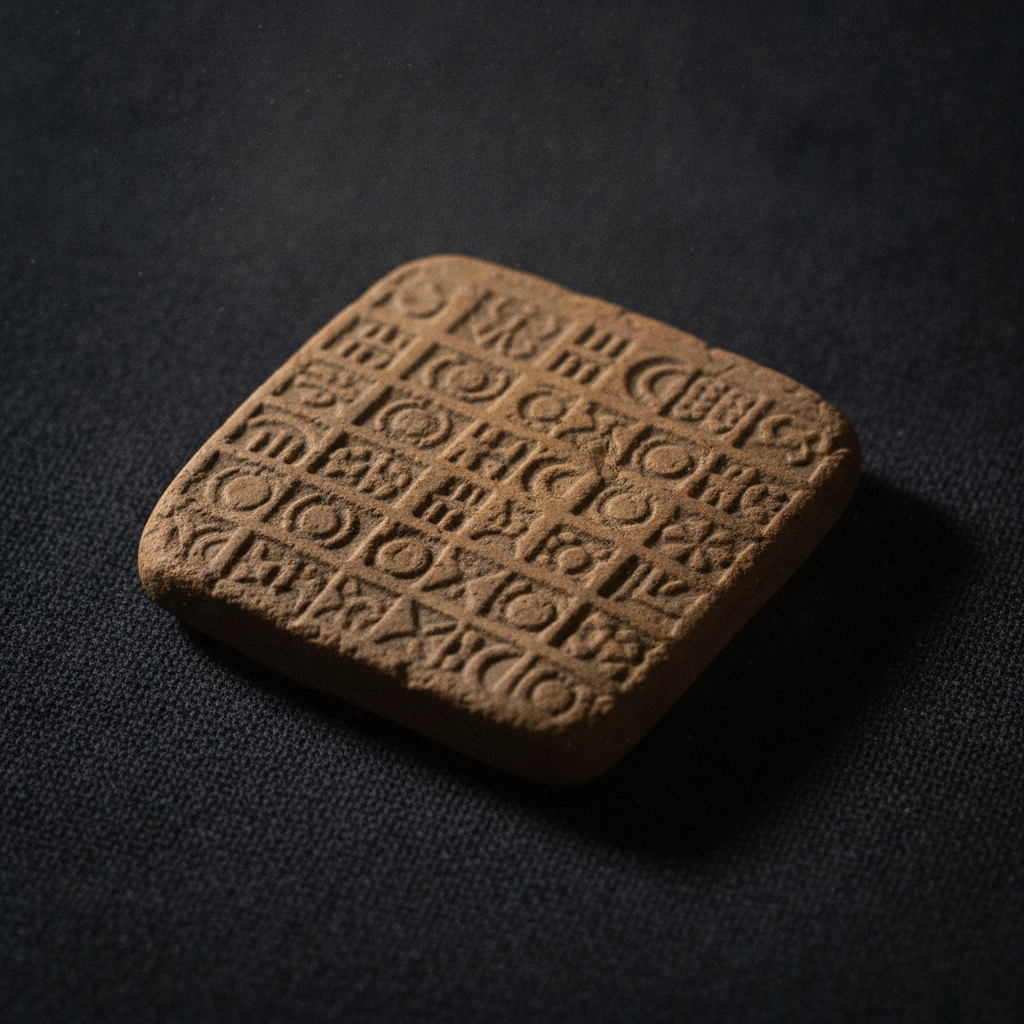
The Proto-Elamite script: 5,000-Year-Old Tablets From Iran That No One Can Read
At the end of the 19th century, French archaeologists were digging into a huge mound of earth at Susa, an ancient city in the south-west of Iran, not far from the border with Iraq.
The mound was made of thousands of years of ruins, one city built on top of the last. Deep down, in the oldest layers, the diggers found 2 small, flat pieces of clay.
They fitted in the palm of a hand. Their surface was covered with marks pressed into the clay while it was still soft: small circles, notches, and strange drawn signs, in neat rows.
It was writing. But it was not any writing anyone had seen before.
Over the next decades the French dug up more and more of these tablets. Today there are about 1,600 of them. More than 125 years after the first 2 came out of the ground, nobody can read them.
What the mystery is
The writing is called Proto-Elamite script. The name means "before Elamite", after the Elamites, a people who later lived in the same region.
It was used for a short time, about 5,000 years ago. The sources give slightly different dates: from about 3100 or 3200 BC to about 2900 BC. That makes it one of the oldest writing systems in the world.
Scholars can read its numbers. They know, roughly, what the tablets are about: they are accounts. Lists of goods, animals and people.
What they cannot do is read the words. Nobody knows what language the scribes spoke. Nobody knows what most of the signs mean. And it is one of the very few writing systems this old that has never been deciphered.
The neighbour that can be read
To understand why this is so frustrating, you have to look west.
At almost exactly the same time, in Mesopotamia, the land between the rivers Tigris and Euphrates in today's Iraq, another people were also starting to write. Their earliest script is called proto-cuneiform. It later grew into cuneiform, the wedge-shaped writing that was used for 3,000 years. Thanks to that long history, scholars can read the early Mesopotamian tablets quite well.
The tablets from Susa look a lot like them. They are made the same way: the clay is shaped into a blank, signs are pressed in, and the back of the tablet is used for the total. Both were used for the same job: keeping accounts in a society where a central authority controlled the goods.
The number systems are also similar. That is the main reason the numbers on the Susa tablets can be read today.
But the signs for things, the non-number signs, are different. So the neighbour gives a key to the numbers, and nothing else.
Before the writing
The story of how writing began here goes back much further.
For thousands of years, people across the Middle East kept records with small clay tokens. One token stood for one jar of oil, or one sheep. About two-thirds of all the tokens ever found come from Susa.
Later, people sealed the tokens inside hollow clay balls, and pressed marks on the outside to show what was inside. Then they realised they did not need the tokens at all. The marks on the clay were enough.
The oldest tablets of this kind, in both regions, carry nothing but numbers. They have been found at a handful of sites from Syria to Iran. Proto-Elamite and Mesopotamian proto-cuneiform are thought to have grown out of these number tablets, side by side, in the same few centuries.
What the tablets say
So what can be read?
Here is one tablet from Susa, now in a museum in Paris, as scholars have worked it out. It lists 47 nanny goats, 8 billy goats, 6 female sheep, 6 male sheep, 10 female kids, 2 male kids, 1 female lamb and 1 male lamb.
That is how most of these tablets read. Counts of animals. Measures of grain. Numbers of workers.
The scribes used several counting systems at once. One counted in 10s. One counted in 60s, like our minutes and seconds. One counted in 120s. And there was a separate system for measuring grain. Scholars have learned to tell which system a tablet is using from the shape of the number signs.
Most of the tablets come from Susa. But not all. About 33 were found at another ancient city in southern Iran, 27 at a site in the south-east, 12 at another, 5 at a site in central Iran, and 1 each at 3 more places, one of them near the border with Afghanistan. Someone carried this way of writing across most of what is now Iran.
Why it has not been cracked
The famous decipherments of history, Egyptian hieroglyphs or the Greek Linear B, depended on 2 things: a text in 2 languages, one of them known, or a good guess about the language behind the script.
Proto-Elamite has neither.
There is no bilingual text. Not one tablet carries the same message in Proto-Elamite and in a script that can be read.
And the language is unknown. Some scholars have suggested it was an early form of Elamite, the language of the later people of the region. But there is no positive evidence for that. Nobody knows what was spoken at Susa 5,000 years ago.
Then there are the signs themselves. Some look like the thing they mean. Most do not. Many signs appear only once in the whole collection, so there is nothing to compare them with. For decades scholars could not even agree whether 2 similar-looking marks were 2 different signs or 2 ways of drawing the same one. It was only in 1974, when an Italian scholar published a full list of the signs, that enough agreement existed to move forward.
There is also something unusual about what the scribes drew. They drew animals and objects. But there are almost no human figures, apart from 2 signs used to mark whether a worker was male or female.
The careless scribes
In 2012, a scholar at the University of Oxford in England announced a new project. His name is Jacob Dahl. He had been working on these tablets for more than 10 years.
His team built a dome with a high-resolution camera at the top and 76 lights arranged around its inside. A tablet is placed under the dome and photographed 76 times, each time lit from a different direction. A computer then combines the pictures, so that every tiny mark in the clay can be seen in light and shadow. The method is called reflectance transformation imaging.
The pictures were put online for anyone to study. Today almost all of the roughly 1,600 tablets can be seen on the internet.
The new pictures corrected older work. Some earlier scholars had mixed up Proto-Elamite signs with the signs of Linear Elamite, a much later and quite different script from the same region.
But the closer Dahl looked, the more he found a problem that nobody expected. The scribes made a great many mistakes.
In Mesopotamia, archaeologists have found lists of signs that student scribes copied over and over, and practice exercises. At Susa there is no sign of that. No lists. No exercises. Dahl concluded that the scribes were not properly trained, and that their errors make it very hard to find the regular patterns a decipherer needs.
He went further. The script, he said, did not just fall out of use. It slowly broke down, until it was no longer useful, and disappeared within a few hundred years. He called it probably the world's first case of a "collapse of knowledge".
In 2012 he said he thought his team was "finally on the point of making a breakthrough." Some specialists called that journalistic hype. Even basic words such as "cow" were still unknown.
**This is where what is known stops. The numbers can be read, the subject of the tablets is understood, but no one has read a single sentence of Proto-Elamite, and no one knows what language it wrote.**
Conclusions and Open Questions
In 2020 a French archaeologist, François Desset, announced that his team had deciphered Linear Elamite, the later script from the same region, used about 2300 to 1800 BC. They worked mainly from 8 inscriptions on silver beakers, and read royal names and titles, such as a king of a land called Awan.
The team also argued that Linear Elamite and the older Proto-Elamite script were closely related.
Dahl disagreed. He said the 2 scripts have about as much in common as either has with the earliest Chinese writing. He also raised doubts about some objects the team used, from a site in south-eastern Iran, which he suspects may be forgeries.
These are the main positions.
**The language was early Elamite.** It was the language of the region later on, and that makes it the obvious candidate. The problem: there is no positive evidence. No word on the tablets has been shown to be Elamite.
**It is related to Linear Elamite, which may now be readable.** This is Desset's position, and if it is right, the later script could open the earlier one. The problem: the leading specialist in Proto-Elamite says the 2 have almost nothing in common, and the Linear Elamite decipherment itself has not won general agreement.
**It may never be read as language at all.** The earliest tablets hold only numbers and pictures of goods, with no clear sign of words being spelled out. The problem: one report quoted the Oxford researcher as saying that some words may have been spelled with sound signs. If that is so, a language is hiding in there somewhere.
So the questions stay open. What language did the people of Susa speak? Were their scribes really so badly taught that their own writing fell apart? And will the 1,600 tablets, now on any screen in the world, give up their first word to a scholar, or to someone who simply looks long enough?