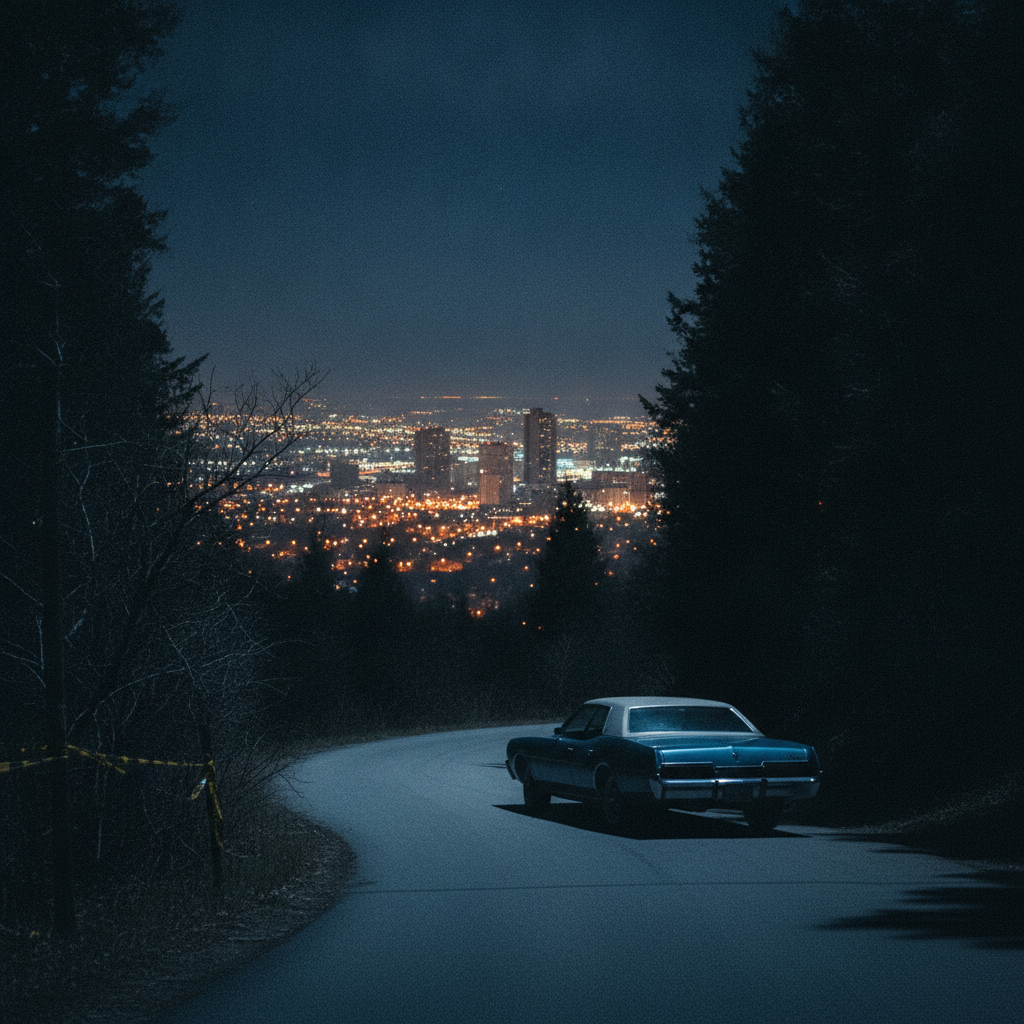
Two Cousins, a Fake Badge and 10 Women: How the Hillside Strangler Case Was Finally Solved
In the autumn of 1977, Los Angeles learned to be afraid of a police badge.
Women were disappearing from bus stops, shopping centres and their own neighbourhoods. A few days later they were found dead, dumped on the hills and slopes around the city, often near a freeway or a quiet road.
The newspapers gave the killer a name: the Hillside Strangler.
Here is the case in one sentence. Between October 1977 and February 1978, 10 women and girls, aged 12 to 28, were abducted, raped and strangled in Los Angeles, and the largest police task force the city had assembled could not find who did it.
The answer, when it came, was a surprise in two ways. The killer was not one man but two: Kenneth Bianchi and his older cousin, Angelo Buono. And the case was not cracked in Los Angeles at all. It was cracked 15 months later, at the other end of the American West Coast, near the Canadian border, after Bianchi killed again.
A city with one fear
Los Angeles is the largest city in California, in the United States. It is spread over hills, valleys and freeways. Glendale, a smaller city, sits right next to it, and many of the bodies were found on the slopes between the two.
The pattern was the same almost every time.
A young woman was last seen alive in an ordinary place. Then she was found naked, on a slope or a roadside, with the marks of a rope or cord around her neck, wrists and ankles. There were no drag marks in the dirt. Someone had carried her there.
And, as the police slowly understood, the women had not fought their way into a stranger's car. They had gone quietly. Many of them had been stopped by a man who showed them a police badge.
The crimes
The first body was found on 18 October 1977. Yolanda Washington, 19, lay on a hillside near the Ventura Freeway.
On 1 November, Judith Miller, 15, was found beside a road in La Crescenta, a hill suburb north of Glendale.
On 6 November, Lissa Kastin, 21, was found on an embankment in Glendale, near a country club.
Up to this point, the press paid little attention. The first 2 victims were young women from the streets, and their deaths barely made the news. Kastin was different. She came from an ordinary middle-class home. So would most of the women who came after her.
Then came one terrible week.
On 20 November 1977, 2 schoolgirls were found together on a hillside near Dodger Stadium, the city's baseball stadium. Dolores Cepeda was 12. Sonja Johnson was 14. They had last been seen at a shopping centre in Eagle Rock, a neighbourhood in the north-east of the city.
The same day, Kristina Weckler, 20, an art student, was found on a hillside between Glendale and Eagle Rock.
On 23 November, Evelyn Jane King, 28, was found in bushes beside a freeway off-ramp.
4 bodies in less than a week. The city panicked.
On 29 November, Lauren Rae Wagner, 18, was found on a street in Glassell Park, a hill neighbourhood in the north-east of Los Angeles. Years later, Bianchi would admit that he and his cousin had stopped her by pretending to be police officers.
On 14 December, Kimberly Diane Martin, 17 (some sources give 18), was found on an empty lot near Los Angeles City Hall, in the city centre. She had been called out to an apartment in Hollywood, and the call had been made from a public pay phone.
And then, for 2 months, nothing.
On 17 February 1978, a car was found on the edge of a cliff off the Angeles Crest Highway, a mountain road north of Glendale. It was her own car. In the boot was Cindy Lee Hudspeth, 20.
She was the last. The killings in Los Angeles stopped. Nobody knew why.
The woman who showed her driver's licence
There was one woman who got away, and her story only made sense years later.
In late 1977, 2 men stopped a young woman in Hollywood and told her they were vice officers. She was the daughter of a famous film actor. She showed them her driver's licence, and with it, a photograph of herself as a child with her father.
The men let her go.
Only after the arrests did she come forward. She said the 2 men who had stopped her, posing as vice officers, were the cousins later charged with the murders.
The investigation: a task force drowning in tips
After the murder of Evelyn Jane King, the authorities formed a joint task force. It began with about 30 officers from 3 agencies: the Los Angeles Police Department, the county Sheriff's Department, and the Glendale police.
By early 1978 it had grown to 162 officers.
They ran a telephone tip line 24 hours a day. The tips poured in. By one count, the investigators logged more than 10,000 clues, looked at about 4,800 men on parole, and checked some 120,000 fingerprint cards.
It was not enough, and part of the reason was the investigation itself.
The 3 agencies did not work as one. Each body was found in somebody's territory, and each agency kept its own files. One detective said later that there was "really no coordination whatsoever."
The police also did not know what they were looking for.
At first, many believed there was a single strangler. But the bodies had been carried, not dragged, and some detectives thought that pointed to more than one man. One senior officer went further and suggested there might be "4 or 5 sets of stranglers" working the city.
There were false starts.
On the word of a jailhouse informant, the police arrested a handyman from Beverly Hills. He was held for 3 days. Then he was released, with a public apology. He had nothing to do with it.
The badge
The hardest idea for the investigators to accept was the one about the badge.
Several of the women had been taken without a struggle. The informal theory inside the task force was that the killer either was a police officer or was posing as one. That meant the city could not simply tell women to trust the police. Some officers feared the killer might be one of their own.
He was not. But he was closer than they knew.
During the months of the killings, Kenneth Bianchi applied to join the Los Angeles Police Department. He also rode along with officers several times, in police cars, while they searched for the Hillside Strangler.
His name came up in the investigation more than once. At one point he even agreed to take a polygraph test. Nobody followed it up.
Later, investigators found one reason why. His name had been misspelled in the police computer system. Each time it surfaced, it looked like a different man.
The quiet year
After February 1978, the killings stopped.
The task force kept working. The tip line kept ringing. But there were no new bodies, and with no new bodies there were no new scenes, and no new evidence.
What nobody in Los Angeles knew was that Bianchi had left the city.
He moved north, to Bellingham, a small university city in Washington state, near the border with Canada. There he found work with a local security company, guarding buildings. He also joined the county sheriff's reserve, a volunteer force.
For almost a year, he lived quietly.
Bellingham, 11 January 1979
Karen Mandic was 22. Diane Wilder was 27. Both were students at the local university, Western Washington University, and they shared a rented house.
Mandic also had a job in a department store. A few days earlier she had told friends about an offer from a man she knew through work, a security guard named Ken. He wanted the 2 women to sit in an empty house for 2 hours, while its alarm system was being repaired. The owners were away in Europe. He would pay each of them 100 dollars.
On the evening of 11 January 1979, at about 7 o'clock, Mandic left work. She and Wilder drove to the house, on Bayside Road, in a quiet, wooded area of the city.
They never came home.
That same night, friends and her employer became worried enough to call the police.
The car in the cul-de-sac
On 12 January, a witness spotted Mandic's car, a green Mercury, parked at the end of a wooded dead-end street.
Both women were inside. They had been strangled with a cord.
This time, the killer had left a trail, and the Bellingham police followed it fast.
In Mandic's car they found a small slip of paper. It read: "334 Bayside 7 p.m. Ken."
At the women's home they found a note in Wilder's handwriting. It recorded a phone call from Bianchi on 9 January.
When the police first asked him, Bianchi said he did not know Mandic. Then he changed his story. He said he had skipped a meeting of the sheriff's reserve that evening and had been driving around alone.
The police took him into custody that same day, at the guard hut where he worked. Wilder's coat was found hidden nearby, about 6 metres from his company truck.
The evidence piled up. A dent in the fuel tank of Mandic's car matched rocks at the house on Bayside Road. A witness had seen a man who looked like Bianchi driving a security company truck in the area. Carpet fibres on the women's clothes matched the carpet in the house. A hair linked Bianchi to Wilder.
The address in Los Angeles
Then the case jumped back south, to Los Angeles.
Bianchi's driver's licence still carried his old address in Los Angeles: an apartment building on Tamarind Avenue, in Hollywood.
A Los Angeles detective recognised it at once. It was the building from which Kimberly Diane Martin had been called out on the night she disappeared.
The links multiplied.
An earlier address of Bianchi's, in Glendale, was connected to Kristina Weckler. Another victim had lived across the street from him.
His fingerprints were found on the pay phone that had been used to call Martin out, and in the apartment she had been taken from.
And in his home in Bellingham, the police found jewellery that resembled pieces worn by victims in Los Angeles.
The Hillside Strangler task force finally had a name. And through Bianchi, it soon had a second one: his cousin, Angelo Buono, who ran a car upholstery shop from his home in Glendale.
The man with 3 personalities
Bianchi now faced 2 murder charges in Washington state, and almost certainly more in California. Washington had the death penalty. He chose a defence.
In March 1979 he changed his plea to not guilty by reason of insanity. His lawyer said he suffered from amnesia and from multiple personality disorder.
Under hypnosis, in front of doctors, Bianchi produced a second personality. It called itself "Steve Walker." "Steve" confessed to the killings in Bellingham. Bianchi, the defence argued, knew nothing about them.
The psychiatrists who examined him did not agree with each other. Some thought the personalities might be real.
The prosecution brought in a leading expert on hypnosis from the University of Pennsylvania. He set 2 traps.
First, in passing, he mentioned that genuine cases of multiple personality rarely involve only 2 personalities. Usually there are 3 or more.
Soon after, a third personality appeared. It called itself "Billy."
Second, while Bianchi was supposedly hypnotised, the expert told him that his lawyer was sitting in the room. The lawyer was not there. Bianchi turned to the empty chair and began talking to the lawyer who was not there. The expert concluded that Bianchi was faking: faking the hypnosis, and faking the personalities.
The detectives found the last piece themselves.
"Steve Walker" was not an invention. He was a real person. Bianchi had placed a fake job advertisement in a Los Angeles newspaper, collected the applications, and used one applicant's psychology diplomas and transcripts as his own. The investigators found the old advertisement on microfilm.
The defence collapsed.
The deal
In October 1979, a judge in Washington ruled that Bianchi was fit to stand trial.
He made a deal to escape the death penalty. He pleaded guilty to the 2 murders in Bellingham. In Los Angeles, he pleaded guilty to 5 of the Hillside murders. In return, he had to testify against his cousin.
In October 1979, Angelo Buono was arrested at his upholstery shop in Glendale and charged with the Los Angeles murders. (Most sources give the date as 22 October; one gives 19 October.)
Now the investigators finally understood the method. The 2 men had cruised the streets together. They had flashed a fake badge, claimed to be vice officers, handcuffed women and put them in the back of the car. Most of the women were taken to Buono's house and shop in Glendale, and killed there. The bodies were then driven out and left on the hills.
The case that almost fell apart
It should have been simple from here. It was not.
The case against Buono rested heavily on one witness, and that witness was Bianchi.
During a preliminary hearing that lasted 10 months, Bianchi kept changing his story. Sometimes he said the 2 of them took turns strangling the women. Sometimes he said he had not been there, or had only watched.
In July 1981, the District Attorney's office in Los Angeles decided it could not win. The deputy prosecutor in charge described Bianchi's performance as "the self-immolation of his own credibility." The office moved to drop all the murder charges against Buono, and to prosecute him only for lesser crimes, which carried a few years in prison at most.
The detectives were furious. They believed the physical evidence was strong, and that the prosecutors simply did not trust a case built on circumstantial proof.
The judge agreed with the detectives.
On 21 July 1981, the judge read aloud a 36-page ruling. He refused to drop the charges. He said the prosecutors had "glossed over" the evidence that supported Bianchi's account. He ordered the case to go on, and it was handed to the office of the California Attorney General.
The judge later summed up his view in one sentence: "10 bodies don't just get swept under the carpet!"
The trial
Jury selection began in November 1981.
The new prosecutors built the case in a different way. They did not rely on Bianchi's word. They used him only where the physical evidence could back him up.
There were fibres. Polyester fibres found on 2 of the victims matched material in Buono's upholstery shop.
There was the knowledge only a killer could have. Bianchi described details of the murders that had never been made public, including how one victim had been injected with a cleaning fluid.
The prosecution was frank with the jury about its main witness. One prosecutor told the jurors to "expect some lies."
The trial ran for 2 years. Nearly 400 witnesses testified, 392 by one count. The court received 1,807 exhibits. It was described at the time as the longest criminal trial in American legal history.
The verdict
Between 30 October and 14 November 1983, the jury returned its verdicts, one murder at a time.
Angelo Buono was found guilty of 9 murders.
He was found not guilty of 1: the murder of Yolanda Washington, the first victim.
The jury chose life in prison without the possibility of parole, rather than the death penalty.
On 4 January 1984, the judge passed sentence. He said that if the law had let him, he would have had no hesitation in imposing the death penalty. And he said the 2 cousins "should never see the outside of a jail cell again."
Buono never did. He died of a heart attack in his cell at Calipatria State Prison, in southern California, on 21 September 2002. He was 67.
Bianchi is serving his sentence in Washington state, at the state penitentiary in Walla Walla. In 1990 the state parole board set his minimum term at 116 and a half years. He was refused parole in 2010 and again in 2025. If Washington ever released him, California has a legal hold that would send him to serve his California sentences.
Afterward
One strange episode belongs to the story. In 1980, while Bianchi was in jail, a woman who had been writing to him attacked a woman in Bellingham and tried to strangle her. The aim was to make it look as if the strangler was still free and Bianchi was innocent. The victim survived. The attacker was convicted of attempted murder in 1981.
A few questions remain, and they are small ones.
Why was Buono acquitted of the first murder? The record shows the jury was not convinced on that count, but it does not explain every juror's reasoning.
How much of what Bianchi said was true? Judges in both states later said he had not testified honestly. His accounts of who did what changed many times, and the full truth of what happened inside the house in Glendale is known only to the 2 men. One of them is dead. The other has never told the same story twice.