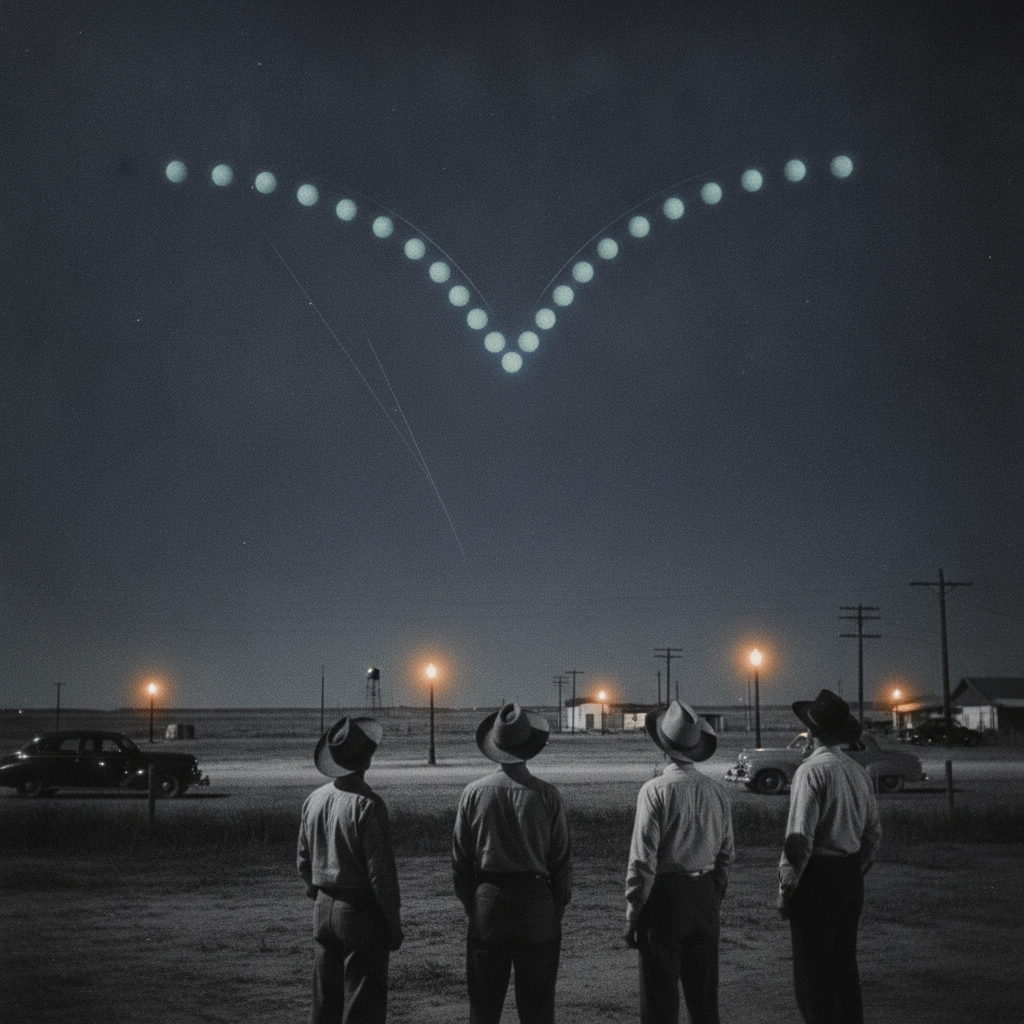
The Lubbock Lights: The Glowing Formations Over Texas That Scientists Saw and the Air Force Never Explained
On the evening of 25 August 1951, a few men were sitting in a backyard in Lubbock, a city on the flat plains of western Texas, in the United States.
They were professors at the local technical college: a geologist, a chemical engineer, the head of the petroleum engineering department, and at least one more. It was a warm night. They were drinking tea and talking shop. According to one account, the subject was tiny meteorites.
At about 9 o'clock, something passed over their heads.
It was a formation of lights. Between 15 and 30 of them, the accounts differ. They were bluish-green, softer than stars but larger. They were arranged in a curve, like a shallow letter V. They made no sound at all.
They crossed the whole sky in a few seconds and were gone.
The men looked at each other. None of them could say what it was.
About an hour later, it happened again. The same kind of lights, the same silence. This time they were not in a neat line but scattered.
What the mystery is
This is the case known as the Lubbock Lights.
Over about 2 weeks in the late summer of 1951, groups of glowing lights were seen crossing the night sky over Lubbock again and again. The first witnesses were trained scientists. A student took 5 photographs of them. The United States Air Force sent its chief investigator of unidentified flying objects, and he came back with an answer.
The question is whether that answer was right. Scientists who were there said no. And the photographs have never been explained.
The same night, 560 kilometres away
The professors were not the only ones who saw something that night.
According to the Air Force investigator's own later account, about 560 kilometres to the west, in Albuquerque, New Mexico, a man and his wife saw a large object fly over them in silence. It was shaped like a wing. Along its back edge were 6 to 8 pairs of bluish lights. The man worked for a laboratory that dealt with nuclear weapons, and he held a high security clearance. The investigator took that as a sign he was a careful witness.
About an hour later, back near Lubbock, the wife of a retired rancher said she saw a silent object glide over her house, with pairs of bluish lights along its back edge.
That same night, another Lubbock couple saw groups of lights pass overhead. A third group circled low over their house. This time they could see and hear what it was: birds. Plovers, a kind of wading bird.
Keep that detail in mind. It will matter.
The professors try to measure it
The professors did what scientists do. They told the local newspaper, and they started watching the sky.
Over the following weeks they said they saw the lights about 12 more times. The lights always flew from north to south. They tried to work out the speed. They set up 2 teams with walkie-talkie radios some distance apart, so that each team could note the angle of the lights at the same moment, and then calculate the height. It did not work well. They never got a reliable height.
On 5 September 1951, several of the professors were together again, this time with a mathematics professor. One witness that night described 12 to 15 lights, greenish-blue, slightly fluorescent, perfectly round, each the size of a dinner plate.
On one night a formation passed above a thin layer of cloud. The cloud gave them something to measure against. A later researcher recorded the result: if the cloud was at about 600 metres, the lights were moving at more than 950 kilometres an hour.
That number is only as good as the guess about the cloud. But it is far faster than any bird.
The student with the camera
On the evening of 30 August 1951, a first-year student at the same college was in his parents' backyard. His name was Carl Hart Jr. One source gives the date as 31 August.
He saw a formation of 18 to 20 white lights in a V shape pass over. He got his camera, a 35 mm Kodak.
The lights came back. He took 2 pictures. Then another formation passed, and he took 3 more.
The photographs show rows of bright points against a black sky, arranged in a curve.
He sold them to the local newspaper for 10 dollars. Within days they were printed across the country. In April 1952 a national magazine, Life, ran them in a long article on flying saucers.
The investigator arrives
By then the Air Force had a small office that collected reports of unidentified flying objects. Its chief investigator was a captain named Edward Ruppelt. In late September 1951 he flew to Lubbock.
He interviewed the professors. He interviewed the student. He spoke to other witnesses. By then hundreds of people in the city said they had seen the lights.
He noticed something. Very few of those witnesses had seen anything before they read about the professors in the newspaper.
A man from a nearby town suggested an answer: plovers. Lubbock had just installed new vapour street lights in 1951. The idea was simple. A flock of birds flies low over the city at night. Their white undersides catch the light from below and glow. From the ground, they look like a formation of lights moving in silence.
There was support for it. On 31 August a local farmer had seen birds flying over a drive-in cinema, with their bellies lit up by the lights. And the couple on 25 August had seen exactly that, close up.
The Air Force accepted the bird explanation for many of the sightings. The investigator also thought that some of the reports, like the wing-shaped object, might have been the Air Force's own experimental flying-wing bomber. But he could not explain why nobody heard its engines.
The scientists who said no
Not everyone accepted the birds.
The head of the college's biology department said the lights could not have been plovers. A game warden agreed. Plovers, they said, fly slower than what was seen, and in small groups, not formations of 20 or 30.
The professors who first saw the lights also rejected it. One of the witnesses said the objects were too big and too fast for any bird.
Then there were the photographs. The newspaper's chief photographer tried to reproduce them. He went out at night and photographed birds flying over the new street lights. He could not get anything like the student's pictures.
The Air Force sent the photographs to its own laboratory at an air base in Ohio. The result was a shrug. The investigator told the press that the photos were "never proven to be a hoax, but neither were they proven to be genuine."
And the professors themselves raised one more problem. The photographs showed the lights in a U shape. What they had seen was a V. Some readers in Lubbock wrote to Life after the article to say the same: the lights in the pictures did not look like what they had seen.
The answer nobody was told
In 1956 the investigator published a book about his years on the job. He gave the Lubbock Lights a full chapter.
He wrote that the professors' lights had been "positively identified" as a "commonplace and easily explainable natural phenomenon."
But he did not say what that phenomenon was. He wrote that he had promised the scientist who solved it that he would not reveal the method. So the official answer exists, but it has never been made public.
**This is where the documented record stops. The professors' lights were declared solved, but the solution was never published. The student's photographs were never solved at all.**
Conclusions and Open Questions
By the 1970s, according to an archivist at the college, nearly all the witnesses, including the professors, had stopped giving interviews. More than 40 years after that summer, the student told a researcher that he still did not know what he had photographed.
These are the explanations on the record.
**Birds lit by the new street lights.** This was the Air Force's answer. One couple saw and heard plovers that same night, and a farmer saw lit-up birds over a cinema. The problem: a biologist and a game warden said plovers fly too slowly and in groups too small. The newspaper's photographer could not photograph birds that looked like the pictures.
**A secret aircraft.** The investigator suspected that some reports, like the silent wing over Albuquerque, were the Air Force's own flying-wing bomber. The problem: a large bomber makes a lot of noise. Nobody heard anything.
**A natural phenomenon nobody named.** The investigator wrote that the professors' sighting was explained, by a scientist he would not name. The problem: an explanation that cannot be checked is not an explanation the public can judge. And it covered the professors, not the photographs.
**A hoax.** Some suggested the student faked the pictures. The problem: the Air Force's own laboratory found no proof of that. And he kept saying, for the rest of his life, that he did not know what he had seen.
So the open questions remain. What did the investigator's unnamed scientist find? Why do the photographs show a shape the professors did not see? And why could nobody, with the same camera and the same street lights, ever take another picture like them?