448 Pages Nobody Can Read: The Rohonc Codex
The book is small enough to hold in one hand. It measures roughly twelve by ten centimetres, it runs to 448 paper pages, and every page is packed with nine to fourteen rows of tight, hand drawn symbols. Nobody can read a word of it. The Rohonc Codex is one of the most stubborn unsolved documents in Europe, and after almost two hundred years of study the basic questions about it are still open: what language it records, what system its script uses, and whether it means anything at all.
Its documented history begins in 1838, when Count Gusztav Batthyany donated his family library to the Hungarian Academy of Sciences. The codex came with the collection. It takes its name from Rohonc, the town in western Hungary where the library was kept, now Rechnitz in eastern Austria. A catalogue of the Batthyany library from 1743 lists an item described as Hungarian prayers in one volume, and many researchers suspect that entry refers to the codex, pushing its documented existence back almost a century. Nothing before that has ever been traced.
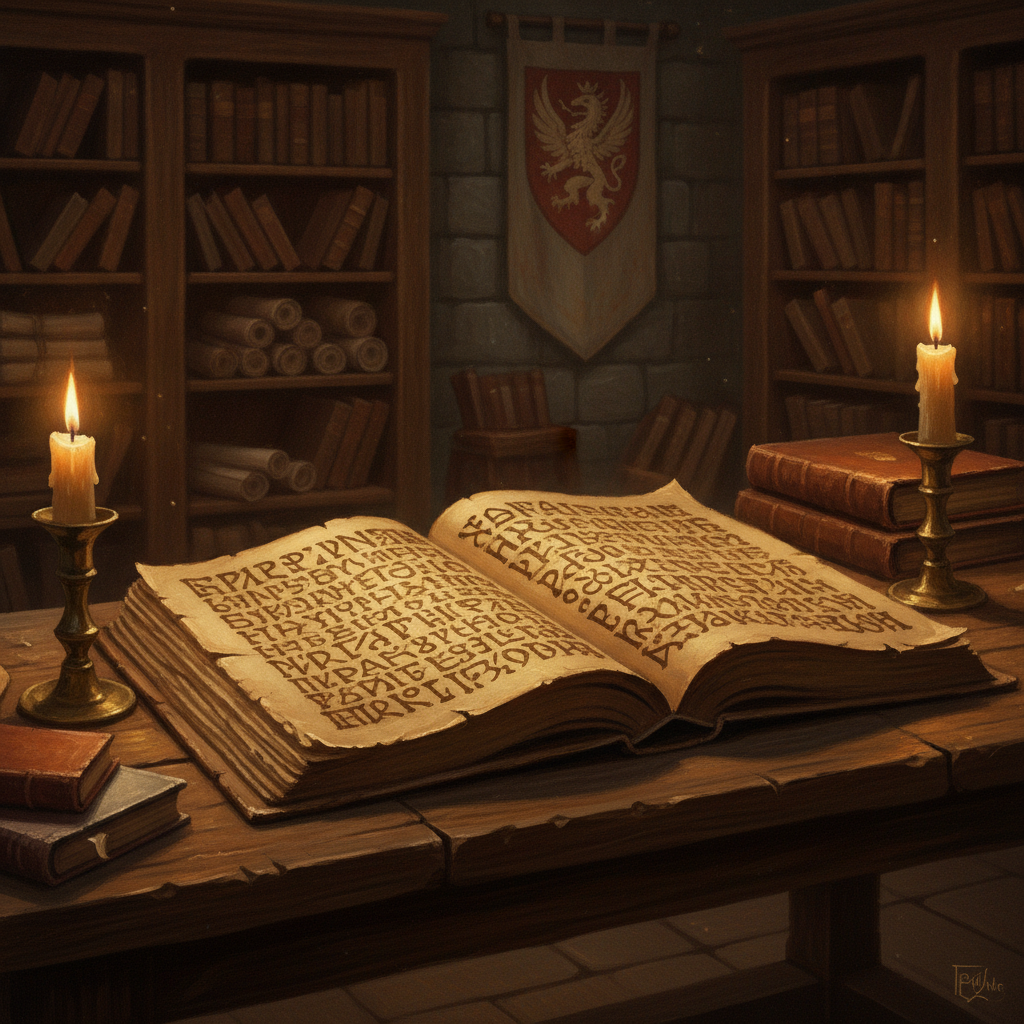
The script is the heart of the problem. The symbols are drawn by hand, sometimes carelessly, and they do not correspond to any known writing system: not Latin, Greek, Cyrillic, Hebrew, Arabic, the Old Hungarian runes, Brahmi or Glagolitic. The right hand margins of the text are justified while the left are ragged, which suggests the lines were written from right to left. The most awkward feature is sheer quantity. When Kalman Nemati produced a photographic copy in 1889 and counted the distinct shapes, he arrived at about 792. Later analysts, treating rare variants as versions of the same sign, reduce the working inventory to roughly 150 to 200 recurring symbols. Either figure is far too large for an alphabet. It points instead toward a syllabary, a set of word signs, or a deliberate code.
The manuscript is illustrated. Eighty seven drawings are scattered through the text, crude in execution but perfectly legible in subject. They show religious, everyday and military scenes: sieges, battles, landscapes, figures at prayer. Christian crosses appear repeatedly, and several images are recognisable as episodes from the Gospels. Alongside them appear Islamic crescents and sun symbols, a mixture that scholars have read as pointing to a region where Christian, Muslim and older folk traditions lived side by side, which fits the Hungarian and Balkan borderlands well enough.
The physical object gives one hard date. The paper carries watermarks that codicologists have matched to Venetian paper making of the 1530s, roughly the years 1529 to 1540. That establishes when the paper was made. It does not establish when anyone wrote on it, and blank sixteenth century paper could still be bought, inherited or stolen centuries later.
Serious study began almost immediately after the donation. The literary historian Ferenc Toldy examined the codex around 1840, followed by the linguist Pal Hunfalvy and the Austrian palaeographer Albert Mahl. In 1884 and 1885 the Czech scholars Josef and Konstantin Josef Jirecek, both professors at Prague, went through thirty two pages and concluded that the thing was a fake. In 1885 the codex was sent to Bernhard Julg at the University of Innsbruck. Between 1890 and 1892 the celebrated Hungarian painter Mihaly Munkacsy took it to Paris so that it could be studied there. Every one of these efforts ended the same way.
The forgery accusation is older than most of that work. In 1866 the historian Karoly Szabo proposed that the codex had been manufactured by Samuel Literati Nemes, a Transylvanian antiquarian and book dealer who died in 1842 and who is known to have produced historical forgeries during the 1830s, the exact decade in which the codex surfaced. It is a plausible fit and it has never been more than a suspicion. No document connects Nemes to the codex, no confession or workshop record has ever turned up, and the manuscript does not appear in the lists of his known fabrications. The theory nevertheless remains the mainstream position among Hungarian scholars.
Meanwhile the decipherers kept coming, and their results have very little in common. In 1996 the Hungarian Attila Nyiri turned the pages upside down, identified what he took to be a Sumerian ligature, and matched the symbols to Latin letters. He read the opening as a declaration that God had come and that the holy angels were present. The archaeologist Otto Gyurk replied that a method that loose could extract almost anything from the code.
In 2002 the Romanian philologist Viorica Enachiuc published a full reading. In her account the language is a Dacian dialect of vulgar Latin, written right to left and bottom to top, and the contents are a history of the Vlachs in the eleventh and twelfth centuries, complete with battles and diplomatic exchanges. Critics pointed out that her transliteration was not consistent: the same symbol was rendered differently in different places, which allows a translator to arrive at almost any desired text.
In 2004 Mahesh Kumar Singh, an Indian researcher, proposed that the script is a variant of Brahmi and the language a form of Hindi, and that the text is an apocryphal gospel. His reading of the opening lines was a lament that the people are poor, sick and starving, and a plea that they be given strength. The same objection was raised at once. Three different scholars had now read the same opening lines as three completely different sentences.
The most systematic modern work belongs to two Hungarians. Gabor Tokai published a series of studies from 2010, working from the imagery and its dating, and Levente Zoltan Kiraly followed in 2011 with structural analysis of the text itself. Working together, they identified a method for marking the ends of sentences, chapter headings that carry biblical references, distinct codes standing for the four evangelists, and a table of contents preceding a seven page section. In a 2018 article in the journal Cryptologia, titled Cracking the code of the Rohonc Codex, they argued that the manuscript is a Catholic devotional book, close in character to a breviary, containing paraphrases of the New Testament together with non biblical devotional material about Seth, Paradise and the Virgin Mary. They also proposed that the text contains the date 1593 as a reference to its own composition, and that the underlying language is most probably artificial.
Around them, the historian of science Benedek Lang set out in a 2010 Cryptologia article the framework most researchers now use. Rather than treating decipherment as a race, Lang laid out the realistic possibilities side by side and argued that the codex is best understood as a consciously encoded text rather than a meaningless fake.
The codex itself sits in the Library of the Hungarian Academy of Sciences in Budapest. Access to the original requires special permission; microfilm and digital copies are available, and in 2015 the University of Hamburg produced high resolution rescans of eight pages. The book has been photographed, indexed, statistically analysed and fed through computational tools. It has not been read.
Conclusions and Open Questions
Everything about the Rohonc Codex is contested except its measurements. Four broad explanations are on the table, and each is damaged.
The forgery theory, first proposed by Karoly Szabo in 1866 and still dominant in Hungarian scholarship, says that Samuel Literati Nemes or someone like him filled an old paper block with invented squiggles to sell to a credulous collector. Its weakness is twofold. There is no evidence tying Nemes to this particular object, and the internal regularities that Kiraly and Tokai have documented, consistent sentence markers, repeated codes for the evangelists, a functioning table of contents, are a great deal more work than a quick forgery requires. Fakers do not usually build working machinery inside a fake.
The cipher theory, developed by Benedek Lang, Levente Zoltan Kiraly and Gabor Tokai, holds that a real text in a real language was deliberately encoded, perhaps by a religious community that wanted its devotions kept private. This explains the structure and the religious pictures. Its weakness is that after decades of work no underlying language has been confirmed and no key has been found, and the symbol inventory remains uncomfortably large for a simple substitution system.
The artificial language theory, which Kiraly and Tokai lean toward, proposes that the script encodes a constructed language invented for the purpose. It fits an era when invented and philosophical languages were a genuine intellectual fashion. Its weakness is that it is close to unfalsifiable: a language with no external attestation cannot be checked against anything.
The exotic language theories, those of Attila Nyiri, Viorica Enachiuc and Mahesh Kumar Singh, each claim a known language hiding behind the symbols. Their shared weakness is fatal and easy to state. All three produced translations of the same opening lines, and the three translations have nothing whatever in common. In every case reviewers found that the transliteration rules were applied inconsistently, which is exactly what allows a determined reader to find a message that is not there.
What remains genuinely unexplained is narrower than the mystery industry suggests. Why does a manuscript of this size use several hundred distinct signs? Why does no second example of the script exist anywhere, in any archive, when scribal systems normally leave traces? Why do Christian crosses share the pages with crescents and sun symbols? And if the paper really is Venetian stock from the 1530s, what happened between the 1530s and the moment someone finally wrote on it?
The open questions are practical ones. A complete high resolution digitisation of all 448 pages, rather than eight, would let modern computational linguistics attack the sign frequencies properly. A second document in the same hand, if one is sitting unrecognised in a Hungarian or Austrian archive, would probably break the case open. And the 1593 reading proposed by Kiraly and Tokai needs independent confirmation before it can be treated as a date rather than a hypothesis. Until then the honest summary is the one the Academy Library itself would give: 448 pages, roughly two hundred recurring symbols, eighty seven pictures, and not a single sentence that anyone can prove they have understood.