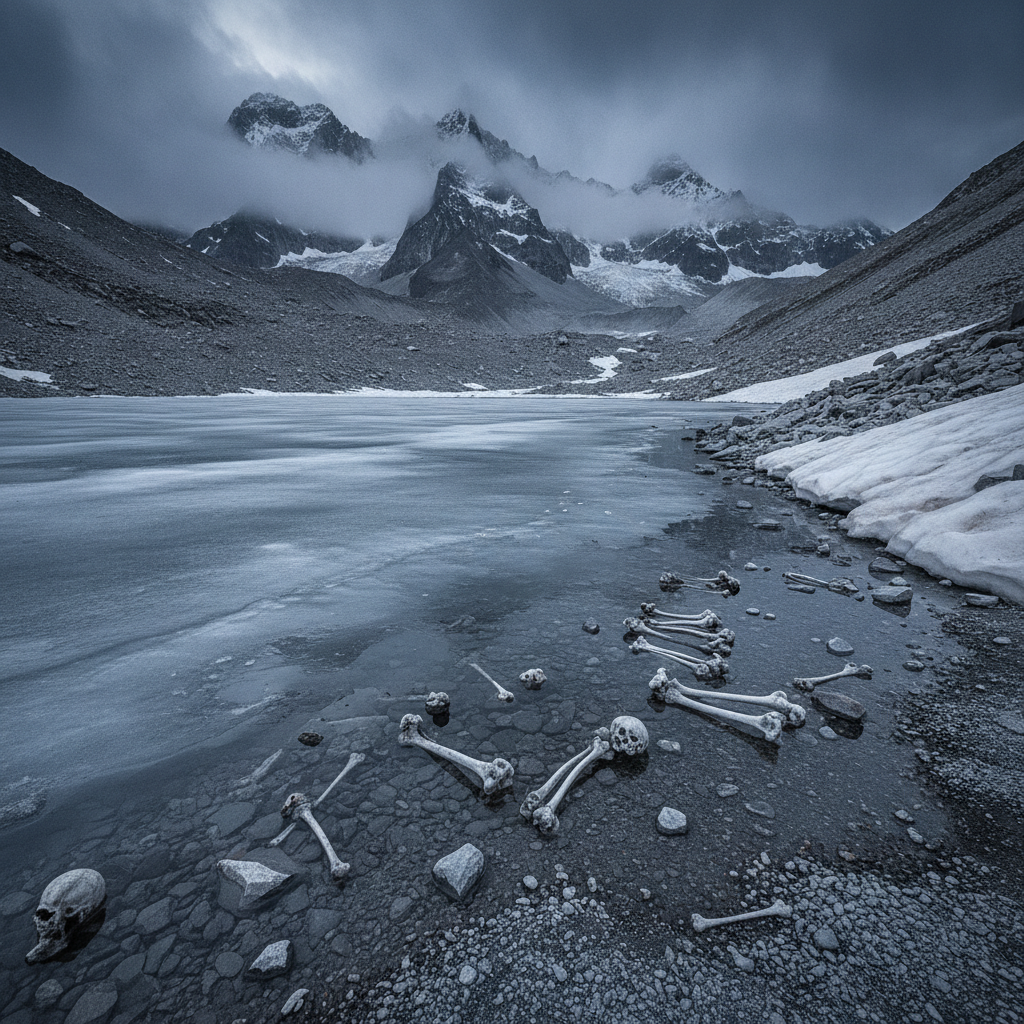
Five Hundred Dead at 5,020 Metres: The Bone Lake of the Himalaya
In the last days of summer the ice on Roopkund draws back from the shore, and the bones come out.
They lie in the shallows and across the scree around the rim: skulls, ribs, whole limbs still jointed, and among them wooden shafts, iron spearheads, scraps of leather and rings. The lake is small, roughly forty metres across in most descriptions and shallow enough to wade, set in a bowl of grey rock at 5,020 metres in the Indian Himalaya, between the peaks of Trishul and Nanda Ghunti. There is no village within two days of walking. There is no shelter, no firewood, and nothing that grows above knee height. For eleven months of the year the pool is frozen solid and the dead are invisible. Then the melt comes, and anyone who climbs the last ridge can stand at the water's edge and look down at several hundred people.
The bones were rediscovered for the outside world in 1942, when a forest ranger named Hari Kishan Madhwal, patrolling the Nanda Devi reserve for the colonial administration, reached the lake and reported what was lying in it. The timing could hardly have been worse. The war had reached the eastern edge of India, and the first official reaction was military: the authorities considered whether these could be the remains of a Japanese force that had tried to cross the mountains and died in the attempt. That idea did not survive contact with the bones. The skeletons were plainly old, weathered, and accompanied by no modern equipment at all. Whatever had killed these people, it had happened long before anyone in the valley below had heard of an aeroplane.
The shepherds of the surrounding districts had known about the lake for generations, and they had a name for it and a story to go with it. Roopkund lies on the route of the Nanda Devi Raj Jat, a pilgrimage to the shrine of the goddess Nanda Devi that is held roughly once every twelve years and involves a procession on foot over some of the hardest ground in the Himalaya. The song sung along that route tells of a king, Jasdhaval of Kanauj, who set out on the pilgrimage with his pregnant wife, Rani Balampa, and a large retinue. According to the story the party travelled in a manner the goddess found offensive, with dancers and music and celebration on sacred ground, and she answered by sending down a storm of hail as hard as iron. Nobody came back. The song is not a document, and there is no way to date it. But it names a mechanism, and for sixty years that mechanism did most of the explanatory work.
After independence, Indian institutions began collecting from the site. Bones were carried down by the sackload, along with the artefacts that lay among them. Radiocarbon work carried out at Oxford appeared to settle the date. It returned a figure of roughly 850 CE, plus or minus about thirty years, which sat close enough to the era of the legend to feel like confirmation. The picture that formed was tidy and easy to tell: a single doomed party, a single catastrophic storm, a single day some twelve hundred years ago.
In 2003 a National Geographic expedition went up to the lake and brought down around thirty skeletons for study, with the work filmed for a documentary broadcast the following year. The condition of the remains was startling. The cold and the dryness had preserved not only bone but hair, and in places flesh still adhered. The physical evidence that drew the most attention was a pattern of injuries. A number of the skulls carried short, deep compression fractures, and there were similar injuries to shoulders. The fractures were consistent with blows delivered from directly above by rounded objects, and inconsistent with weapons, with rockfall along a slope, or with a fall.
From that observation came the version of the story that has circulated ever since. A party caught in the open at 5,000 metres, with no overhang and no cover, struck by hailstones the size of cricket balls. Hail of that size is rare but recorded, and it kills. In the absence of shelter, a hailstorm above the treeline is one of the few natural events that could plausibly kill a large group in the space of minutes and leave that particular signature on their skulls. For a while the case looked closed.
Then, in 2019, a team of researchers published a genetic study of the site in the journal Nature Communications, and every part of the tidy version came apart at once.
The work drew on laboratories in India, Europe and the United States, including the ancient DNA laboratory of David Reich at Harvard Medical School and the Max Planck Institute in Germany, with Eadaoin Harney, Nick Patterson and Ayushi Nayak among the named authors. They recovered genome-wide data from thirty-eight individuals and dated the bones directly rather than relying on the earlier figure for the site as a whole.
The dead were not one group. They were at least three.
Twenty-three of the individuals carried ancestry that falls comfortably within the range of present-day South Asians. Their bones dated to around 800 CE, consistent with the old radiocarbon result. But the dating did not point to a single moment. The evidence indicated that these people had been deposited at the lake in more than one event, spread over a period of time rather than in one afternoon.
Fourteen of the individuals were something else entirely. Their ancestry was typical of the eastern Mediterranean, clustering with people from mainland Greece and Crete. Their bones dated to around 1800 CE, a full millennium after the group they were lying next to. Stable isotope measurements taken from their remains showed a diet with very little millet, which is inconsistent with having grown up in South Asia and consistent with a Mediterranean upbringing. Unlike the older group, they appear to have died together, in one event.
The thirty-eighth individual was different again: a single person whose ancestry pointed towards Southeast Asia, and who also dated to around 1800 CE.
The team also looked in the bones for the genetic traces of bacterial disease, since an epidemic had been one of the older proposals, and reported finding none.
So the lake contains a group of South Asians who died in stages around the ninth century, a group of people of Greek and Cretan ancestry who died together around the year 1800, and one individual of Southeast Asian ancestry who died at about the same time as the second group. And here the record simply stops. India around 1800 was one of the most heavily documented places on earth. There were East India Company records, missionary correspondence, princely state archives, traveller accounts, revenue surveys. A party of more than a dozen people from the eastern Mediterranean walking into the high Himalaya and never coming back should have left a paper trail somewhere. No such record has been found.
Conclusions and Open Questions
The hailstorm remains the strongest explanation for at least some of the deaths, and its strength is physical: the compression fractures on skulls and shoulders are real, they were delivered from above, and above the treeline there is no cover. Its weakness is that it now has to be told three times over. A storm that killed pilgrims in the ninth century cannot also have killed Mediterranean travellers a thousand years later, and a hypothesis that has to be repeated for every group in the lake explains rather less than it appears to.
The pilgrimage theory covers the older group well. The Raj Jat route passes near Roopkund, the older dead include both men and women of a range of ages, which is what a pilgrimage looks like and not what an army looks like, and the artefacts fit travellers rather than soldiers. Its weakness is the finding that these people were not deposited in a single event. That points away from one destroyed procession and towards a place where groups kept dying, over years or generations, on a route that people kept using.
That leads to a quieter theory that some researchers now favour: that Roopkund is not the scene of one disaster at all, but an accumulation. A high, exposed pass on a route that people had reason to walk, where the weather can turn lethal within an hour, will collect the dead slowly, and a frozen lake will preserve them and hold them in one place until they look like a single event. The strength of this reading is that it needs no special catastrophe. Its weakness is that it does not account for the 1800 group, who do appear to have died together.
The identity of the Mediterranean group is the hardest question and has no good answer. An old popular suggestion was that they were descendants of soldiers left behind by Alexander, but the genetics work against it: they cluster with present-day Greeks and Cretans rather than with a population long mixed into South Asia, and they date to about 1800, not to antiquity. One theory holds that they were members of a Greek community settled somewhere in the region who travelled into the mountains for reasons now lost. Another is that they were part of a larger expedition whose records exist but have not been connected to this site. Both are possible; neither has produced a document.
What is unexplained is easy to state and hard to work on. Nobody knows who the fourteen were, why they were at 5,020 metres, why one person of Southeast Asian ancestry died with them, or why an event of that size around 1800 left no trace in the archives of a heavily administered country. Nobody knows how many separate deaths the older group represents, or over how long. And because the bones have been moved and removed for eighty years, some of the evidence that could have answered these questions no longer exists in the place where it would have meant something.