The Grave on Taongi: Nine Years, Two Thousand Miles, and a Cross Made of Driftwood
The water in Hana Bay was so flat on the morning of February 11, 1979 that the men who watched the Sarah Joe motor out would later say the sea looked like a lake. It was a Sunday on the windward side of Maui. The sky over the Alenuihaha Channel was clean, the trade winds were asleep, and five men loaded a seventeen foot boat with fishing gear and a cooler and pointed the bow toward the fishing grounds. They expected to be home for dinner.
The Sarah Joe was a small open motorboat with an eighty five horsepower engine on the transom. She carried no life raft, no emergency beacon and no long range radio. In Hana in 1979 that was ordinary. Men went out for a few hours in good weather and came back, and had done so for as long as anyone could remember.
The five were Ralph Malaiakini, twenty seven, a Hana man with a twin brother named Robert. Scott Moorman, also twenty seven, who had grown up in Massachusetts and moved to Maui chasing a version of Hawaii he had seen on television. Benjamin Kalama, thirty eight. Patrick Woessner, twenty six. Peter Hanchett, thirty one. Between them they knew the water in front of Hana as well as anyone alive.
The Alenuihaha Channel, which separates Maui from the island of Hawaii, is one of the roughest stretches of water in the world. The trade winds pile against Haleakala on one side and Mauna Kea on the other and accelerate through the gap like air through a nozzle. On a bad day the channel produces short, steep, breaking seas with very little warning. February 11 became a bad day. By one in the afternoon the wind had risen to gale force. By evening a squall was running through, with seas that searchers later put at forty feet.
The Coast Guard was notified that same afternoon. What followed was one of the largest searches in the modern history of the islands: cutters and aircraft, military planes, private boats and hundreds of volunteers from Hana and beyond. The search covered roughly fifty six thousand square miles of ocean. Volunteers walked the coastlines of the neighbouring islands looking for anything that had washed ashore. One man who took his own boat into the channel described the swell lifting his hull until the vessel was going vertical.
After about five days it was called off. Nothing had been found. No hull, no cooler, no life jacket, no fuel can, no slick. Five men and a seventeen foot boat had gone into the channel and the ocean had closed over them without leaving a receipt.
In Hana, which is small and remote and where families are tied together by blood and marriage, the absence settled in and stayed. There were no bodies, so there was no funeral that felt like one. Children grew up asking what would happen if their father came back.
Nine years and seven months later, in September 1988, a researcher named John Naughton stepped onto a beach two thousand miles away.
Naughton worked for the National Marine Fisheries Service and was surveying wildlife in the northern Marshall Islands. He had also taken part, in 1979, in the search for the Sarah Joe. The island he came ashore on that day was Sibylla, one of the islets of Taongi Atoll, the northernmost atoll in the Marshalls and one of the emptiest places in the Pacific. Taongi is uninhabited. It has no fresh water and almost no shade. Ships do not stop there.
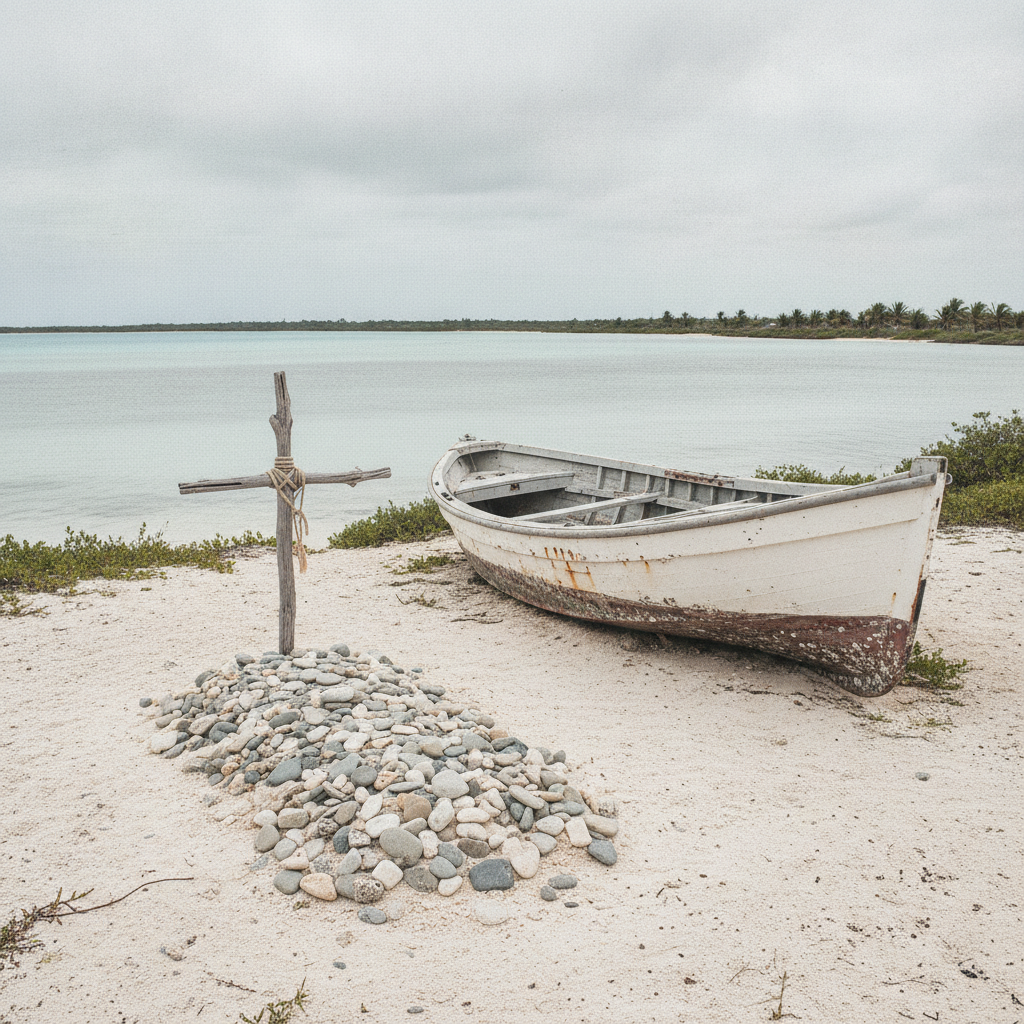
On the beach was a wrecked boat. It was small, open and battered, and it still carried Hawaii registration numbers on the hull. Naughton read them and understood what he was looking at before he had finished. The registration and the engine numbers matched the Sarah Joe. She had come to rest 2,054 miles from the ramp at Hana Bay.
That should have been the end of the story. A boat swamped in a storm, emptied of its crew, drifting west for years on the current until it grounded on a reef, is sad but not strange. It was not the end of the story, because of what lay a short distance from the wreck.
Someone had dug a grave. It was shallow and covered over with stones, and standing at it was a cross that had been made out of pieces of driftwood. Under the stones were human bones, including a jaw. They were flown back to Hawaii and compared against dental records, and they belonged to Scott Moorman.
Near the grave, partly buried, was one more thing that nobody has ever satisfactorily explained: what looked like a pad of blank notepaper, its sheets interleaved with thin sheets of aluminium foil.
There was no second grave. There were no remains of Benjamin Kalama, Patrick Woessner, Peter Hanchett or Ralph Malaiakini, on Taongi or anywhere else. There was no shelter, no fire ring, no sign that anyone had camped and waited. There was one wrecked boat, one buried man, one cross, and a stack of foil and paper.
In 1990 Robert Malaiakini went to Taongi himself, together with the former Hawaii television fishing host Hari Kojima and a private investigator named Steve Goodenow. They searched the atoll. They came home with nothing that closed the case.
Conclusions and Open Questions
The journey of the boat is the least mysterious part of the case. The prevailing surface current in that part of the Pacific runs westward, and an abandoned hull is exactly the kind of object that drifts thousands of miles over years. Taongi sits more or less downstream of Maui. Nobody has had much trouble accepting that the Sarah Joe could get there on her own. The difficulty begins with the grave.
A grave means a person. Somebody found the body of Scott Moorman on an uninhabited atoll, carried it above the tide line, dug into coral sand, covered it with stones and made a cross out of driftwood. That is not the work of an accident. It is a burial, performed with some care, by a person or people who then said nothing to anyone for years.
The theory that has attracted the most support was put forward by the investigator Steve Goodenow, and it is that foreign fishing crews working illegally in Marshallese waters found the wreck and the body, buried it, and kept quiet because reporting it would have meant admitting where they had been. The strength of the idea is that it explains both halves of the puzzle at once, the burial and the silence. It also speaks to the strangest object at the scene, because sheets of paper interleaved with metallic foil closely resemble joss paper, the ceremonial money laid out or burned for the dead in Chinese funeral custom. Its weakness is that the entire chain is inference. No crew has ever come forward, no vessel has ever been identified, and the reading of the paper and foil as joss paper is an interpretation offered by researchers, not a finding confirmed by anyone who examined the objects at the time.
A second theory holds that Moorman was buried later by the crew of a passing yacht or research vessel who assumed the authorities already knew. This has the same weakness in sharper form. Small boats do occasionally call at remote atolls, but a sailor who buries an unknown man under a cross and then never mentions it to a harbourmaster, a consulate or a newspaper is behaving very strangely indeed.
A third possibility, and the one the families have had to live with, is that one or more of the other four survived the crossing with Moorman, buried him on the beach, and then died themselves on the atoll or in the water around it. Nothing at the site supports this and nothing rules it out. Against it stands the absence of any camp, any fire, any second set of remains and any attempt to signal for help.
Threaded through all of this is a claim that, if correct, damages every version of the story. Several accounts, including some given by relatives of the crew, state that a survey team visited Taongi a few years before Naughton and reported nothing unusual. A wrecked boat on a beach and a grave marked by a cross are not easy to overlook. If that earlier report is accurate and complete, the Sarah Joe reached Taongi long after she disappeared, and Moorman was buried later still. It should be said plainly that the claim has never been resolved. The underlying survey record has not been published or examined in public, Taongi is a ring of low islets and a party ashore for a day does not walk all of them, and the story may simply be wrong. It is set down here because the case cannot be honestly summarised without it, not because it has been verified.
What is left is a short list of things nobody can answer. Where the Sarah Joe was during the years she was missing. Who dug the grave, and why that person never spoke. What the foil and the paper were doing beside it. And where, in two thousand miles of open ocean, the other four men from Hana Bay went. The bones came home and were buried again on Maui. The other four are still out there.