The Shroud of Turin: The Cloth That Refuses to Give Up Its Age
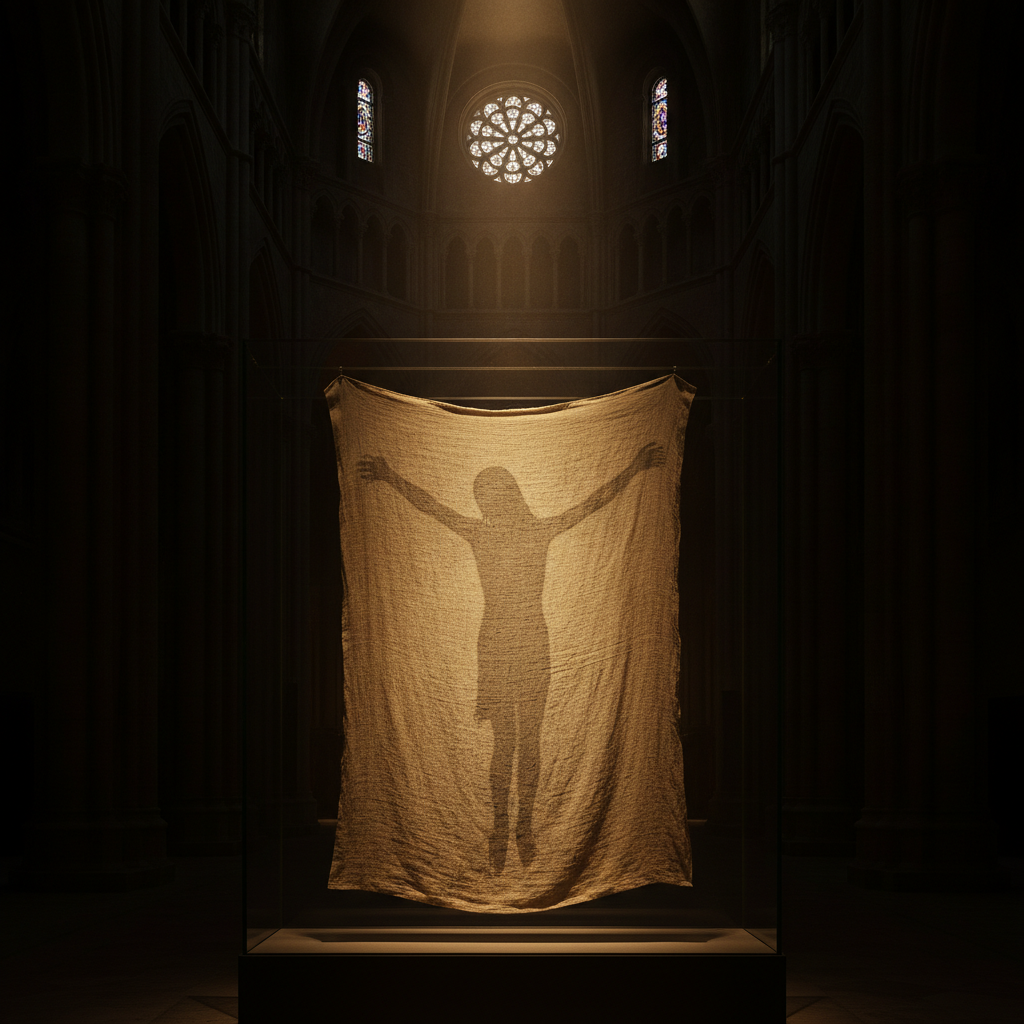
In a side chapel of Turin Cathedral, behind bulletproof glass, a strip of linen lies flat inside a sealed case flooded with inert gas. It is about 4.4 meters long and 1.1 meters wide, woven in a herringbone twill. On it, so faint that a visitor who leans in too close can lose it altogether, floats the front and back image of a naked man laid out as if for burial. He is bearded, his hands folded over his groin, and darker stains the color of old rust run across his forehead, down his side, and through his wrists and feet. This is the Shroud of Turin, among the most examined objects on earth and the least settled.
The physical description is not in dispute. The image is superficial: it rides on the topmost fibers of each thread and does not soak into the cloth. There are no brush strokes, no outline and no pooling of any medium. The stains that read as blood lie beneath the image rather than on top of it. Examiners have described the marks as consistent with scourging, with a wound in the side of the chest, and with nails driven through the wrists rather than the palms.
The cloth enters the written record late. It appears in the 1350s at Lirey, a small village in the French region of Champagne, in the hands of the family of Geoffroi de Charny, a knight who died at the battle of Poitiers in 1356, and it was displayed in the collegiate church he had founded. Pilgrim badges cast for those showings survive, including one in the Musee de Cluny in Paris that depicts the cloth held up between two coats of arms. Around 1389 the local bishop, Pierre d'Arcis, sent a memorandum to the Avignon pope Clement VII objecting to the exhibitions. He wrote that a predecessor, Bishop Henri of Poitiers, had investigated an earlier display, that the image was the work of a human artist, and that the painter had been identified and had confessed. No confession document survives; the memorandum is the only source for it. Clement VII did not stop the displays; he ruled that the cloth could be shown provided it was announced as a representation rather than the true burial cloth of Christ.
In 1453 Geoffroi's granddaughter Margaret de Charny transferred the cloth to Louis, Duke of Savoy, and it was kept at the Sainte-Chapelle in Chambery. On the night of 4 December 1532 fire broke out there. The heat melted part of the silver reliquary in which the folded linen was stored, and molten metal burned through the layers, leaving a symmetrical line of scorch holes still visible today. Water used to fight the fire left further stains. In 1534 Poor Clare nuns sewed triangular patches over the burns and stitched a full backing cloth of Holland linen to the reverse. In 1578 Duke Emmanuel Philibert moved the relic to Turin, where it has remained ever since.
For three centuries afterward it drew devotion and little study. Then, on the evening of 28 May 1898, during an exposition in Turin, an Italian lawyer and amateur photographer named Secondo Pia was permitted to photograph it. When he lifted the glass plate from the developing bath, the vague brown smudge on the linen had resolved, on the negative, into a coherent and almost sculptural human face. The stain on the cloth behaves like a photographic negative, with light and shadow reversed. Pia's plates were immediately challenged as a darkroom artifact, but in 1931 the professional photographer Giuseppe Enrie repeated the work under controlled conditions and obtained the same effect, and the negative property is now accepted by researchers on every side.
Direct scientific access came slowly. In 1969 and 1973 the archbishop of Turin convened small commissions to examine the cloth, and the Belgian textile specialist Gilbert Raes was given a sample cut from an edge. The Swiss criminologist Max Frei pressed adhesive tape to the surface in 1973 and again in 1978 to collect dust and pollen. The largest examination took place in October 1978, when a team of about thirty American and Italian scientists working as the Shroud of Turin Research Project, or STURP, ran roughly 120 hours of continuous testing on the cloth itself using X-ray fluorescence, infrared and ultraviolet spectroscopy and photomicrography. Their published conclusion was that they had found no paint layer capable of accounting for the image, and their forensic specialists reported that the reddish stains were consistent with human blood.
In March 1983 the exiled former king Umberto II of Italy died and left the Shroud to the Holy See in his will, making the Vatican its outright owner for the first time. Five years later the Church authorized a radiocarbon test. On 21 April 1988 a single strip about the size of a postage stamp was cut from one corner of the cloth and divided among three laboratories: the University of Arizona in Tucson, the Swiss Federal Institute of Technology in Zurich and the University of Oxford. A fourth portion, the Riserva, was retained by the archbishop. Working independently, Arizona reported an age centered near 646 radiocarbon years before present, Zurich near 676 and Oxford near 750. The combined calibrated result was announced at press conferences in Turin and London on 13 October 1988 and published in the journal Nature the following February: a range of 1260 to 1390 AD at 95 percent confidence, placing the flax in the same century in which the cloth first appeared at Lirey.
The Shroud has since survived one emergency and one major intervention. On the night of 11 April 1997 fire broke out in the Guarini Chapel where it was kept, and a Turin firefighter named Mario Trematore broke through the bulletproof glass with a sledgehammer and carried the case clear. The linen was undamaged. In 2002 the Vatican commissioned a restoration by the Swiss textile conservator Mechthild Flury-Lemberg, who removed the 1534 patches and the Holland backing cloth and mounted the linen flat. It has been kept horizontal in a sealed case ever since and shown publicly only rarely, with modern expositions in 1998, 2000, 2010 and 2015. The Catholic Church has never issued a ruling on whether the cloth is authentic. Successive popes have venerated it and described it as an icon, an image offered for contemplation, while leaving the question of its origin formally open.
Conclusions and Open Questions
Everything above is documented. Almost everything that follows is contested.
The 1988 radiocarbon date is the heaviest item in the file. Its defenders point out that three independent laboratories, blind to one another, converged on the same answer, and that it matches the documentary record: the cloth surfaces at Lirey in the 1350s and a bishop reports a painter's confession within a generation. The weakness is that no confession document survives, and that the d'Arcis memorandum is a hostile secondhand account written during a jurisdictional quarrel.
Several researchers have challenged the sample rather than the method. Raymond Rogers, a chemist from the 1978 STURP team, reported in 2005 that fibers from the tested corner contained cotton, a dye and traces of vanillin absent from the main body of the cloth, evidence he read as an invisible medieval repair that would drag the date forward. In 2019 a team led by Tristan Casabianca obtained the laboratories' raw measurements through a legal request and argued that the individual results were less statistically homogeneous than a single uniform sample should be. The weakness is just as plain: no such repair is recorded anywhere, expert weavers dispute that an invisible mend of that size is possible, and the simplest explanation for three laboratories agreeing is that all three dated the same linen.
A rival clock appeared in 2022, when the Italian researcher Liberato De Caro and colleagues used wide angle X-ray scattering to measure the structural breakdown of the flax cellulose and reported that the Shroud's molecular aging resembled linen from Masada in Israel, dated to 55 to 74 AD. The method assumes a known history of temperature and humidity, and the Shroud has spent centuries in unknown conditions, including the 1532 fire. De Caro's team asked other laboratories to reproduce the result; none has published a confirmation.
The image carries its own competing explanations. The microscopist Walter McCrone argued from tape samples that it was a dilute red ochre and vermilion grisaille in gelatin tempera, a painting and nothing more; the objection is that the STURP instruments found no such layer. The art historian Nicholas Allen proposed that a medieval craftsman used a camera obscura, a quartz lens and a light sensitive silver salt to project an image onto the linen, which would explain the negative property; the objection is that no such apparatus or workshop has ever been found. The engineer Giulio Fanti has argued for a burst of energy that scorched the surface fibers; Rogers replied that such a discharge leaves chemical signatures on linen that are not present here.
Other threads pull toward antiquity without settling anything. Max Frei reported pollen from plants that grow around Jerusalem and on the Anatolian steppe, but he worked largely alone, his samples were never verified by others, and he had earlier authenticated the forged Hitler diaries. The Hungarian Pray Codex, dated to about 1192 to 1195, shows a crucified figure with crossed hands on a cloth marked with an L shaped pattern of holes; some argue this proves the Shroud existed before 1260, others that shared artistic convention explains it. Some researchers say the Sudarium of Oviedo's bloodstains match the Shroud's face, though that is not independently confirmed.
What remains unexplained is stubborn. Why does the image behave like a photographic negative five centuries before photography? Why is there no medium? Why does the blood lie under the image rather than over it? Two dating techniques return two irreconcilable answers, and the cloth cannot be resampled without permission that has not been granted. For those who venerate it, the Shroud is an icon whose meaning does not depend on a laboratory. For everyone else it is an unusually well studied object that has not given up its age.