It Is Ended: The Nameless Man on Somerton Beach
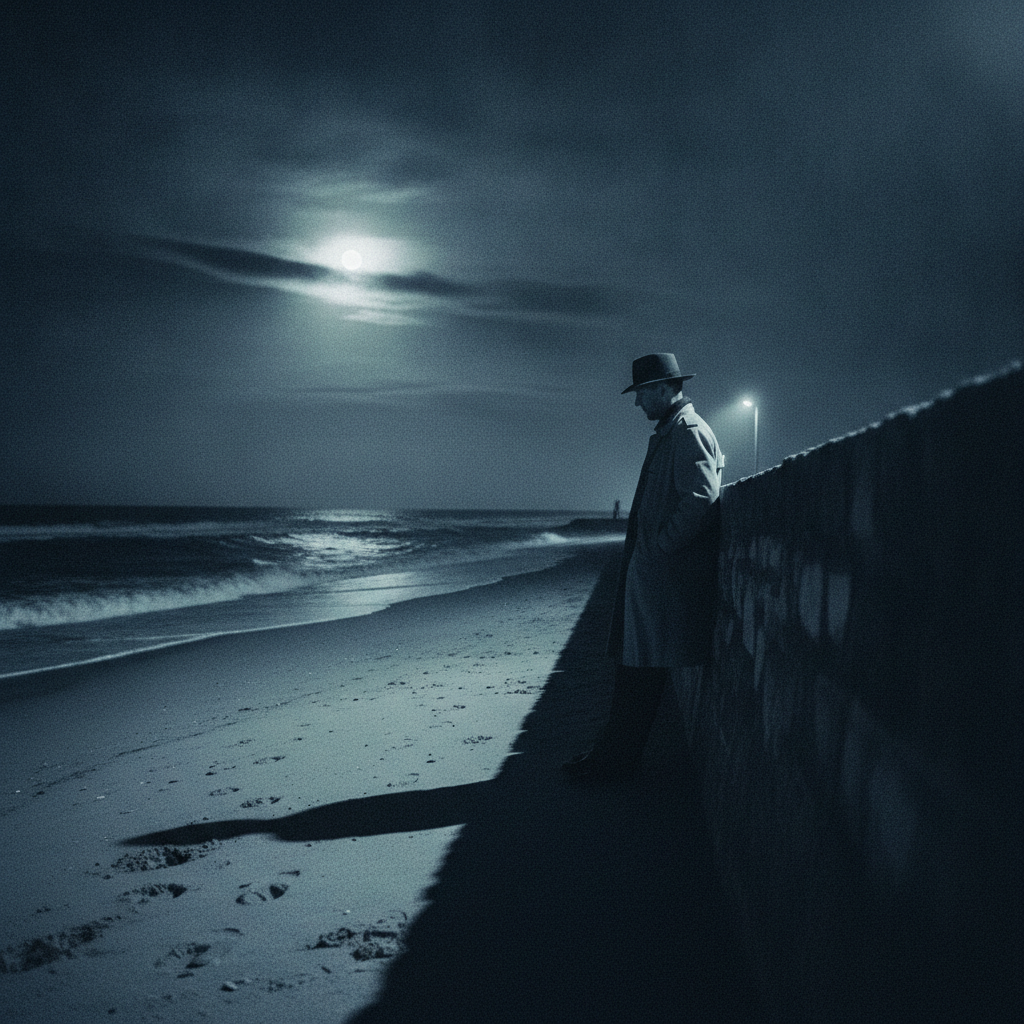
On the evening of 30 November 1948, the last night of the southern spring, a well dressed man lowered himself onto the sand against a stone seawall at Somerton Beach, a few miles south of Adelaide. A jeweller and his wife walking along the esplanade noticed him at around eight o'clock; they saw his arm lift and then drop. A young couple saw him too, lying motionless. At half past six the next morning, a man exercising his horse found the stranger slumped in the same spot, head against the wall, legs crossed, an unlit cigarette resting on his collar as though it had fallen from his lips. He was dead. There was no mark of violence and no sign of a struggle.
He carried nothing that could identify him. His pockets held a used bus ticket, an unused rail ticket to the nearby resort of Henley Beach, a comb, a packet of chewing gum, a box of matches and a quarter full packet of Army Club cigarettes that contained cigarettes of a more expensive brand. There was no wallet. There was no hat, which was unusual for a man of that era. And when investigators examined his clothing, they found that the labels had been cut from every garment.
In January 1949 the police connected him to a brown suitcase that had been checked into the cloakroom at Adelaide railway station on the morning of 30 November. Most of the clothing inside had also had its labels removed, although a few items carried the name Keane. The case held a stencilling brush, a table knife, a pair of scissors and a card of orange waxed thread of a type not sold in Australia, which matched a repair to the pocket of the trousers the dead man was wearing.
The body itself deepened the puzzle. He was about forty to forty five, tall, broad shouldered and narrow waisted, in what the pathologist called top physical condition, with high, wedge shaped calf muscles of the kind seen in dancers or in men accustomed to boots with a raised heel. He was missing eighteen teeth, and he lacked two lateral incisors through a rare genetic trait shared by only a small fraction of people.
Inside, the pathologist John Dwyer found deep congestion, a stomach engorged with blood, a liver damaged at its core and a spleen roughly three times its normal size. It looked like poisoning. Every toxicology test came back clean. Dwyer concluded that he was convinced the death could not have been natural, and that the likely agent was a barbiturate or a soluble hypnotic that had broken down before it could be measured. The inquest heard that digitalis and strophanthin were the most likely candidates, and that both decompose quickly in the body. It closed without naming the man or his cause of death.
In the middle of 1949 came the detail that would give the case its name. Sewn into a small, hard to find fob pocket in the dead man's trousers was a tightly rolled scrap of paper. Printed on it in an ornate typeface were two words: Tamam Shud. The phrase is Persian for it is ended, and it closes the Rubaiyat of Omar Khayyam, the medieval sequence of verses about wine, mortality and the futility of chasing meaning. The paper had been torn from the last page of a real copy of the book.
Police appealed for that copy, and a man came forward. Months earlier, around the time of the death, he had found a rare edition of Edward FitzGerald's translation tossed onto the back seat of his unlocked car, which was parked near the beach. The torn final page matched the scrap exactly.
Two things had been pressed faintly into the back cover of the book. The first was five lines of capital letters, scrawled and then partly struck out, reading approximately WRGOABABD, MLIAOI, WTBIMPANETP, MLIABOAIAQC, ITTMTSAMSTCAB. Naval code experts, national agencies and generations of amateur cryptographers have worked on the string ever since, without agreeing even on whether it is a cipher, a set of initial letters, or meaningless. The second imprint was a telephone number. It belonged to a young nurse who lived a few hundred metres from where the body was found.
Her name was Jessica Thomson, known to friends as Jo and to the case as Jestyn. When detectives showed her a plaster cast of the dead man's face, witnesses said she seemed close to fainting, yet she insisted she did not know him. During the war she had owned a copy of the Rubaiyat and had given it to an army officer named Alfred Boxall. Detectives traced Boxall and found him alive, still holding the book Jo had given him, its final page intact. Decades later her own daughter said she believed her mother had known the dead man's identity and had taken it to her grave.
The man was buried in West Terrace Cemetery in Adelaide beneath a headstone that recorded him as unknown. Public interest never faded, and in 2021 South Australia Police exhumed the body for DNA testing.
In 2022 came the answer many had stopped expecting. Derek Abbott, an engineering professor at the University of Adelaide who had studied the case for years and who had married one of Jo Thomson's granddaughters, worked with the American forensic genealogist Colleen Fitzpatrick. Using hairs preserved in the plaster death mask and a family tree built out to some four thousand relatives, they proposed a name: Carl Charles Webb, an electrical engineer and instrument maker born in Melbourne in 1905, the youngest of six children. Webb wrote poetry, gambled on horses, suffered dark moods and a failing marriage, and disappeared from the record after his wife left him in 1947. The identification has been widely reported and is documented in detail, but the South Australian authorities have still not officially confirmed it, and the coroner's file remains open.
Conclusions and Open Questions
A name is not an explanation, and three readings of the death still compete.
The espionage reading is the most widely repeated. It was advanced by Cold War era commentators and revived by many later writers, and it draws its force from the setting: the case broke as the Cold War hardened, and Adelaide lay close to the Woomera rocket range, a hub of secret Anglo-Australian weapons testing that Soviet intelligence wanted to penetrate. A body stripped of labels, an undeciphered string of letters, a book of poetry that could serve as a signalling device and a telephone number leading to a woman who nearly fainted can all be read as tradecraft. The weakness is that no hard evidence supports it. No agency has ever claimed him, the letters have never been shown to carry a message, and an agent who left a contact's telephone number embossed in his own book would have been remarkably careless.
The plainest reading is suicide, and it is close to the view of Gerald Feltus, the retired South Australian detective who reinvestigated the case and published a book on it; he has pointed to a personal connection rather than a political one. Tamam Shud, it is ended, sewn against the body, reads like a note reduced to two words, and Carl Webb, if it was he, was a depressive man abandoned by his wife and drawn to a poem about the pointlessness of striving. The weakness is that suicide does not explain who cut the labels from his clothes, why no bottle, syringe or container was found beside him, or how the drug left no measurable trace at all.
The third reading, which the 2022 identification quietly supports, is that he was nobody extraordinary: an estranged husband who travelled to Adelaide, perhaps to find a woman he cared for or to die near her, and who died of causes the science of 1948 could not read. Abbott himself has said he does not believe Webb was a spy. On this view much of the intrigue is coincidence magnified by decades of retelling. Its weakness is that it leaves the strangest specifics untouched, among them the cut labels, the hidden pocket and Jessica Thomson's reaction.
Several things remain unexplained whichever reading is preferred. No poison was ever identified. The labels were removed from his clothes and from most of the clothing in the suitcase, which is not something a man ordinarily does to himself without a reason no one has found. The letters on the back cover have resisted seventy years of analysis. The timeline is contested, because witnesses may have seen him alive hours after the pathologist believed he was already dead. And the identification itself, however persuasive, has not been confirmed by a coroner.
The open questions are simple and stubborn. Who cut the labels? How did a private telephone number come to be pressed into a book connected to his death, when the woman who held that number lived a two minute walk away and swore she had never met him? What, if anything, do the five lines of letters mean? Some argue the string is a cipher still waiting to be broken. One theory holds that it is a mnemonic, the initial letters of lines of verse or of a private farewell, meaningful only to a man now dead and therefore permanently locked. Seventy eight years on, we may know this man's name and still not know his story.