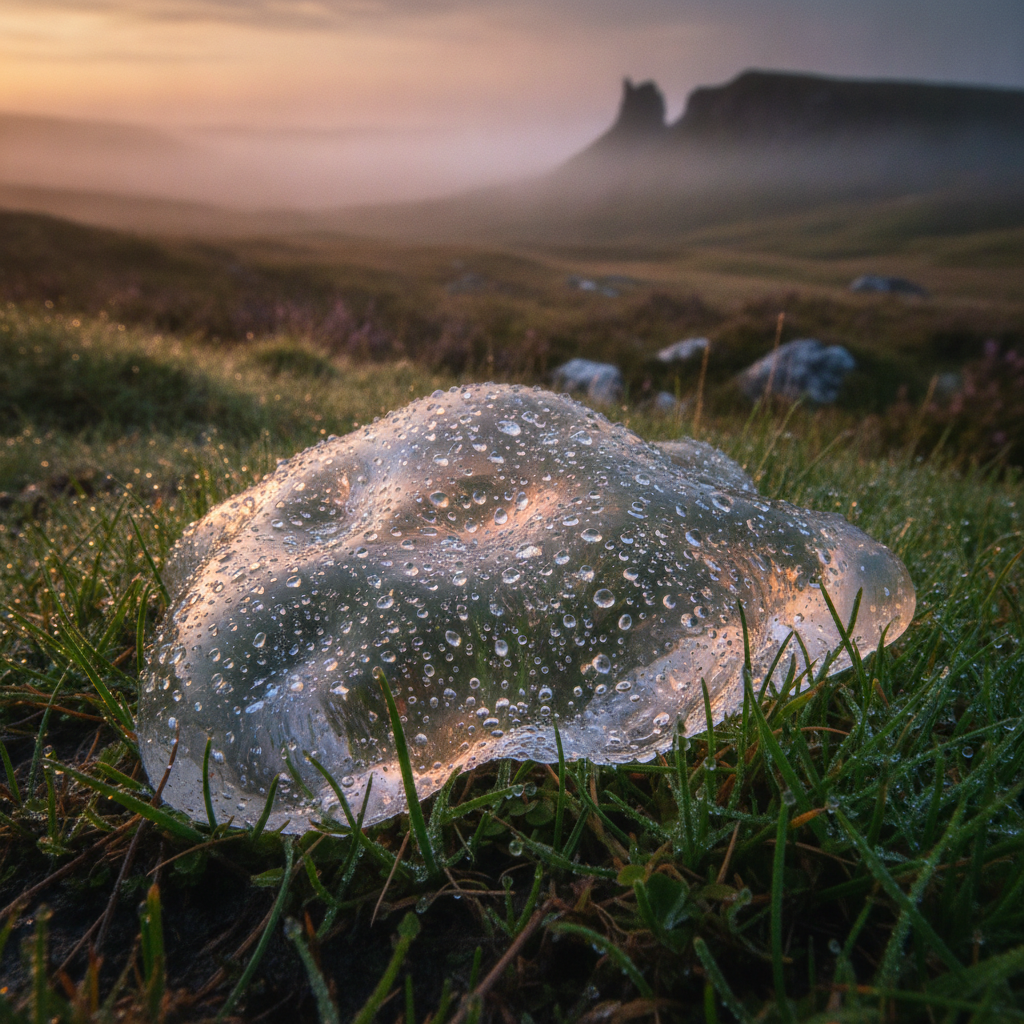
Star Jelly: The Sky Slime That Science Keeps Failing to Name
On a raw autumn morning in 2009, a hillwalker crossing the moors of the Scottish Highlands stopped at something that did not belong. Scattered across the wet grass lay clumps of a pale, translucent jelly, cool to the touch and quivering faintly when nudged, holding no shape of their own and belonging to no plant or animal he could name. There had been shooting stars in the night sky. He did what people in that position have done for the better part of seven centuries. He looked up, and assumed that a fragment of the heavens had fallen in the dark.
The assumption is old enough to carry a medieval name. The English physician John of Gaddesden, who lived from around 1280 to 1361 and served the court of Edward II, described in his writings a mucilaginous substance found lying upon the ground, which the Latin of his day called stella terrae, the star of the earth, and which he recommended as a treatment for abscesses. The Welsh had their own word, pwdre ser, which translates bluntly as the rot of the stars. An English-Latin dictionary from around 1440 lists sterre slyme. The name changed from tongue to tongue, but the idea beneath it held steady: that the jelly and the meteors were one and the same, and that what burned overhead at night could be found cold and formless on the grass at dawn.
Poets kept the belief in circulation long after physicians had moved on. Sir John Suckling, writing in 1641, imagined a man chasing a false star only to catch a jelly in his hands. John Dryden, in 1679, wrote of a man being cheated with a jelly for reaching after a fallen star. Sir Walter Scott, in his novel The Talisman, dismissed a shooting star as nothing more than some foul jelly. Across three centuries of English letters the same small joke recurs, and behind the joke sits a genuine folk conviction: that ordinary people, again and again, walked out after a meteor shower and found something waiting on the ground.
The blobs themselves are not folklore. They keep turning up in the modern record, on the hills of Scotland in the autumn of 2009, on lawns, playing fields and moorland across Britain, North America and beyond, almost always after rain or during the damp months of the year. They are usually colourless or faintly white, soft and gelatinous, sometimes no bigger than a coin and sometimes spread in a scatter of fist-sized lumps. They are also fugitive. They appear without warning and are gone within a day or two, dried to a papery smear or washed away by the next shower.
A few episodes entered the record in unusual detail. In August 1994 the small town of Oakville in Washington State was spattered, over a period of weeks, by a soft gelatinous material that residents said fell with the rain. Some of them reported a spell of illness in the town at the same time. No cause was ever firmly established, and no laboratory result settled what the material was.
In 1979 a woman named Sybil Christian found purple blobs in her garden in Frisco, Texas, on the morning after a meteor shower. For a moment the old legend appeared to be confirmed. Investigators then followed the trail to a battery reprocessing plant down the road, where the caustic soda used in the recycling process accounted for both the colour and the chemistry. The Frisco blobs had come from a factory, not from the sky.
When scientists get samples onto a laboratory bench, the answers are usually earthbound. A great many of the masses turn out to be the swollen remains of frog or toad spawn. Female amphibians carry a glycoprotein in their oviducts that has an extraordinary appetite for water. When a heron, a fox or a crow eats the animal and abandons the jelly-bearing organs, that material absorbs rain and swells into a translucent heap far larger than the innards it came from. Field observations in Scotland have supported exactly this origin, with observers finding the discarded remains of amphibians lying beside the jelly.
Other masses have been identified as colonies of Nostoc, a cyanobacterium that lies invisible and dry on the ground until rainfall swells its gelatinous sheath into a green-brown jelly. Still others are fungi, such as the clear, quivering Myxarium nucleatum found on damp wood, or slime moulds like Enteridium lycoperdon, which country people in Mexico call caca de luna, moon droppings. Each of these is a common organism with a known life cycle, and each has been recovered from cases first reported as star jelly.
Collecting a usable sample is harder than it sounds. Star jelly is mostly water, structurally flimsy, and it begins to break down as soon as it is exposed. By the time a walker has found a blob, gone home for a container, returned and carried it to someone who might test it, hours or days have passed and the sun and the wind have done their work. The scientist who finally opens the bag is rarely looking at what formed on the grass; they are looking at what is left of it. A certain proportion of samples therefore comes back unreadable.
On the point that gives the legend its name, the physics is not in dispute. A shooting star is a grain of cometary debris, often no larger than a sand particle, that burns away completely high in the atmosphere, forty or fifty miles up. It leaves no residue that could survive the fall to a garden, let alone a cool, intact mass of jelly. Meteors and jelly appear together in the reports because people who go outdoors to watch a meteor shower spend a night or two looking first at the sky and then at the ground, and so they find what was already lying there.
One modern result stands apart from the rest. When the National Geographic Society commissioned laboratory tests on star jelly material gathered in the United States, the analysts reported that they had found no DNA in it at all. No genetic material, no cell walls, nothing a microscope or a sequencer could grip. The identified cases remain the great majority. That result belongs to the remainder, the small share of finds that reach a laboratory and leave it unnamed.
Conclusions and Open Questions
Weigh the explanations against one another and none of them covers the whole file.
The amphibian-spawn explanation, argued by field naturalists in Scotland and elsewhere who found spawn and predator remains at the sites themselves, is the strongest account of a large share of cases. Its weakness is scale and content: no spawn recorded in the wild approaches the size of the largest reported masses, and many samples are colourless and contain no trace of eggs or of an animal.
The Nostoc explanation, favoured by botanists and microbiologists, accounts neatly for jelly that swells on bare ground after rain, and it has a common, well studied organism behind it. Its weakness is colour: Nostoc is characteristically green, and a great deal of star jelly is not.
The fungal and slime mould explanations, put forward by mycologists who have identified named species in real samples, are convincing wherever the jelly sits on rotting wood or leaf litter. Their weakness is habitat: they do not fit the open grass and the bare hillside where much star jelly is found.
Industrial pollution earned its place in 1979, when the purple blobs of Frisco were traced to a battery plant. That case was genuinely solved. As a general theory its weakness is obvious: most star jelly appears nowhere near a factory, and the great majority of samples are plainly organic even when they cannot be named.
The oldest theory of all, the meteoric one held by medieval physicians and by folk tradition ever since, has no mechanism behind it. Nothing survives the burn-up of a meteor to land as a cool blob of jelly.
What remains unexplained is narrower than the legend, but it is real. Some samples reach a laboratory and yield nothing at all: no DNA, no RNA, no cells. Sceptics answer that a fragile, water-heavy mass may simply rot past the point where genetic material stays legible, and that degradation, not mystery, is the whole story. It is a reasonable reply, and it carries a built-in difficulty, because the evidence that would confirm it is the evidence that has supposedly decayed.
One theory holds that star jelly was never a single substance awaiting a single explanation, and that the phrase is a folk label draped over a cabinet of unrelated things, amphibian remains here, reviving bacteria there, a fungus, a slime mould, an occasional slick of pollution, bound together only by the human habit of finding them after a night of falling stars. Some argue, further, that a small fraction of samples is not biological in origin at all and has never been characterised by any test applied to it. Neither position can be settled with the material currently in hand.
The open questions are narrow and stubborn. Why does a phenomenon so often explained keep producing samples the explanations cannot hold? Why are the largest reported masses larger than any spawn recorded in the wild? Why are so many blobs colourless if Nostoc is the answer? And can a fresh sample be collected and frozen quickly enough to test the degradation defence rather than simply assume it? Seven hundred years after John of Gaddesden pressed his star of the earth to an abscess, most of the jelly can be named, and some of it still cannot.