The Sweating Sickness: The Tudor Plague That Killed in Hours and Then Vanished
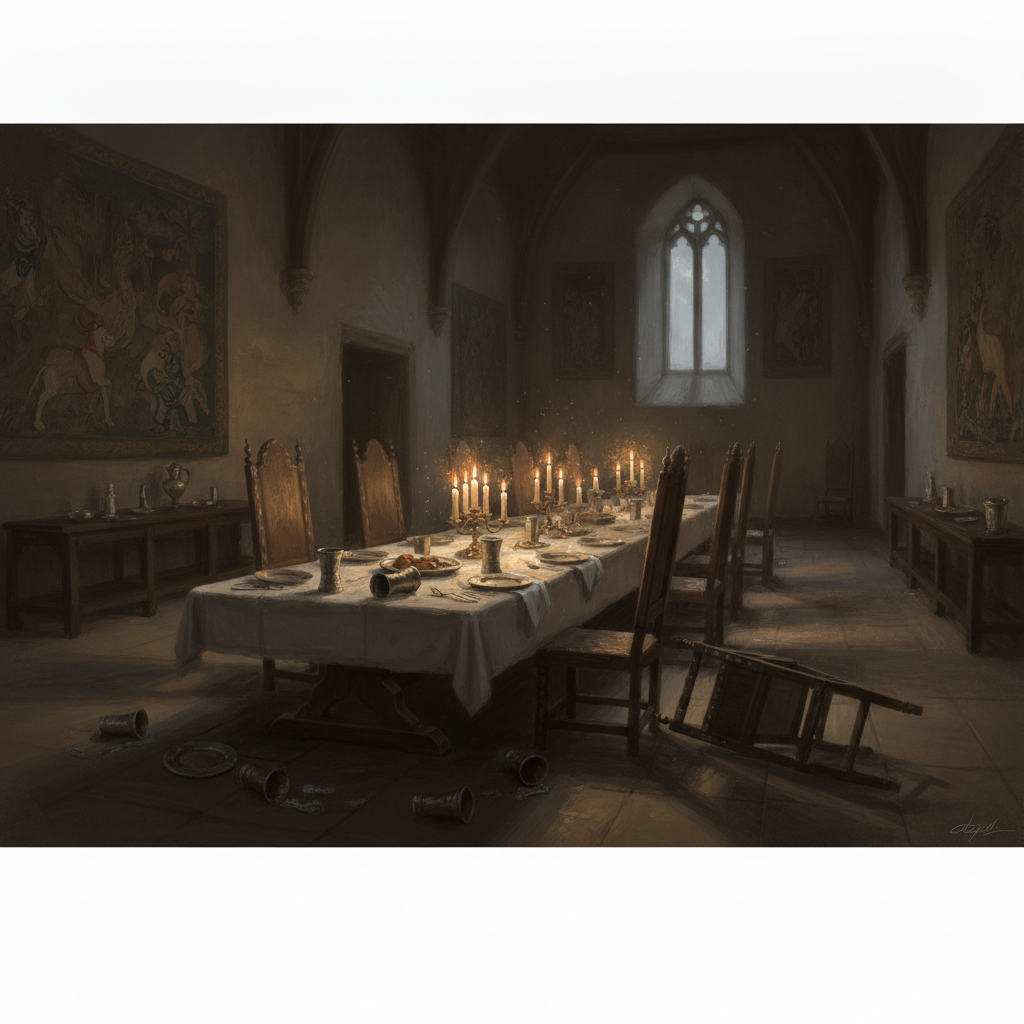
Some were merry at dinner and dead at supper. The line has been worn smooth by five centuries of retelling, and it remains the most exact short description of the disease the Tudors called the sweat. It did not creep. A man could wake healthy, work a full morning, sit down to eat and be a corpse before the candles were lit.
The course of the illness was described consistently by those who watched it. It began with a nameless dread, a sense that something was badly wrong, followed by a cold shivering violent enough to shake the whole body, headache, pain driving through the neck, shoulders and limbs, and a crushing weariness. Within a few hours the cold gave way to its opposite: a drenching, foul-smelling sweat that soaked the bedclothes and gave the disease its name. The heart raced, the breath came in gasps, and over all of it lay an overwhelming urge to sleep. To surrender to that sleep was very often to die.
The English sweating sickness struck five times. The first epidemic broke out in the summer of 1485, in the same weeks that Henry Tudor marched from his victory at Bosworth toward London and a new crown. It swept the capital with such force that, by some accounts, it killed many thousands of Londoners within a matter of weeks. It carried off two successive lord mayors and six aldermen within days of one another, and it forced the anxious new king to postpone his coronation. A disease that arrived with the House of Tudor would shadow the dynasty for as long as it reigned.
Four more waves followed, in 1508, 1517, 1528 and 1551. Each burned through town after town with terrifying speed, then died away within weeks and fell silent for years before returning without warning. The pattern was always the same: a sudden appearance, a few violent months, and then nothing.
From first to last, the entire recorded history of the disease in England spans sixty-six years, from 1485 to 1551. Five outbreaks, none of them lasting more than a few months, separated by long silences. Nor did surviving one wave protect anyone against the next, since the same people could and did fall ill again years later.
What frightened people most was not simply the speed but the selection. Plague and most other pestilences fell hardest on the poor, the old and the already weak. The sweat inverted the rule. It reached into the households of the rich and the well fed, struck down young men in the fullness of their strength, and spared neither courtiers nor priests. Contemporaries also noticed, and could not explain, that it seemed to prefer the English above all others. There were reports of Englishmen abroad falling ill while their foreign neighbours in the very same streets did not, which deepened the sense that this was a curse fitted to one people.
The wave of 1517 may have been the deadliest of all. It is said to have emptied Oxford and Cambridge, closed courts and markets, and in the worst-hit towns to have killed a large share of those it touched. Cardinal Wolsey, the most powerful man in England after the king, is reported to have caught the sweat more than once and to have survived each time.
The disease brushed against the Tudor court again and again, and never more dramatically than in 1528. In that summer outbreak Anne Boleyn, then the object of Henry VIII's furious courtship, caught the sweat and survived it, as did her father Thomas. Others were less fortunate: William Carey, the husband of Anne's sister Mary, died of it. Henry, who feared few things but feared this, broke up his court, sent Anne away to the family seat at Hever in Kent, and moved from house to house across the countryside, shifting whenever the sickness drew near and dosing himself with medicines of his own devising.
Against such an enemy Tudor medicine was almost helpless. Physicians argued over whether to keep the victim warm or cool, and whether to let them sleep or force them to stay awake. Their remedies, herbal possets, banked fires and sealed rooms, amounted to little more than educated guessing. Ordinary people had no defence but flight, and flight itself carried the disease down every road it travelled.
Then, after the outbreak of 1551, it simply stopped. That last epidemic began, as far as the records show, in Shrewsbury in the spring, killed perhaps a thousand people there, and rolled across England through the summer before fading by the autumn. It was the physician John Caius, who watched it at close quarters, who left the fullest description we have, in a short book with the long Tudor title A Boke or Counseill Against the Disease Commonly Called the Sweate. He meant it as a guide for the next outbreak. There was no next outbreak. There was never a sixth English epidemic. A disease that had terrorised a kingdom for two generations withdrew as abruptly as it had come.
Nearly two centuries later, a disease that observers called the Picardy sweat began to appear in France. Like its Tudor predecessor it was marked by sudden fever and drenching sweats, though it also produced a rash, and it recurred in scores of local outbreaks into the nineteenth century. Whether the two were related is disputed, but the French outbreaks are the closest documented parallel to what happened in England.
That is very nearly the whole evidential record. The sweat vanished centuries before anyone understood that diseases are caused by microbes, before a germ could be grown in a dish or a genome read from a bone. Everything we have is testimony: Caius and a handful of chroniclers describing what they saw, filtered through the medical assumptions of their age, listing the symptoms they thought mattered. No confirmed victim's grave has yet yielded pathogen DNA. Without biological material, no Tudor account, however vivid, can be pinned to an organism.
Conclusions and Open Questions
Because there is no pathogen to test, every modern identification of the sweat is an argument from description, and each one has a clear weakness.
The best known modern candidate is a hantavirus, one of a family of viruses carried by rodents. Its pulmonary form can kill a fit adult within a day or two by flooding the lungs, which fits both the speed of the sweat and its taste for the healthy. Its weakness is transmission: hantaviruses pass from rodents to people and only very rarely from person to person, whereas the sweat plainly moved from human to human through households and whole towns.
An older theory holds that the sweat was a relapsing fever spread by ticks and lice, vermin that thrive in summer as the sweat did. Its strength is the seasonal fit and the abundance of such parasites in Tudor life. Its weakness is that relapsing fever leaves marks the chroniclers never mention, a dark scab at the site of the bite and a characteristic rash, and that it tends, as its name says, to relapse in waves within a single patient, which the sweat's single brutal blow does not resemble.
Others have proposed a virulent influenza, on the grounds that influenza epidemics do arrive, mutate and fade. Its weakness is the clinical picture: influenza kills mainly through the lungs over days rather than through drenching sweat in hours, and it does not usually spare the old while taking the young. A few have suggested anthrax caught from wool and livestock, an idea that founders on the plain fact that the sweat passed from person to person, which anthrax does not.
Some argue that the Picardy sweat was a relative of the English disease, different expressions of a single rodent-borne family of viruses. Among them are the same researchers who favour the hantavirus explanation. The strength of the link is the striking similarity of the sweating and the speed. Its weakness is that the Picardy sweat differed in important ways, above all the rash, and that a resemblance across two hundred years and the English Channel proves kinship no more than it proves coincidence.
One theory holds that the sweat was a pathogen that no longer exists in the form that caused it: that some virus emerged, found in the crowded, verminous, undernourished but not quite starving conditions of late medieval England a narrow and perfect window, burned through a population with no immunity, and then, as immunity spread and living conditions changed, lost the exact combination it needed and either died out or subsided into a milder illness nobody would think to connect to it. It would explain the disappearance. It is also, at present, untestable.
What remains unexplained is the pattern itself. We do not know why the disease preferred the young and the strong when almost every other infection we know preys on the frail. We do not know why the English seemed more vulnerable than their neighbours. We do not know why five epidemics in sixty-six years were followed by none at all.
The open questions are simple to state. Did the sweat truly die out, or did it change into something we now call by another name? Was the Picardy sweat its descendant? And somewhere beneath an English churchyard lie the bones of people who were merry at dinner and dead by supper. If the right grave is ever opened and the right fragment of DNA survives in it, the fever may at last be given a face. Until then it keeps the one thing every real mystery needs, which is the power to unsettle.