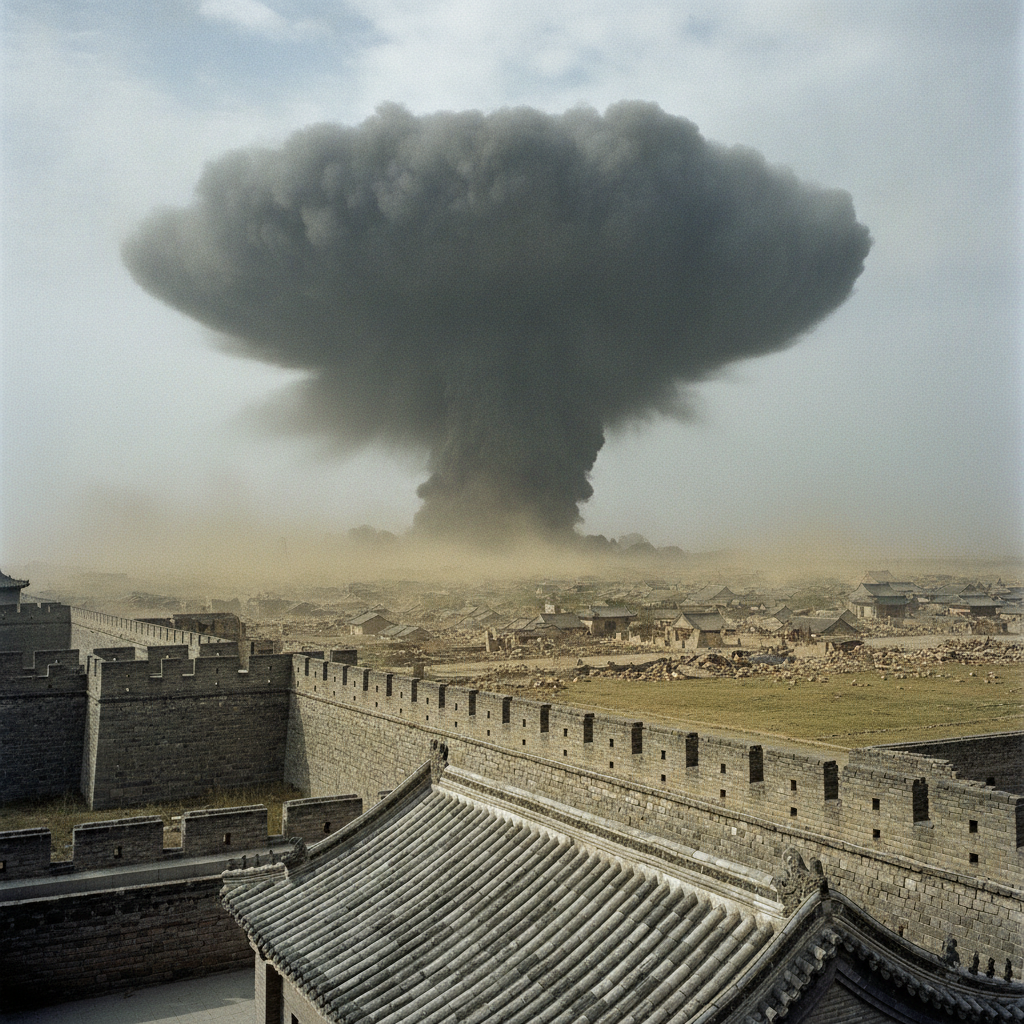
The Morning Beijing Was Torn Open: The Blast of 1626 Nobody Has Explained
It is mid-morning on 30 May 1626, in Beijing, the capital of China.
In the southwest of the walled city, smoke starts to rise from a compound of workshops. People point at it.
Then, according to the accounts written afterwards, there is a rumbling roar, like something heavy rolling through the sky. Houses begin to shake. A bright light appears. And then the bang.
When the dust falls, an area of roughly 4 square km is gone. Not damaged. Gone.
The compound was an imperial gunpowder works, one of 6 run by the government department in charge of public works. It made and stored powder, armour, firearms and ammunition for the troops who defended the capital. It stood about 3 km southwest of the palace complex at the centre of the city.
The recorded death toll is around 20,000 people.
And from that morning to this one, nobody has been able to say for certain what happened. This is not a case where the answer is obvious and the details are missing. It is the opposite. The details survive in unusual quantity, and several of them do not fit an exploding gunpowder store at all.
What the records describe
The main contemporary source is an official government gazette that collected reports of the disaster, together with private chronicles written in the years that followed.
They describe the sequence in a consistent order. First a noise from one direction, then shaking, then a flash of great light, then the explosion itself.
They describe the ground at the centre of the site sinking by more than 6.5 m.
They describe thousands of houses levelled inside a zone roughly 2 km across.
They describe a stone lion weighing about 3 tonnes being thrown over the city wall.
They describe large trees pulled out of the earth and carried away to the north.
They describe a cloud that stayed in the sky for hours afterwards, coloured in bands, shaped, in the words of one account, like a black mushroom.
The sound was reported from towns up to 150 km away in several directions, and the ground shaking was felt at similar distances.
Sources disagree on how far the noise carried. Several accounts put it at up to 150 km. At least one modern account claims much more. Nobody was measuring anything, and every figure comes from someone writing down what other people told them.
The palace
The palace at the centre of the city was being repaired that spring, and the accounts say more than 2,000 workmen were up on the roofs when it happened. They were thrown off.
The emperor was inside. He ran from one hall towards another. The accounts say the single guard who was with him was killed on the way by a falling roof tile.
His son, the heir to the throne, was 7 months old. He died shortly afterwards, and the chronicles attribute it to the shock.
So the ruling house lost its heir on the same morning it lost a district of its capital.
The part that does not fit
Here is the detail that has kept the case alive for 4 centuries.
The records say that many of the dead were found with no clothes on. Not burned off. Stripped.
They say clothing came down elsewhere. In a town about 40 km north of the city, an account describes clothes heaped in a school yard, mixed with silver coins and jewellery. Other clothes were described as hanging in the trees of the hills west of the capital.
One chronicle records a woman sitting in a sedan chair in a street when the noise came. The top of the chair was lifted away. When she came to herself she was unhurt, and she had nothing on.
A gunpowder explosion burns and it throws. It does not undress people who survive it and then deposit their clothes in a tidy pile 40 km away.
None of this can be checked now. But it appears in more than one text, written by people who had no obvious reason to invent a detail so specific, and so useless as a moral lesson.
The emperor answers
In the court of the time, a disaster on this scale was not an engineering matter. It was a verdict from heaven on the man on the throne.
The emperor was 20 years old and had a reputation for caring far more about carpentry than about governing. His administration was run in practice by others.
He issued a public edict blaming himself, which was the conventional response, and released 20,000 taels of gold for relief of the survivors. The treasury could not really afford it.
The dynasty fell 18 years later.
Who was blamed
Nobody.
In practice the court was run by a powerful palace eunuch and by the emperor's former nurse. A group of reforming officials opposed them, and after the blast that group used it as proof that the throne had lost the approval of heaven.
The official finding was that the disaster had been a heavenly event. Not an accident, not negligence, not the failure of a government workshop. A sign.
So no engineer was questioned. No storekeeper was arrested. No inventory was produced. The one moment when somebody might have walked onto the site and asked what had been in it was spent arguing about what the sky had meant.
That is a large part of the reason the case is still open 400 years later.
Here is where what is known ends
Everything above comes from written accounts. There was no investigation in the modern sense. Nobody measured anything, nobody collected fragments, nobody dug the site to find out what had been at the centre of it.
**There is no surviving record of how much gunpowder was actually in store that morning. Without that number, the cause cannot be settled, and it has not been.**
Modern popular articles often compare the blast to a small nuclear weapon. That comparison is not a measurement. It is a calculation worked backwards from the descriptions in the chronicles, and it is only as good as they are.
Conclusions and Open Questions
**It was an accident at the gunpowder works.** The evidence: the site was a powder factory and store, the destruction is centred on it, and the ground beneath it collapsed. Chronicles mention careless handling of powder in the workshops. The problem: no record says how much powder was there, so nobody can show the quantity was enough. And a chemical explosion does not account for the stripped clothing, or for clothes and jewellery landing 40 km away.
**It was a meteor that exploded in the air above the city.** The evidence: the roar approaching from one direction before the blast, the flash, the wide circle of flattening, the cloud left hanging afterwards, and a pressure wave strong enough to tear cloth off bodies. The problem: no fragments were ever recorded or recovered, and it asks you to accept that an object from space happened to burst directly over the one place in the city that was full of explosives.
**An earthquake released something underground that ignited.** The evidence: the accounts put shaking before the flash, and the region does have recorded earthquakes. The problem: an earthquake big enough to be felt 150 km away should have damaged the whole city. The destruction was confined to one zone.
**It was a tornado, and the explosion was only part of it.** The evidence: this is the only proposal that explains clothes carried tens of km and dropped in trees and courtyards, roof workers thrown from a building, and objects lifted rather than shattered. The problem: a tornado does not make a single bang audible 150 km away, and it does not flatten a district in a circle.
**The accounts are exaggerated.** The evidence: they were written inside a court that needed the event to mean something, in a reign already seen as failing. The figure of 20,000 dead rests on no count that survives. The problem: the strangest details, including the clothing, appear in more than one source, and they are exactly the details a writer inventing a portent would have no reason to invent.
What is agreed is small and solid. On that morning something destroyed a large piece of a walled capital city, killed a very large number of people, and was heard and felt at a distance of 150 km.
What is not agreed is everything else. And the one measurement that would settle it, the amount of powder in the store, was never written down by anyone who survived to write.