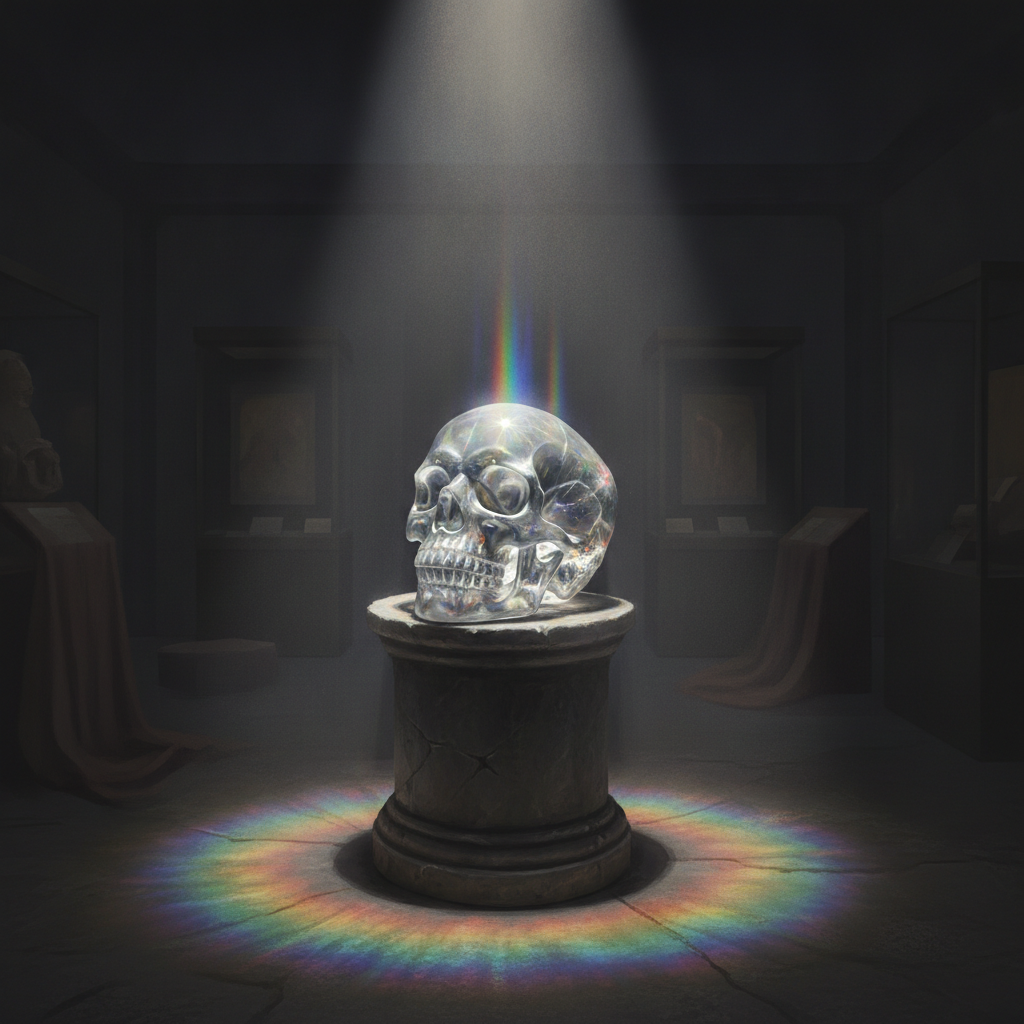
The Crystal Skulls: How a Jeweller's Wheel Betrayed the Ancient Maya Legend
In 1881 a life-size human skull, carved from a single block of polished rock crystal, went on sale in the Paris shop of the antiquities dealer Eugene Boban. Boban was no marginal figure. He had served as official antiquarian to the court of Emperor Maximilian during the brief French imperial adventure in Mexico, and he understood exactly what a European market hungry for the vanished New World would pay. He had already tried and failed to sell crystal skulls to Mexico's national museum as genuine Aztec finds. The Paris skull passed through auction to the New York jeweller Tiffany and Co., which bought it from Boban for 950 dollars and in 1897 passed it to the British Museum, where it was catalogued as Aztec and put on display. A second skull, also traceable to Boban, entered French public collections; it is held today at the Musee du quai Branly in Paris.
In July 1936 readers of Man, the journal of the Royal Anthropological Institute in London, were given a piece of forensic theatre: two life-size human skulls of polished rock crystal, photographed and measured point by point. One was the British Museum's. The other stood in the London gallery of the art dealer Sydney Burney. The anatomist G. M. Morant reported that the two objects resembled each other far too closely to be independent works. Adrian Digby of the British Museum answered him in print. Nobody in that polite exchange imagined that Burney's skull would end up the most famous Maya relic on earth.
The paper trail behind Burney's skull is specific. On 17 February 1933 he wrote to the director of the American Museum of Natural History in New York, offering, in his own words, a life size rock crystal skull with separate jaw, newly acquired from Mexico. The museum declined. In October 1943 the skull came up at Sotheby's in London, where the British adventurer F. A. Mitchell-Hedges bought it for around 400 pounds. A letter to his brother that December confirms the purchase.
Then came the legend, and it was magnificent. Mitchell-Hedges let it be known that the skull had been found rather than bought. His adopted daughter Anna, he said, had discovered it around her seventeenth birthday in 1924, beneath a collapsed altar in the Maya ruins of Lubaantun in British Honduras, today Belize: a flawless object, cold to the touch, which he took to calling the Skull of Doom. In his 1954 memoir Danger My Ally he wrote only that he had reasons not to reveal how it had come into his possession. The records of the Lubaantun excavations mention no crystal skull, and no member of the expedition ever placed Anna at the site. In the documents, found in 1924 means bought in 1943.
Anna carried the story for the rest of a long life. She exhibited the skull for paid admission, spoke about its powers to anyone who came, and repeated the Lubaantun account, with shifting dates and details, until her death in 2007 at the age of one hundred.
By then a whole body of belief had grown around such objects: skulls that heal, hum, glow and store memory, and a set of thirteen destined to be reunited and to reveal cosmic secrets. Frank Dorland, the art restorer who kept the Mitchell-Hedges skull for years, described auras around it, images forming inside the crystal, and phantom sounds. The thirteen-skull scheme cannot be traced to any Maya or Aztec source. It grew in the twentieth century out of Spiritualist circles and was elaborated by enthusiasts who tied it to the end of the Maya Long Count calendar in 2012.
The first laboratory examination came in 1970, when the crystallography lab at Hewlett-Packard in Santa Clara, California, studied the Mitchell-Hedges skull for Dorland. The lab established that skull and detachable jaw had been cut from a single block of quartz. The more dramatic claims that later attached to that visit, that the skull was carved against the crystal's natural axis, that it should have shattered, that it demanded generations of hand-polishing, came from Dorland's own retellings rather than any published HP finding, as the investigator Joe Nickell has documented.
The decisive work began by accident. In 1992 a package with no return address arrived at the Smithsonian Institution in Washington. Inside was a crystal skull, crudely made, together with a note insisting it was genuine Aztec work. The Smithsonian anthropologist Jane MacLaren Walsh began pulling at the thread, comparing the anonymous gift with the museum pieces in London and Paris and tracing their provenance back through the nineteenth-century dealers. The investigation occupied her for most of two decades.
With the British Museum scientist Margaret Sax she placed the surfaces under a scanning electron microscope. They found straight, regular grooves cut by spinning wheels fed with hard abrasives: the signature of a lapidary's rotary lathe, a technology pre-Columbian America never possessed. Authentic Mesoamerican lapidary work carries the irregular traces of hand tools and abrasive sand instead. Their study of two skulls, The origin of two purportedly pre-Columbian Mexican crystal skulls, appeared in the Journal of Archaeological Science in 2008. On the Smithsonian skull, X-ray diffraction turned up traces of silicon carbide, a synthetic abrasive not manufactured anywhere until the 1890s. When the Mitchell-Hedges skull itself came under Walsh's microscope in 2007, it showed the same rotary toolmarks. French laboratory tests on the Paris skull returned the same verdict: nineteenth-century workmanship, no older.
The shape of the objects points the same way. Genuine Aztec and Mixtec work in quartz survives, and it is small, stylized and ground with stone and abrasive sand into forms quite unlike these smooth, anatomically rounded heads with drilled eye sockets and neat rows of teeth. No Mesoamerican tradition produced anything close to them. The likely place of manufacture is Europe, and above all the German gem-cutting town of Idar-Oberstein, whose workshops carved quartz curiosities for the nineteenth-century curiosity trade and which appears to have been Boban's own source. Gemological analysis of the museum skulls pointed to quartz that may not be Mexican at all, consistent with sources as distant as Brazil or Madagascar.
The reckoning came in 2008. Both the Smithsonian and the British Museum publicly accepted that their crystal skulls were nineteenth-century productions rather than ancient American art. It is rare for a museum to announce that one of its celebrated pieces is a fraud, and rarer for two to do it in the same year. The British Museum now displays its skull with a label stating that it was probably made in nineteenth-century Europe. In the same year the film Indiana Jones and the Kingdom of the Crystal Skull opened in cinemas worldwide, and the legend reached a far larger audience than it ever had while it was still believed.
Conclusions and Open Questions
On the essentials the science is settled. Rotary toolmarks and an industrial abrasive date the museum skulls to the nineteenth century, and the objects are European workshop pieces sold as American antiquities. What the laboratory cannot supply is a maker. No workshop ledger, no craftsman's name and no invoice for the carving of any single skull has ever surfaced. The forgers remain as anonymous as the Maya priests the legend invented for them.
On the most famous skull of all, Walsh went further than the tests strictly allow. She argued that the Mitchell-Hedges skull copies the British Museum's so closely, echoing Morant back in 1936, that it was probably carved from it, which would make the best known crystal skull in the world later than 1897. The weakness is that resemblance is not provenance. Nobody has produced a document tying the two objects together, and the argument rests on shape rather than on paperwork.
The gaps in the human record are where the case stays open. Sydney Burney traded openly under his own name, yet never said where his skull had come from. Who mailed a crystal skull to the Smithsonian in 1992 without a return address, and what did the sender know, or fear? Neither silence has been explained.
Mitchell-Hedges himself is unresolved. One theory holds that he was a straightforward fraud who bought an object at auction and invented a jungle discovery to sell books and lecture tickets. Another reading, rarely stated plainly, is gentler: that an ageing showman who lived off tales of jungle danger was not so much hiding a forgery as buying himself, for 400 pounds, the legend he meant to leave behind. Nothing documented tells us what he actually believed, and the same uncertainty covers Anna, who defended the Lubaantun story for seventy years. Whether she believed the tale she had inherited or knowingly defended a lie cannot be recovered from the files.
Some argue that Boban was less a lone opportunist than the visible end of an organised supply line: a dealer with court credentials in Mexico, a European cutting town able to produce to order, and museums willing to pay. The weakness is again the missing ledger: not one order for a skull has ever been found in the Idar-Oberstein records. Others suggest that the stone itself should settle the question of origin, but gemological sourcing is indicative rather than conclusive, and Brazilian or Madagascan quartz reached European workshops through many hands.
Believers in the skulls' powers have not conceded, and their argument deserves fair statement: a laboratory can date a carving without touching any of the claims made for it. The difficulty is that none of those claims, healing, humming, stored memory, or the thirteen that must be reunited, has ever survived a controlled test, and the tradition they belong to is younger than the objects it explains.
Two questions remain genuinely unanswered. Why did the fakes deceive professional archaeology for more than a century, sitting unchallenged in the world's great collections while serious scholars debated their meaning in learned journals? And why did exposure make so little difference to the myth, which is healthier now than it was in 1936? The quartz is real, the workmanship superb, the age about a century and a half. The magic was supplied entirely by the buyers, and it is being supplied still.