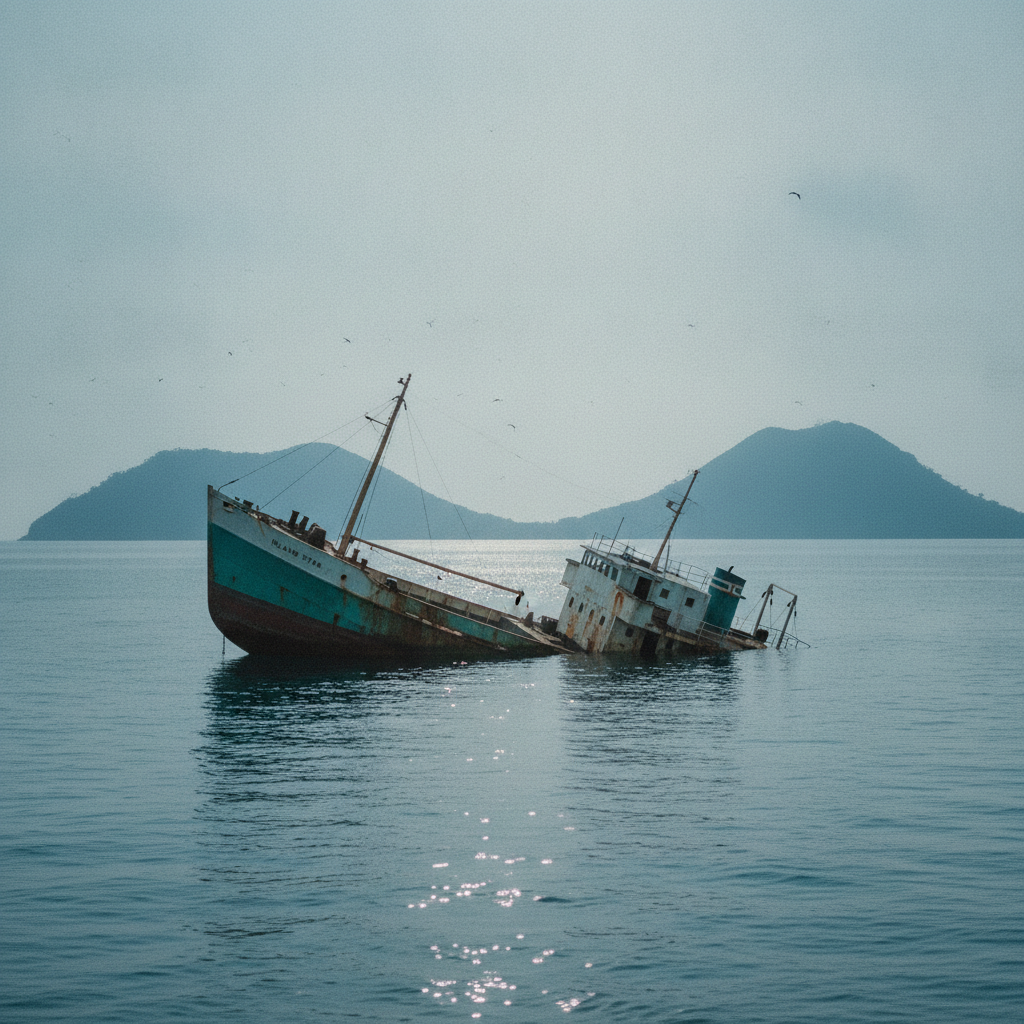
The Ship That Couldn't Sink — and the 25 People Who Vanished From It
On 10 November 1955 the merchant ship Tuvalu came upon a small white vessel drifting in the South Pacific north of the Fijian island of Vanua Levu. She lay three-quarters submerged and heeled hard over to port, her port rail awash, with no hand at the wheel. She was the motor vessel Joyita, five weeks overdue and more than six hundred miles off her course. Captain Gerald Douglas put his men aboard. Of the 25 people who had sailed in her, not one was ever seen again.
The Joyita had been built in 1931 at the Wilmington Boat Works in Los Angeles as a luxury yacht for the film director Roland West, who named her after his wife, the actress Jewel Carmen. Joyita is Spanish for "little jewel." Below her cedar-on-oak decks ran a hull lined with cork. During the Second World War she served the US Navy as the patrol boat YP-108. In that service she ran aground and was repaired, and in the repair her original copper and brass pipework was swapped for galvanised iron. By 1955 she was working the islands under charter to Thomas "Dusty" Miller, a British-born master who had taken her on and knew her intimately.
The Tokelau group is three low coral atolls with no harbour and, in 1955, no radio station of its own. Chartered island traders like the Joyita were their only regular link with Samoa, carrying officials, medical supplies, mail and copra. A vessel that failed to arrive could not be reported missing quickly, because the atolls had no way of saying so.
She left Apia, in what was then Western Samoa, at around five in the morning on 3 October 1955, bound for the Tokelau Islands some 270 miles to the north. It was an easy passage of about two days. Aboard were 16 crew and 9 passengers: a government medical officer, the Irish-born Dr Alfred Denis Parsons, travelling with supplies; a copra buyer; district officials; and two children. It was an ordinary island manifest: sixteen men who worked the vessel, a doctor going out to the atolls, officials travelling on government business, a trader buying copra, and two children.
She sailed in poor condition. One of her two engines was already out of service, its clutch partly dismantled, so she was running on the other. Her radio was set to 2182 kilohertz, the international distress frequency, but its antenna cable was broken and painted over, which cut the set's effective range to perhaps two miles. She carried too few life jackets for the number of souls aboard, and her passenger licence had lapsed. In her holds were around eighty empty forty-five-gallon oil drums along with timber and light cargo. Together with the cork lining, investigators later concluded, this made her for all practical purposes unsinkable. Miller, who knew every seam of her, knew that better than anyone.
Some time after nine o'clock on the second night out, in a stretch of empty ocean with nine hours of darkness still ahead, seawater began to climb through the engine room. A galvanised iron pipe in the cooling system had corroded through. The flooding went unnoticed in the dark until the bilge pumps, which lacked strainers and had clogged, could no longer cope. Every electric clock aboard the ship stopped at 10:25.
When the Joyita failed to arrive at Tokelau, the alarm went up slowly, because the islands had no radio contact of their own. Eventually aircraft of the Royal New Zealand Air Force swept nearly 100,000 square miles of ocean over several days. They found nothing at all. It was Captain Douglas, five weeks after her departure, who found the ship.
What his men boarded was a catalogue of damage and stranger absences. The Joyita was three-quarters submerged yet stubbornly afloat, and barnacles grown above her normal waterline showed she had wallowed at that angle for a long time. Around four tons of cargo were gone. So were the logbook, the sextant, the chronometer and the rest of the navigation gear, the firearms Miller kept aboard, and all three Carley life rafts along with the dinghy. The flying bridge had been smashed and deckhouse windows were broken. On deck sat a doctor's bag holding a stethoscope, a scalpel and four lengths of bloodstained bandage. The radio was still tuned to the distress frequency.
Two further details stood out. Mattresses had been jammed down over the starboard engine, the kind of thing a crew does in a hands-on fight to stem a leak or shield the electrics from spray. A canvas awning had also been rigged over the deckhouse, the patient work of people expecting to sit and wait for hours or days. Both were on the same deck.
Douglas took the derelict in tow and brought her to Fiji, where she was pumped out and examined.
The official inquiry sat at Apia in early 1956. It reconstructed how the emergency had probably begun, tracing it to the corroded pipe and the clogged pumps, and it found the Joyita badly maintained. It condemned Miller's decision to sail with a dead engine, a crippled radio, too few life jackets and a lapsed passenger licence. On the fate of the 25 people, the court recorded that the outcome was "inexplicable on the evidence submitted."
The ship outlived her passengers by decades. She was towed in, sold at auction in July 1956 for 2,425 pounds to a Fiji Islander named David Simpson, repaired and sent back to sea, where she grounded again and again before finally breaking up at Levuka in the 1970s.
In seven decades since that November morning, no raft, no body, no life jacket and no identified piece of wreckage from the Joyita has ever come ashore anywhere in that scattered ocean of islands.
Conclusions and Open Questions
The central obstacle to every explanation is the ship herself. She did not sink. She was still afloat five weeks later, in the condition her passengers left her. Every rule of survival at sea says that when a vessel is more buoyant than any raft, you stay with the vessel, and the one man aboard best placed to know that was her master.
The simplest theory is catastrophic panic. The deck tilted in the night, someone, perhaps Miller himself, was injured, and passengers who believed the ship was going down took to the rafts, which the open ocean then swallowed. Its strength is that it needs no criminals and fits the flooding the inquiry proved. Its weakness is glaring: a competent master does not lead 25 people off a floating hull into the dark, and Miller had no reason to think she would sink.
A darker and more elaborate reading comes from the British author Robin Maugham, who owned the Joyita years later and published his account in 1962. Maugham accepted the inquiry's flooding but argued for something like a mutiny on top of it. In his reconstruction Miller, deep in debt and desperate to complete the charter, pressed on knowing the ship could not sink; his first mate, the American Chuck Simpson, and perhaps others demanded he turn back; a struggle broke out in which Miller was seriously hurt, which would account for the bandages; and Simpson, taking command and the navigation instruments, ordered the ship abandoned for a nearby island or reef that the rafts never reached. Its strength is that it accounts for the blood, the missing instruments and the orderly stripping of the ship. Its weakness is that it is built on inference rather than testimony, and it still asks us to believe that experienced seamen would trade an unsinkable hull for a raft in heavy weather.
Miller's own friend, Captain S. B. Brown, offered a blunter fragment of the same idea. He was convinced Miller would never have left the Joyita alive, that the captain died aboard, and that the others left in fear and disorder.
Then there are the theories that draw on the era's suspicions, and they are open theories with no evidence behind them. Some argue for piracy. One theory holds that a fraud or an insurance scheme went wrong. Others have blamed Japanese fishermen. None has been supported by a single piece of physical evidence, and the piracy idea founders on a simple point: pirates take a ship and her cargo, not the crew and the life rafts while leaving a valuable hull to drift.
What remains unexplained is substantial. The smashed flying bridge fits none of the theories cleanly. Nobody has ever identified whose blood soaked the four bandages, or what became of the injured person. The gathering of the sextant, the chronometer, the logbook and the guns is the deliberate work of people who believe they are making a considered passage, not fleeing a sinking deck, and it sits badly beside the mattresses shoved over the engine. And the complete absence of debris over seventy years is far rarer than the loss itself: people vanish at sea often, but three rafts and 25 people leaving no trace at all is close to unique in the region's records.
The open questions are these. Why did 25 people leave a ship that would not sink? Whose blood was on the bandages, and where did that person go? Who smashed the flying bridge, and with what? Why were the navigation instruments taken if the departure was a panic? And why, in all the years since, has the sea that took them never given back so much as a plank or a bone?