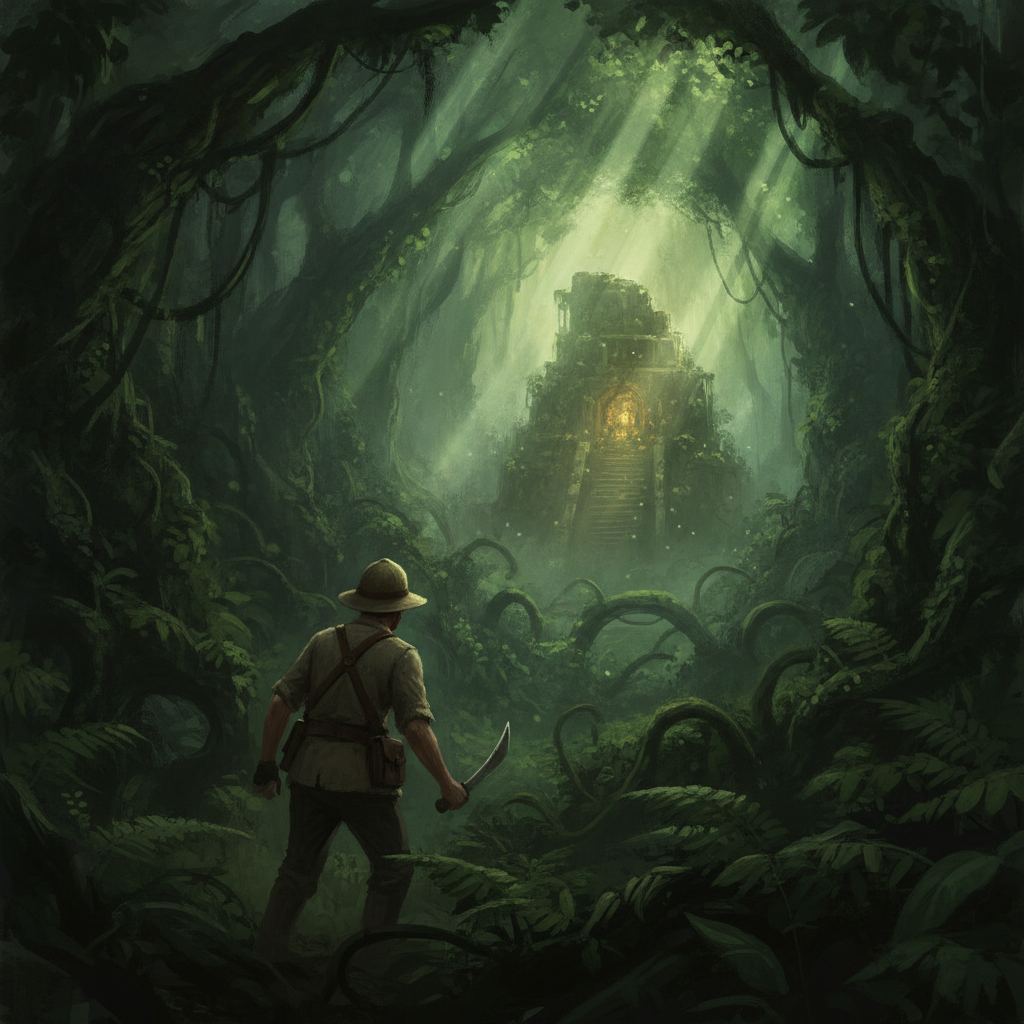
Percy Fawcett and the Lost City of Z: The Explorer the Amazon Never Returned
On 20 April 1925 three men rode out of Cuiaba, in the Brazilian state of Mato Grosso, and headed north-east toward the headwaters of the Xingu River. Colonel Percy Harrison Fawcett was fifty-seven and had already completed seven expeditions into the interior of South America. With him went his elder son Jack, twenty-one, and Jack's boyhood friend Raleigh Rimell. By the standards of the period they travelled extremely light. Fawcett had chosen a small party deliberately: large expeditions, he argued, alarmed the peoples of the forest, moved slowly and consumed supplies faster than they could be carried. Three fit men, he believed, could pass through country where a column would be stopped. They were looking for the remains of a city he referred to in his papers by a single letter, chosen precisely because it gave nothing away: Z.
Fawcett was not an amateur adventurer. He had joined the Royal Geographical Society in 1901 to train in surveying, and from 1906 the Society sent him to map the disputed borders of Bolivia and Brazil, work carried out in fever country with primitive equipment and repeated risk. He completed those surveys with enough accuracy and composure to make his name within British exploration circles. He had crossed rivers no European had charted, endured malaria and near starvation, and returned each time.
His belief in a lost city rested on documents as well as instinct. Chief among them was a yellowed manuscript held in the National Library of Brazil, catalogued as Manuscript 512. Written in 1754 and attributed to a Portuguese bandeirante, a slave and treasure hunter named Joao da Silva Guimaraes, it described how in 1753 his party had come upon the ruins of an abandoned city deep in the Mato Grosso: stone arches, a roofless temple, paved streets, inscriptions in an unknown script, and traces of silver. Fawcett combined this account with indigenous oral traditions about ancient settlements and with his own conviction that the Amazon had once supported far larger societies than outsiders assumed. He also carried a small basalt figure given to him by the novelist H. Rider Haggard, which he believed came from the lost culture.
The expedition's final message reached the outside world from a spot Fawcett called Dead Horse Camp, named for an animal that had died there on an earlier journey. In a letter he placed it at roughly eleven degrees forty-three minutes south. On 29 May 1925 he wrote to his wife Nina that she need have no fear of any failure. Jack, he reported, was strong and in good spirits. Raleigh was limping with an infected leg but was determined to continue. The three men then turned east. No further word was ever received. There was no distress signal, no abandoned camp, no grave. There was also no certainty about the coordinates: Fawcett had feared that rivals would follow him to Z, and it has never been established whether the position he gave was accurate.
The last people known to have seen them were the Kalapalo, an indigenous nation of the Upper Xingu. Their account, passed down through generations and recorded by researchers many times since, has remained consistent. They fed the strangers, helped them cross the Kuluene River, and warned them not to travel east into territory held by groups the Kalapalo considered dangerous. Fawcett went east regardless. For about five evenings afterwards the Kalapalo could see the smoke of the expedition's campfire in the distance. On the fifth night there was no smoke, and there was none afterwards. That is where the documented record of Percy, Jack and Raleigh Rimell ends.
The search began almost immediately. In 1928 an expedition led by the explorer George Dyott travelled into the Xingu, collected local accounts and concluded that the party had been killed by an indigenous group. Dyott brought back no bodies and no equipment that could be positively identified as Fawcett's. Over the following decades further expeditions went in, some of them well equipped and some little more than adventures, and a number of searchers died or disappeared themselves. In his 2009 book The Lost City of Z, the writer David Grann reported a widely quoted estimate that as many as a hundred people had died or vanished while looking for Fawcett or retracing his route. The figure is repeated everywhere and cannot be verified. Grann, following the trail himself, ended up among the Kalapalo and heard their version directly.
The case appeared to break once, in 1951. Orlando Villas-Boas, the Brazilian indigenist known for his work protecting Xingu peoples, announced that Kalapalo men had given him bones said to be Fawcett's, together with an account of a killing. The remains were sent to London. Fawcett's surviving son Brian rejected the identification immediately, and anatomical examination supported him: the skeleton belonged to a considerably shorter man, and the teeth did not match Fawcett's dental records. Fawcett had stood well over six feet. The Kalapalo later explained that the bones had been handed over in part to satisfy the constant stream of outsiders who arrived demanding answers.
The final development in the story concerned not the men but the city. For most of the twentieth century, academic consensus held that the Amazon was incapable of supporting large, complex societies. Its soils were thin, the argument ran, and the population had always been small and dispersed. Fawcett's ruined metropolis was therefore filed as fantasy. That consensus collapsed. From the 1990s onward the archaeologist Michael Heckenberger, working over many years with the Kuikuro people at the headwaters of the Xingu, mapped a network of around twenty pre-Columbian settlements now known collectively as Kuhikugu. The sites include plazas, wide causeways connecting communities, bridges, moats and defensive ditches, engineered gardens, fish weirs and managed forest. Nothing was built in stone and there were no towers of the kind Fawcett imagined. But the settlements were unmistakably planned, organised on a regional scale, and by some estimates capable of supporting tens of thousands of people before European diseases spread through the region in the centuries following contact. Kuhikugu lies close to the area where Fawcett had insisted, against the experts of his day, that a substantial civilisation had once existed.
A century after the expedition set out, no verified trace of Percy Fawcett, of Jack, or of Raleigh Rimell has ever been found.
Conclusions and Open Questions
The competing explanations for the disappearance each rest on something real and each fail at a specific point.
The oldest is that the three men were killed by an indigenous group east of the Kalapalo, which is what Dyott concluded in 1928 and what several later accounts asserted, including a version naming a chief called Izarari who was said to have ordered the deaths after an offence. It fits the geography, the warning the Kalapalo gave, and the abrupt end of the campfire smoke. Its weakness is that the various versions contradicted one another, none produced physical evidence, and the Kalapalo themselves consistently denied killing anyone, maintaining that the men simply walked on eastward.
A second explanation, argued by Fawcett's former travelling companion Henry Costin, who had accompanied him on several expeditions, removes violence entirely. Costin doubted that the men were killed at all and considered it far more likely that they died of starvation, exhaustion or fever, in a region that has killed many others without any human involvement. Raleigh Rimell was already ill when the party left the Kalapalo. This explanation is sober and requires no assumptions. Its weakness is that it does not account for the complete absence of a camp, remains or equipment.
A third reading was proposed in 2004 by the researcher Misha Williams, who had studied Fawcett's private papers. Williams argued that the colonel never intended to return: that Fawcett, influenced by the Theosophical ideas current in his era, planned to establish a settlement in the interior organised around spiritual principles. On this account the three men were not lost but withdrawn by choice. It has the attraction of explaining Fawcett's secrecy and his willingness to risk his son's life. Its weakness is that it rests on interpretation of the writings of an obsessive man rather than on evidence, and no trace of such a settlement, or of three Englishmen living among the Xingu peoples, was ever substantiated. The more popular claims, that Fawcett lost his memory and lived as a chief, that he was held captive, or that his descendants remain in the region, belong to the same category and have never been supported by anything checkable.
What is genuinely unexplained is narrow but stubborn. An experienced surveyor and two companions vanished in country where far less capable travellers have died and still left bones, tins or rusted equipment behind. No campsite has been located. The position of Dead Horse Camp has never been fixed with confidence, partly because Fawcett may have obscured it himself. The one physical claim ever tested, the 1951 bones, failed on examination.
The open questions follow. Would a properly targeted archaeological search of the country east of the Kuluene find anything after a hundred years of forest growth, or is the window closed? How much weight should be given to Kalapalo oral testimony, which has proved the most consistent account in the entire case and which archaeology has otherwise vindicated on the region's history? And there is a question about Fawcett himself that resists a tidy answer. The scientific establishment of his time was wrong about the Amazon and he was, in outline, right: complex societies had existed there, roughly where he said. Whether that instinct was insight or coincidence cannot be settled, and it did not help him. The forest has surrendered the civilisation. It has not surrendered the men.