The Phaistos Disc: A Message Printed 3,000 Years Too Soon
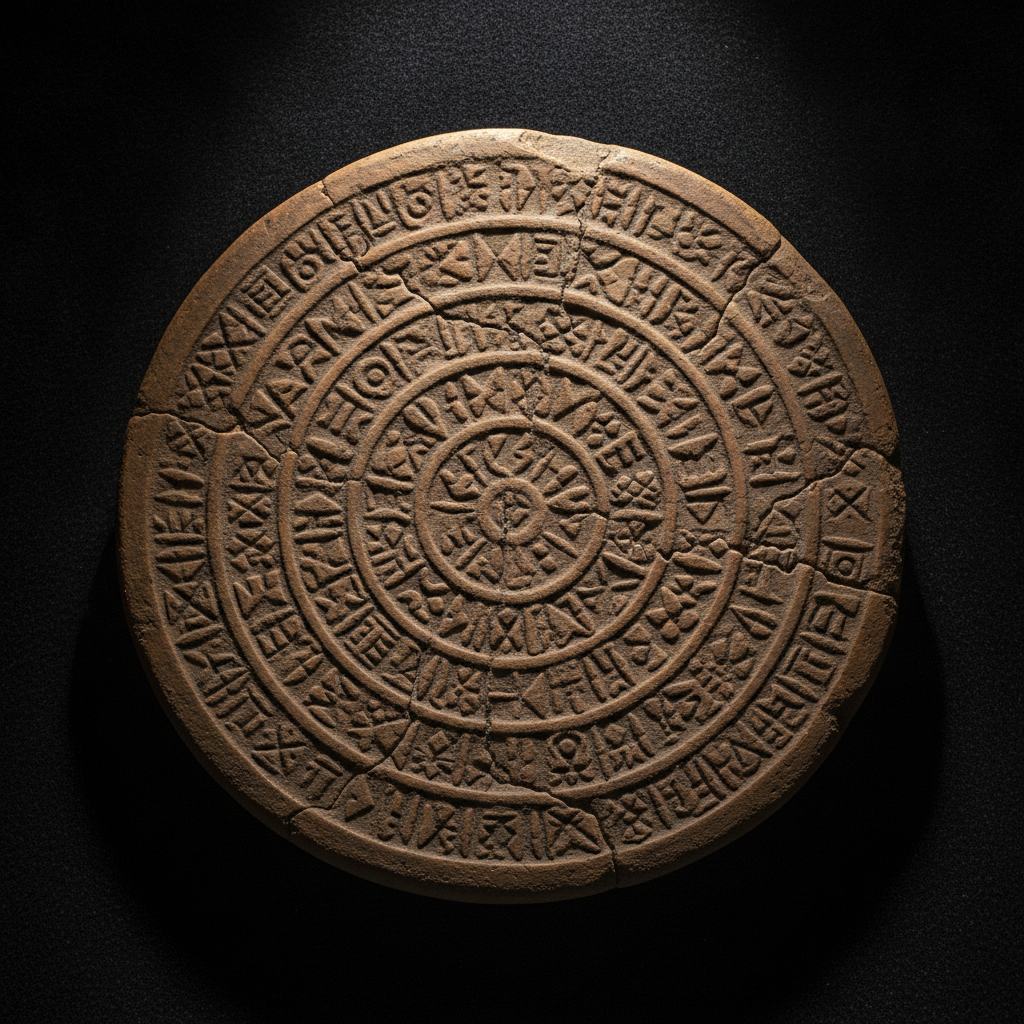
On 3 July 1908, in the ruins of a Bronze Age palace on the southern coast of Crete, a young Italian archaeologist named Luigi Pernier reached into a small mud-brick chamber and lifted out an object that has never been explained. It was a disc of fired clay, roughly the size of a saucer, and it had lain in that basement storeroom of the palace of Phaistos, alongside a tablet inscribed in the Minoan script known as Linear A, for something like three and a half thousand years. Both faces were crowded with tiny pictures: a plumed head, a walking man, a fish, a branch, a shield, arranged in a spiral that wound inward toward the centre. Pernier had never seen anything like it, and neither, it turned out, had anyone else. More than a century later the Phaistos Disc remains one of the most famous unsolved puzzles in archaeology.
The disc measures about sixteen centimetres across and carries, between its two faces, 241 impressions drawn from a set of just 45 distinct signs. The detail that lifts it out of the ordinary is the way those impressions were made. The signs were not scratched or drawn by hand. Each was pressed into the wet clay with a small carved stamp, one punch per sign, before the disc was baked hard. Whoever made it was not writing in the usual sense but printing, composing a text from a reusable set of type.
In mechanical terms that makes the Phaistos Disc the earliest known example of movable-type printing on Earth, produced some three thousand years before Johannes Gutenberg pulled his first page in Mainz. The economics of it are worth pausing on. A scribe writing by hand needs nothing beyond a stylus. Whoever produced the disc had first to design 45 distinct symbols, then cut each one as a punch in some hard material, and only then compose the text. Carving 45 separate stamps is a serious investment of labour. The stamps themselves have never been found, and no other object from Bronze Age Crete is known to have been made with them.
The 241 impressions are gathered into sixty-one small clusters, each fenced off by an incised line, as though the text had been divided into words. Even the direction of reading is unsettled. Most scholars follow the spiral inward, from the outer rim toward the centre and from right to left, but that is inference rather than proof, and if the reading runs the other way every proposed translation collapses.
The signs themselves are unusually vivid pictures, catalogued soon after the discovery by Sir Arthur Evans, the excavator of Knossos and the leading authority of his generation on Minoan Crete. Their clarity is of no help at all. One sign is plainly a crested head, another a fish, another a hide or a shield, but knowing what a picture shows says nothing about the sound, syllable or word it was meant to carry. Some signs recur far more often than others, and the plumed head in particular opens many of the clusters, which has tempted more than one researcher to read it as a title or a repeated name. With only 241 impressions to work from, however, even a promising pattern dissolves into guesswork the moment anyone tries to build a whole sentence on it. The disc is a document that can be described down to the last curl of clay and still not read. Evans himself, who had done more than anyone to recover the Cretan past, left it unread.
Most scholars place the disc around 1700 BC, in the period of the great Minoan palaces, though even that is contested. The excavation was not recorded with the rigour a modern dig would demand, and the precise layer the disc came from has been argued over ever since.
What is not in doubt is its isolation. The 45 signs do not match Linear A, Crete's own undeciphered script, closely enough to be read as the same system, and they resemble no other ancient writing anywhere on the planet. In the most literal sense the disc is an orphan. A script is normally attested across many objects, on tablets, seals and inscriptions, which lets scholars count how often each sign recurs and slowly work out its value. The Phaistos signs appear essentially nowhere else. Their nearest known relatives are a single bronze votive axe from the cave of Arkalochori in central Crete, which bears a handful of symbols in a broadly similar style, and a clay seal found at Phaistos itself. Beyond those faint echoes, the disc stands entirely alone.
That isolation is what has defeated a century of decipherment, and the obstacle is statistical before it is linguistic. A sample of 241 signs is very small, and a script attested by a single document cannot be cracked by the ordinary tools of the field, which depend on comparing many texts against one another and watching which patterns hold. The linguist Yves Duhoux, among others, has argued plainly that the disc cannot be deciphered from itself alone, and that the honest scholarly position is to say so. The same discipline that read Egyptian hieroglyphs, Linear B and the cuneiform of a dozen dead languages has here simply run out of raw material.
One physical test could at least settle the question of the object's age. A thermoluminescence analysis would reveal when the clay was last fired. It has never been carried out, because it would mean drilling into an irreplaceable object, and the museum that holds the disc has not permitted the damage.
Today the disc rests in a case in the Archaeological Museum of Heraklion, a few centimetres of patterned clay behind glass, and it is quietly one of the most photographed objects of the ancient world. It has outlasted the palace that housed it, the civilisation that made it, and every scholar who has tried to break its code. Visitors lean in and read nothing, because no one alive can.
Conclusions and Open Questions
Dozens of decipherments have been published over the past century and they contradict one another wildly. Each is internally clever. None can be independently checked, because there is no second text anywhere to check it against.
The New Zealand linguist Steven Fischer read the spiral, in the 1980s, as a Greek call to arms. Others have read it as a prayer, a calendar, a legal record, an astronomical table, or the layout of a board game. The most publicised recent effort belongs to Gareth Owens, a researcher based in Crete, who with the Oxford phonetician John Coleman spent years assigning sound values to the signs by borrowing them from the later, deciphered Linear B script. Owens reads the disc as a religious text, a prayer to a Minoan mother goddess, and points to sign groups he transcribes as I-QE-KU-RJA, which he renders as great lady of importance, and AKKA, which he glosses as pregnant mother. The proposal is careful and systematic. Its critics answer that it is built on sand: to read an unknown script by lending it the sounds of a different one is to assume the very thing that most needs proving. Aegean specialists have largely declined to endorse it.
A more radical position holds that there is nothing to decipher at all, because the object is a modern fake. In 2008 the art historian and antiquities dealer Jerome Eisenberg argued that Pernier, ambitious and hungry for a career-making find, had either forged the disc himself or been deceived by someone who had, and that the too-clean edges and the total absence of parallels were the fingerprints of a hoax. Mainstream archaeology has not accepted this. The excavation, for all its shortcomings, is documented; the Arkalochori axe and the Phaistos seal, found independently, suggest the sign style genuinely belonged to the Bronze Age world; and no plausible forger has ever been named. The theory nonetheless cannot be closed off entirely while the thermoluminescence test remains undone.
Two further theories question the premise rather than the reading. One holds that the disc may not carry language at all. A spiral of stamped pictures could as easily be a ritual object, a game board, or a devotional path to be traced with a fingertip as a sentence to be read aloud, in which case the long search for words has been forcing the object to be something it never was. Another, more haunting, argues that the disc is not unique but merely the sole survivor. If the Minoans printed routinely onto perishable materials such as cloth, wood, wax or soft leather, a whole tradition of stamped texts could have existed and long since rotted away, leaving this one object only because on this occasion someone used clay and then fired it. On that reading the disc is not a curiosity but the last surviving page of a library that has otherwise turned to dust.
What remains unexplained is nearly everything that matters. Nobody knows what language, if any, the disc records. Nobody knows what became of the 45 punches, whether they were melted down, lost, or are still in ground that has never been turned. Nobody can explain why an entire technology should appear once, on a single palm-sized object, and leave no sibling behind. And nobody knows whether the text is a hymn, an inventory, a name, a curse, or something that would strike a modern reader as entirely banal. After more than a century in the light, the small clay disc of Phaistos keeps its single patient secret exactly as it kept it in the dark.