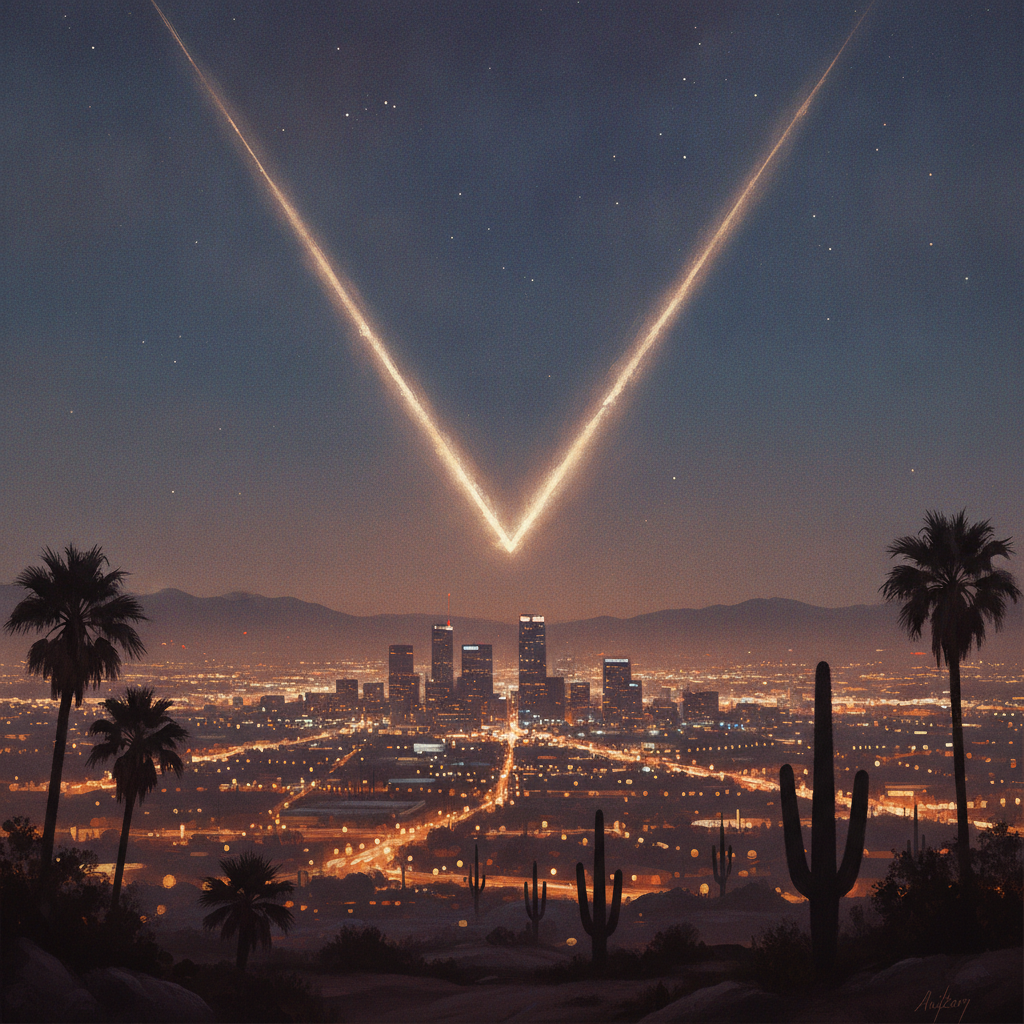
The Night Arizona Looked Up: Inside the Phoenix Lights of 1997
The evening of Thursday, 13 March 1997 found an unusual number of Arizonans already outside and looking up. Comet Hale-Bopp was approaching its closest pass to Earth and was easily visible to the naked eye, and families across the state had carried lawn chairs into their backyards to watch it. Whatever else is true of the next three hours, more eyes were on the desert sky that night than on almost any other night of the decade.
The first report did not come from Arizona at all. At about 7:55 p.m. Mountain Standard Time, a witness in Henderson, Nevada, telephoned the National UFO Reporting Center to describe a large V-shaped object travelling southeast, carrying several lights along its leading edge and making a sound the caller compared to rushing wind.
Roughly twenty minutes later the reports began moving down the map. At around 8:15 p.m., a former police officer in Paulden, in northern Arizona, watched a cluster of reddish-orange lights cross the sky and disappear over the southern horizon. Within minutes calls were coming from Prescott and Prescott Valley, then Wickenburg, then Glendale and Phoenix itself, and finally from Tucson, some 300 miles from where the sequence had begun. The reports arrived in a rough line, in a rough order, at roughly the pace of a slow aircraft.
What people described was remarkably consistent in its broad strokes and maddeningly inconsistent in its details. Most saw between five and seven lights arranged in a V or a shallow boomerang, moving slowly and, almost universally, silently. Many insisted the lights were not separate objects at all but were fixed to a single dark mass. The detail repeated most often is that as the formation passed overhead the stars behind it went out, row by row, and came back once it had gone. Witnesses in the northern suburbs, among them the Ley family, said the object passed almost directly above them at low altitude and took a full minute or more to clear the sky. Size estimates ran from the width of a football field to close to a mile.
The lights were seen by people with every professional reason to be careful about what they said. Bill Grava, an air traffic controller with twelve years of experience working the tower at Phoenix Sky Harbor International Airport that night, went outside to look and later described the sighting as weird and inexplicable. Nothing appeared on his radar. Police departments took calls from residents. Luke Air Force Base, west of the city, told callers it had nothing aloft that could account for what they were seeing.
Then, at about 10 p.m., something quite different happened. A row of brilliant lights appeared low in the southwestern sky over Phoenix, roughly in a line, apparently motionless and then slowly sinking. This second event lasted long enough for people to fetch camcorders, and it was filmed from dozens of vantage points across the city. It is this footage, not the earlier formation, that ran on the local news and travelled around the world. The two events were quickly merged in the public mind, and have been tangled together ever since.
Officially, very little happened next. Project Blue Book, the Air Force's public investigation of unidentified objects, had been shut down in 1969, and no federal agency opened an inquiry. The vacuum was filled at street level. Frances Emma Barwood, then a member of the Phoenix City Council, asked publicly what the lights had been and who was looking into them. She received no substantive answer from any federal body, and later said she had personally spoken with more than 700 witnesses, not one of whom had been interviewed by an official investigator. Her questions made her a target of ridicule in Arizona politics.
That ridicule reached its high point in June 1997, when Governor Fife Symington III called a press conference and announced that the party responsible had been apprehended. Two uniformed officers then escorted in a figure more than two metres tall in a silver alien costume. Under the mask was Symington's own chief of staff, Jay Heiler. The room laughed, and the Phoenix Lights effectively stopped being a serious matter for the state press.
An explanation for the second event did eventually arrive. The Air National Guard stated that on the night of 13 March, A-10 Thunderbolt II aircraft of the Maryland Air National Guard, deployed to Arizona under the winter training programme known as Operation Snowbird, had dropped LUU-2B/B illumination flares over the Barry M. Goldwater Range southwest of Phoenix. These are parachute flares designed to burn slowly and very brightly as they descend. Seen from the city, they would appear as a row of stationary lights hanging above the Estrella mountain range, then extinguishing or dropping behind the ridgeline one by one. In 2007 a reporter for The Arizona Republic located Lt. Col. Ed Jones, who confirmed that he had flown one of the aircraft that dropped flares that night.
A candidate explanation for the earlier formation had been available from the start. Mitch Stanley, an amateur astronomer in Scottsdale, watched the passing lights through his telescope while they were overhead. He reported that under magnification they resolved cleanly into individual aircraft flying in formation, each with recognisable wings, and that he said so at the time. Sceptical investigators, among them the Tucson astronomer and retired Air Force pilot James McGaha and the writer Robert Sheaffer, argued that both events traced back to the same organisation: a formation of A-10s transiting under visual flight rules, showing steady formation lights rather than blinking collision beacons, followed two hours later by the flare drop.
That might have settled the matter, except for what happened ten years later. In March 2007, on the tenth anniversary, Fife Symington told Fox 10 news anchor John Hook and other journalists that he had gone out that night himself, driven toward the Squaw Peak area, and watched an enormous craft pass overhead. Symington was a former United States Air Force officer and a pilot. He said he knew just about every machine that flies, that what he saw was bigger than anything he had ever seen, and that it was enormous and inexplicable. Asked why he had staged the costume stunt, he said he had wanted to calm a jittery public rather than feed a panic.
Others came forward late as well. Dr Lynne Kitei, a Phoenix physician, had filmed lights over the valley on several occasions including 13 March, and waited seven years before putting her name to the footage, fearing for her professional reputation.
Nearly three decades later the Phoenix Lights remain among the most widely witnessed unexplained aerial events on record, and the anniversary is still marked in Arizona every March.
Conclusions and Open Questions
Two separate things happened on 13 March 1997, and most of the argument since has come from treating them as one.
The 10 p.m. lights over Phoenix have a strong, specific and testable explanation. The Air National Guard named the unit, the aircraft type and the munition. The geometry works: flares released over the Barry M. Goldwater Range would appear from the city to rest on the Estrella ridgeline before dropping behind it. The videos show lights that do not move laterally, fade at different moments, and vanish in the order a descending flare line would. And a pilot who flew the mission confirmed it on the record. The weakness is not the explanation but its use: it is repeatedly presented as covering the whole night, though it says nothing about the reports from Nevada and northern Arizona two hours earlier.
For that earlier event, the leading explanation is a formation of A-10 aircraft, argued by James McGaha and Robert Sheaffer and supported by Mitch Stanley's telescope observation. Its strength is that it accounts for the timing, the direction of travel and the steady unblinking lights. Its weaknesses are real. It rests heavily on one amateur observation of one part of the sky. It does not obviously account for the low altitude and slow speed that many witnesses described, for the near-total silence, or for the repeated claim that the lights were mounted on a single continuous body that blotted out stars. Aircraft in formation do not usually erase constellations.
Beyond the two mainstream accounts, several open theories circulate. Some argue that the object was a classified aircraft under test, pointing to Arizona's proximity to restricted airspace. The weakness is that no documentation has surfaced in nearly thirty years, and that flying an unacknowledged airframe of the reported size low over a metropolitan area of more than a million people would be a strange risk for any test programme. One theory holds that the craft was not of human manufacture at all, which is what most of the witnesses themselves believe. Its weakness is the complete absence of physical evidence: no trace on the ground, no radar return, and no photograph that resolves a structure rather than lights. A further line of argument treats the case mainly as a lesson in memory, with the vivid, heavily filmed second event supplying the imagery that people later attached to the first.
What remains genuinely unexplained is narrower than the legend and harder than the debunking. No radar record of the earlier formation has ever been produced by any civilian or military facility, despite an object crossing controlled airspace beside a major international airport. No federal agency took statements from the witnesses, including a serving air traffic controller and a sitting governor. And the size discrepancy has never been resolved: a formation of five aircraft at altitude and a single object close to a kilometre across at low level are not descriptions that can both be roughly right.
The open questions have never been answered. Was there ever radar data, and if so, where is it? Why did no agency take statements while memories were still fresh? Why did a governor with a military flying background wait ten years to speak? And what should be made of the fact that the man who publicly turned the case into a joke is also one of its witnesses?