CROATOAN: The Colony That Walked Off the Map
On the morning of 18 August 1590, an English sailor waded onto the sandy shoulder of Roanoke Island and sounded a trumpet into the trees. It should have been a celebration. Somewhere on that low, wooded island off the coast of what is now North Carolina, a little girl named Virginia Dare was turning three, and the man who had ordered the trumpet call, the colony's governor and the child's own grandfather, John White, was waiting for her to come running. No one came. The sailors sang familiar English songs to coax out anyone hiding in the brush, and the woods gave back only their own echo.
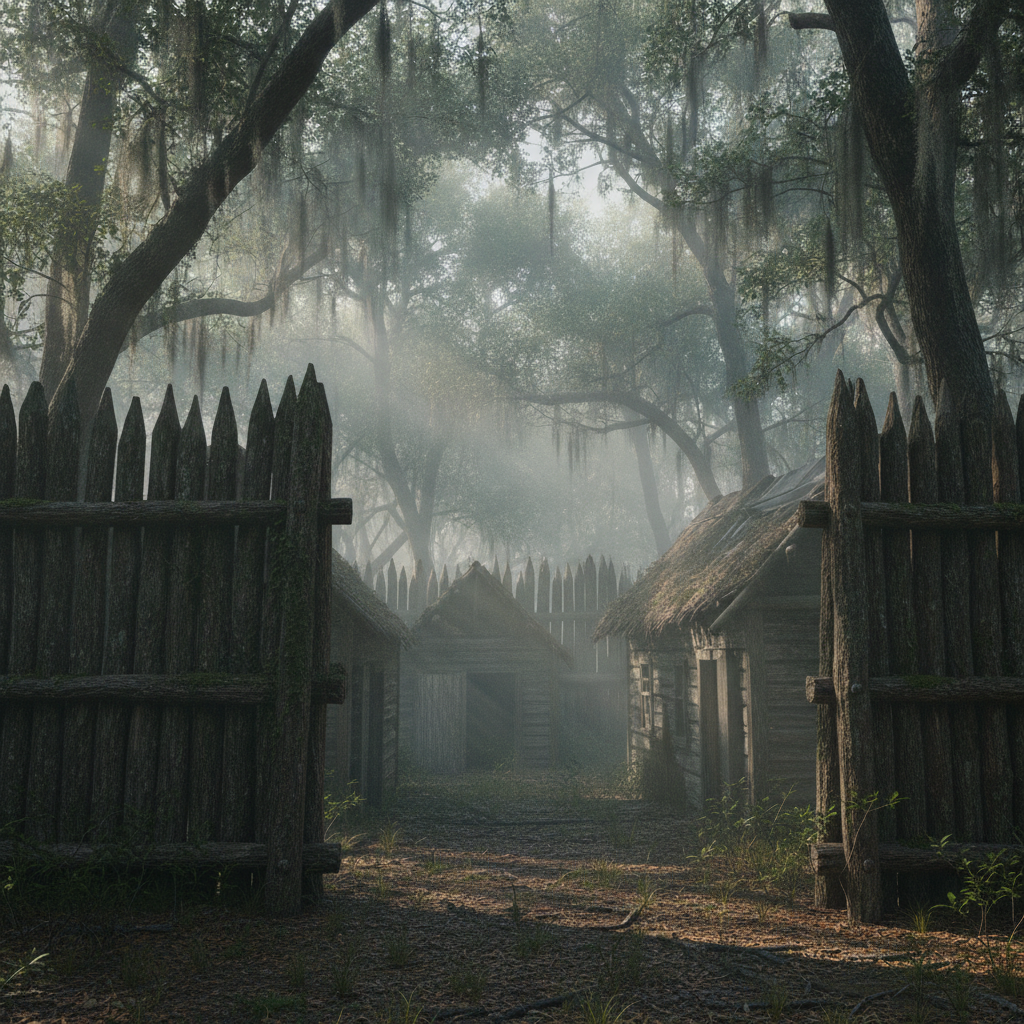
When White finally pushed through to the settlement he had left three years earlier, he found it taken apart with a deliberate care. The houses had been dismantled rather than burned. Heavy chests were found buried, dug up again and rifled through. And carved into a post of the palisade, in what he called fair capital letters, stood a single word: CROATOAN.
The trumpet on that empty beach was the last act of a venture that had been in trouble from its first day. In 1587, under a charter from Sir Walter Raleigh, about 115 English men, women and children crossed the Atlantic to build a permanent colony in the New World. They were meant to settle on the Chesapeake, but the expedition's Portuguese pilot, Simon Fernandes, refused to carry them any further and set them down at Roanoke instead. An earlier all-male military garrison had already failed there and had left relations with the local tribes poisoned by violence, including the killing of the Roanoke leader Wingina. It was on that island, on 18 August 1587, that White's daughter Eleanor gave birth to Virginia Dare, the first English child born on American soil.
Within weeks the situation was desperate. Food was short, the season was turning, and the colonists pressed their governor to do the one thing no leader wants to do: sail back to England himself and plead for relief. He could not have known it would take three years to return. White reached England late in 1587 and found the country bracing for invasion. When the Spanish Armada came in 1588 the Crown requisitioned every seaworthy vessel, and the two small ships White eventually begged loose turned to piracy on the way over, were mauled in a sea fight and limped home without ever reaching Roanoke.
Not until 1590 did he secure passage on a privateering voyage. By the time his boats worked their way toward the island a storm was already rising. Anchors were lost and seven men drowned in the surf near the inlet. Once White had seen the abandoned fort, the weather drove his fleet back out to open water before he could cross the few miles to Hatteras. He never set foot in America again and died around 1593, most likely in Ireland, without ever learning what had become of his daughter and granddaughter.
The word on the post was not meaningless to him. Before leaving in 1587 White had agreed a simple code with the colonists. If they moved inland or along the coast, they were to carve the name of their destination. If they left in distress, under attack or in fear, they would add a cross above it. On the palisade post stood CROATOAN, on a nearby tree the letters CRO, and nowhere any cross. To White the message read as almost hopeful. Croatoan was today's Hatteras Island, home of the one tribe that had stayed loyal, whose leader Manteo had sailed to England and back. White meant to follow. The Atlantic, and then his own death, decided otherwise.
Four centuries later, the most heavily documented modern search runs east, to Hatteras itself. Beginning in 2013, the Croatoan Archaeological Society, founded by the Hatteras-born historian Scott Dawson together with the British archaeologist Mark Horton of the University of Bristol, dug into a site at Cape Creek. Four to six feet down they pulled thousands of artifacts from the same layers of earth: fragments of English swords, gun hardware, writing slates, worked copper and lead, all of it lying among Croatoan pottery and arrowheads, with evidence of blacksmithing and metalworking that continued well into the 1600s. Dawson set out his reading of the finds in his 2020 book The Lost Colony and Hatteras Island. There is a faint documentary echo as well: years later, settlers at Jamestown gathered reports of light-skinned, English-looking people living among Native groups to the south.
A second body of evidence points the other way, inland. In 2012 researchers at the First Colony Foundation asked the British Museum to place John White's own 1585 map, La Virginea Pars, on a light table. Beneath two small corrective patches something had been hidden: at the confluence of the Roanoke and Chowan rivers, the faint symbol of a fort, as though White had marked and then deliberately concealed a planned inland refuge. Excavating in that area, at a spot they call Site X in the Salmon Creek region of Bertie County, the foundation recovered fragments of Tudor-era pottery of the kind a small group of colonists living away from the coast would have used.
Not every find has held up. The celebrated Kendall ring, a signet stamped with a prancing lion, was once linked by a London heraldry expert to a Kendall who had sailed on the voyages of the 1580s and was long assumed to be gold. Re-examination at East Carolina University found it to be brass.
What has never been found is the thing that would settle the case. In more than four centuries of searching there is no colonist's grave, no identifiable remains, no strand of DNA linking a living family to Eleanor Dare or one of her neighbours, and not a scrap of a journal. The houses are gone, the palisade is gone, and even the shoreline White knew has been reshaped by the sea. The post itself rotted away long ago, so that the word survives only as a description in a grieving grandfather's report. What became of Virginia Dare is not merely unknown but unknowable from any surviving record, and over the centuries her name has drifted out of history and into legend.
Conclusions and Open Questions
The most popular reading today is the plainest one, argued most forcefully by Scott Dawson and supported by the Cape Creek excavations: that the colonists were never lost at all. They moved in with their allies exactly as the post said, and their descendants blended into the tribe. Its weakness has been stated steadily by the archaeologist Charles Ewen of East Carolina University, who is the field's main voice of caution. English goods travelled Native trade routes for decades, he points out, so a sword hilt at Cape Creek proves contact, not necessarily residence. Much of the Hatteras material has still not passed full peer review, and the Kendall ring is a warning of how quickly a tidy story can dissolve under a laboratory light. Popular is not the same as proven.
The Site X evidence, put forward by the First Colony Foundation, suggests instead that at least part of the group walked west to the fort White had drawn and then hidden on his map. That pottery is genuine but sparse. A scatter of sherds could mark a handful of colonists or a later English trader, and none of it can yet be tied to a settler by name.
The oldest theory is massacre. It rests largely on later Jamestown testimony in which the Powhatan paramount chief was reported to have boasted of destroying a nearby English settlement. The account is secondhand, reached English ears years afterward, and left no burned village and no mass grave to confirm it. A rival idea holds that the colonists built a boat and drowned trying to reach England; that explains their absence but not the calm, plank-by-plank dismantling of the houses, nor a sign that clearly named a destination on land. The fear that haunted White himself, a Spanish raid, collapses against a simple fact: Spain was still hunting for the English colony years later and never found it either.
One theory now gaining ground is that the long search for a single answer was itself the mistake. Some argue that a frightened, half-starved community left three years without relief would not have moved as one body, and that it fractured under the strain: the greater part going to Croatoan with Manteo's people and cutting the word into the post, a smaller party heading inland, perhaps a desperate few gambling on the open sea. If so, there is no one lost colony waiting to be found, only several smaller disappearances.
The open questions remain concrete. How does a community of more than a hundred people leave behind not one body and not one marked grave? Who takes a village apart plank by plank, patient work for unhurried hands, rather than run? Why did no later English visitor sit down with the people of Hatteras and simply ask them what had happened? And why did the colonists leave exactly one clue, when four hundred years of digging has yet to follow it all the way to its end?