The Twelve-Sided Object Rome Never Explained
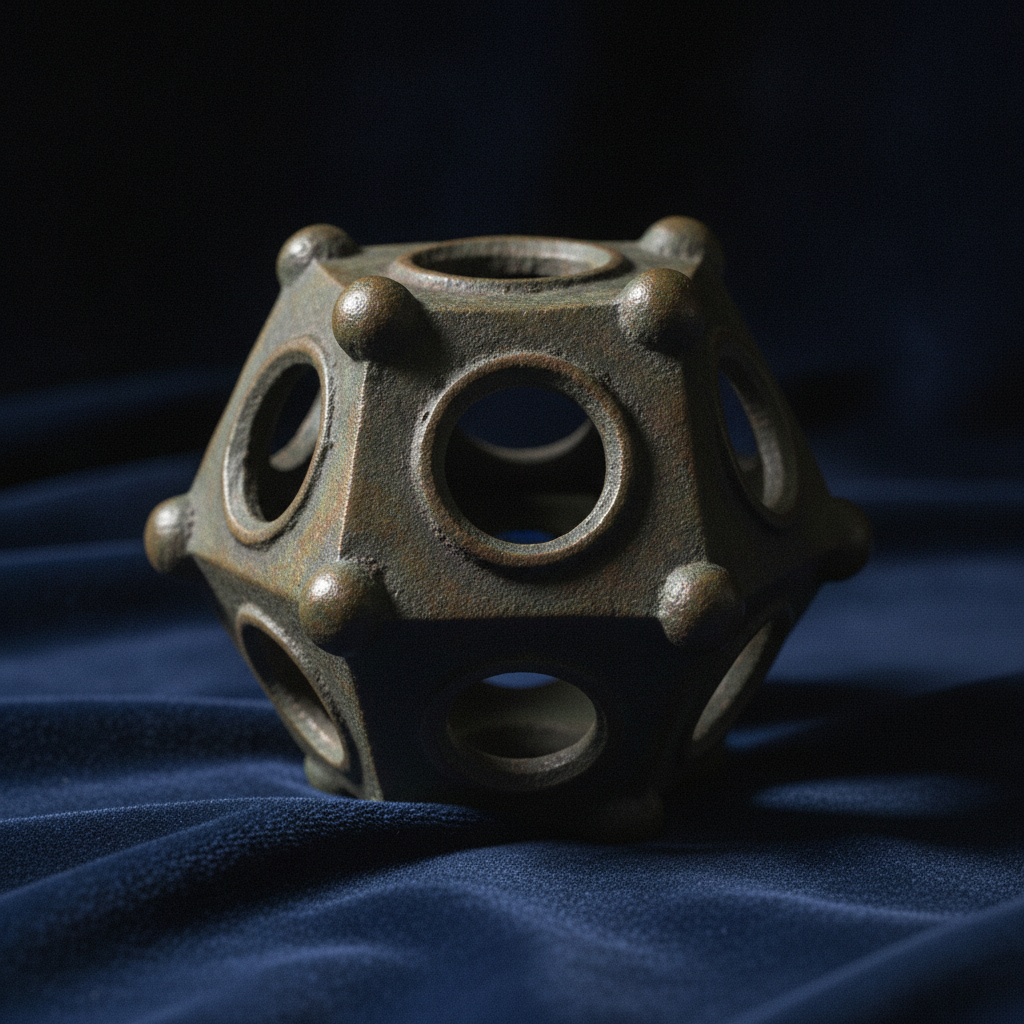
In June 2023, volunteers from the Norton Disney History and Archaeology Group were closing out a community excavation in a field at Potter Hill, near the village of Norton Disney in Lincolnshire, England. The trench had already yielded the ordinary residue of Roman rural life: potsherds, animal bone, building rubble. Then, in the final days of the dig, a heavy corroded lump came out of a pit. Cleaned, it turned out to be hollow and twelve-sided. Every one of its twelve pentagonal faces was pierced by a round hole, and no two holes were the same diameter. At each of its twenty corners sat a small knob.
The object stands about 8 centimetres tall and weighs 245 grams, which makes it one of the largest and heaviest examples ever recovered in Britain and, after some 1,700 years underground, one of the most complete. Analysis showed an unusual alloy: roughly 63 percent copper and 27 percent lead, with traces of other metals. The high lead content would have helped the molten metal flow into a complicated mould, which suggests a caster who knew exactly what the shape demanded. The finders understood at once what they were holding, because objects of this kind have been surfacing in Europe for nearly three centuries. What nobody could tell them, in 2023 or today, was what it was for.
The first recorded example came to light in 1739 at Aston in Hertfordshire, England, and was described at the time as a curiosity of unknown use. Since then more than a hundred have been catalogued. They come from Britain, France, Belgium, the Netherlands, Luxembourg, Germany, Switzerland, Austria and Hungary. The Norton Disney find brought the British total to 33, and it was the first from the English Midlands. The distribution is the first hard fact about these objects, and it is a strange one: every secure find comes from the north-western provinces of the Roman Empire, the lands the Romans called Gaul, Britannia and Germania. Not one has been securely excavated in Italy, in Greece, in Spain, in North Africa or anywhere else around the Mediterranean, which was the empire's demographic, economic and literary heartland. Whatever these things were, they belonged to the provinces and apparently never travelled south.
Physically they form a recognisable family without ever being standardised. Diameters run from about 4 to 11 centimetres. Weights run from about 35 grams to a full kilogram. The holes bored through the faces measure anywhere from 6 to 40 millimetres, and within a single object the holes are deliberately different from one another, frequently arranged so that a large opening faces a small one across the hollow interior. The knobs at the twenty corners were usually made separately and attached. Almost every known example is copper alloy, cast by the lost-wax method; a handful in silver survive, and gold is reported. Where dating evidence exists it points to the second, third and fourth centuries of our era, with production concentrated in Gaul. Not one dodecahedron carries a number, a scale, a graduation or an inscription explaining itself.
There are relatives. In 1982 a solid silver dodecahedron was found in Geneva, Switzerland, engraved with the names of the signs of the zodiac, one to a face. From Arloff, near Bonn in Germany, comes a bronze icosahedron, a twenty-sided object built on the same logic, with several enlarged knobs. In 2009, at Saint-Trivier-de-Courtes in eastern France, excavators recovered a roughly spherical bronze piece pierced by both triangular and pentagonal openings. These variants show that provincial Roman craftsmen were working through a family of geometric forms rather than repeating one fixed design, and that at least one of those forms was linked, in somebody's mind, to the twelve signs of the zodiac.
The archaeological contexts are as varied as the objects themselves. Some dodecahedra have been recovered from graves. Some come from hoards, buried alongside coins and scrap metal, which implies that whoever hid them thought them worth saving. Others come from what looks like plain refuse. Norton Disney belongs in that last category. The object lay in a large Roman pit originally dug to extract sand and later reused as a rubbish dump. A coin of the emperor Claudius II, who reigned from 268 to 270, was recovered above it, and locally made Swanpool pottery of the fourth century was present in the fill. The dodecahedron lay neither at the very bottom of the pit nor at the very top, and it was surrounded by ordinary domestic waste. An elaborate, expensive, technically demanding piece of bronze appears to have been thrown away like a broken pot.
And then there is the silence. The Romans wrote prolifically about their own material world. Surveyors described their instruments. Agricultural writers described their tools. Doctors listed their implements. Mosaics, wall paintings, tombstones and carved reliefs across the empire show objects in use, from scales and styluses to looms and surgical kits. Nowhere in any surviving Roman text is there a sentence that can be matched to a dodecahedron. No inscription names one. No image shows a hand holding one. For an object produced in the hundreds over two or three centuries, across a territory stretching from the Scottish borders to Hungary, that absence is itself the central problem.
The Norton Disney dodecahedron went on public display at the National Civil War Centre in Newark in January 2024, drew international press coverage, travelled for study and exhibition, and returned to Newark in June 2025. Around it a broader research effort continues. Lorena Hitchens, a doctoral researcher in the United Kingdom, has been working through the entire European corpus, recording sizes, weights, alloys and find contexts in the hope of seeing a pattern that individual finds have never revealed.
Conclusions and Open Questions
More than fifty explanations have been published since 1739. The honest summary is that not one of them has been proved.
The most durable practical proposal is that the dodecahedra were measuring devices. Amelia Carolina Sparavigna, a physicist at the Polytechnic University of Turin, argued that a user could sight through a pair of differently sized holes on opposite faces and, knowing the size of a distant object, calculate its distance, making the dodecahedron a lens-free optical instrument, a dioptron or rangefinder. The weakness is close to fatal: measuring instruments need standard dimensions and marked scales, and these objects have neither. Two dodecahedra of different sizes would give two different readings of the same distance.
A second popular idea is textile work. Martin Hallett tested it with a 3D-printed replica and produced the fingers of a glove, using the knobs as pegs and the holes as guides. That would explain both the varying hole sizes, for different finger widths, and the varying overall sizes, for different hands. Against it stands the fact that knitting as such is not securely documented in the Roman west, where the related craft of nalbinding was practised, and that most surviving dodecahedra show little or no wear on the knobs and edges where yarn would have rubbed for years. There is also the economics: bronze was costly, and a wooden or bone tool would have done the same job far more cheaply.
G.M.C. Wagemans proposed an agricultural and astronomical function, using a bronze copy to measure the angle of sunlight and identify the spring and autumn equinoxes, and so fix sowing dates. The objection is the same as for surveying. Without standard sizes and reference marks the readings cannot be consistent, and no excavation has yet produced a dodecahedron in a setting that resembles an observation point.
Candlesticks, gaming dice, coin gauges, children's toys and showpieces cast by metalworkers to advertise their skill have all been proposed. Each is possible. None of them explains why the objects stop dead at the Mediterranean.
The reading most archaeologists currently favour is ritual or symbolic. Hitchens points out that the lack of standardisation and the lack of wear together rule out most utilitarian explanations, and that the distribution matches the Gallo-Roman religious world rather than the military or administrative one. The shape itself carried weight: in the Platonic tradition the dodecahedron was the solid associated with the cosmos as a whole, and the Geneva silver piece with its zodiac names proves a real ancient link between this form and the heavens. The weakness is that archaeologists reach for the word ritual precisely when function is unknown, and the Norton Disney context, a rubbish-filled quarry pit, is a poor fit for a sacred object.
Claims that the dodecahedra are relics of Atlantis or evidence of visitors from other worlds circulate widely online and are rejected by archaeologists without qualification. The alloys, the casting technique and the datable find contexts are unambiguously Roman provincial. As an open theory, several researchers now suggest there may never have been a single answer, and that a shape already charged with meaning was put to different uses by different people across three centuries.
The open questions are precise. Why is there no secure Mediterranean example? Why does no Roman writer mention an object that hundreds of people owned? Why are the holes deliberately unequal, if not for measurement? Were they made by one workshop tradition in Gaul, or invented repeatedly? Until a dodecahedron is found in a context that speaks clearly, or a line of ancient text is finally recognised as describing one, the answer stays where it has been since a Hertfordshire field gave up the first of them in 1739.