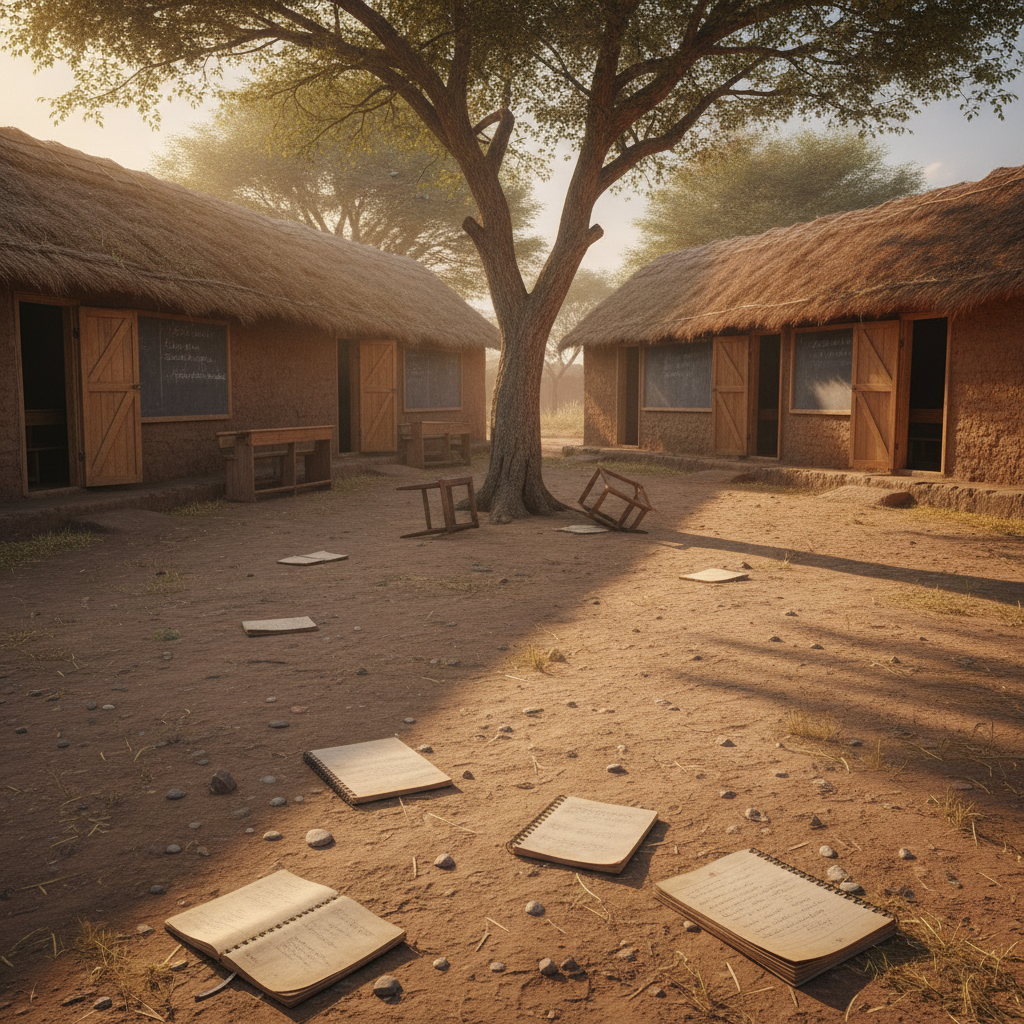
The Laughter That Closed the Schools: Tanganyika, 1962
The rains had barely eased over Lake Victoria on the morning of 30 January 1962 when three pupils at a mission boarding school for girls in the village of Kashasha, in the Bukoba district of what was then Tanganyika, began to laugh in class. The laughter was not a response to a joke. It came in waves that doubled the girls over, and when one wave passed another followed. Within hours it had spread to the girls sitting beside them, and then to the girls beside those, until the teachers at the front of the room had lost the class entirely. Over the following eighteen months the same condition would empty fourteen schools and affect roughly a thousand people across one corner of a country that had been independent for less than two months.
The popular label, the laughing epidemic, describes the outbreak poorly. Witnesses and the doctors who later examined the victims recorded attacks in which laughing and crying alternated without warning, accompanied by screaming, aimless running, restlessness, fainting, difficulty breathing, rashes on the skin and a diffuse pain the girls could not locate. Some of those affected reported a fear that something or someone was chasing them. An individual attack could last from a few hours to as long as sixteen days, with an average of about a week, and the same girl could be seized again after apparently recovering. Between attacks the victims looked and behaved normally. Almost all of them were young, roughly twelve to eighteen years old, and while an episode held a girl she was, for practical purposes, unreachable.
Inside Kashasha the spread was continuous. Of the 159 pupils enrolled, 95 were eventually affected. Not one member of the teaching staff fell ill, although the staff stood in the same rooms, breathed the same air and in many cases ate the same food. After roughly forty eight days of failed attempts to hold classes together, the school gave up. On 18 March 1962 it closed and sent the girls home.
Closing the school did not end the outbreak. The pupils returning to their home villages carried the condition with them, and it appeared wherever they went. In Nshamba, a village about fifty five miles west of the district town of Bukoba, 217 people, most of them young, were affected over a period of about thirty four days in April and May. When Kashasha reopened cautiously on 21 May, the attacks returned within weeks and 57 more pupils were affected, forcing a second closure. At the Ramashenye girls' middle school near Bukoba, another 48 girls were affected in June. Researchers who later reconstructed the episode counted fourteen schools closed and roughly a thousand people affected, with every outbreak falling inside a radius of about a hundred miles of Bukoba. The waves continued for somewhere between six and eighteen months and then stopped.
The district had its own account of what was happening. Talk of poisoning circulated through the villages, and parents pressed the authorities to find out what had been put into the food or the water. The mission staff, the district administration and the visiting doctors were all asked the same question, and none of them could answer it.
Two physicians documented the outbreak properly. A. M. Rankin and P. J. Philip, working out of Bukoba, published their account in 1963 in the Central African Journal of Medicine under the plain title An Epidemic of Laughing in the Bukoba District of Tanganyika. They looked for a poison in the food and the water and found none. They performed lumbar punctures, drawing spinal fluid to search for infection of the brain and the nervous system. They ran virus studies. They took blood. They recorded the transient physical signs the victims did show, among them dilated pupils and exaggerated reflexes. There was no fever, no organic pathology and nothing in any laboratory result that pointed to disease in the ordinary sense. Across all those months and all those hundreds of cases, nobody died.
Rankin and Philip concluded that they were dealing with a form of mass hysteria, which they described as a culturally determined condition rather than a disease of the body. Their report set out the features that led them there. The victims were confined almost entirely to the pupils and to young people in the villages the pupils came from. The condition travelled along lines of friendship and family rather than by simple proximity. The symptoms rose and receded with social contact. Their paper remains the primary source for nearly everything that is known about the episode, because no other systematic clinical record was made at the time.
The setting matters to every account written since. Tanganyika had become independent on 9 December 1961, barely seven weeks before the first attack. Kashasha was a mission school run on European lines, with strict discipline, boarding conditions and an examination system that families treated as the gateway to a place in the new country. Most of the girls were living away from home in close quarters, in each other's company day and night, under pressure from the school on one side and from family expectation on the other.
The outbreak ended without intervention. No treatment was given, no source was removed and no antidote existed to administer. The attacks became smaller and less frequent through 1962 and into 1963 until they ceased, and the schools reopened for good. Since then the Kashasha outbreak has become the most frequently cited example of what medicine now calls mass psychogenic illness, a category in which symptoms are real, involuntary and physical but spread through social contact rather than through a pathogen or a toxin. Comparable outbreaks have been documented many times since, in factories, in schools and, more recently, among young people connected only through video and social media.
Conclusions and Open Questions
Three explanations have been offered for the Kashasha outbreak, and a fourth account attempts to supply the motive the others lack.
The first, and the one the villagers themselves reached for, was poisoning. It is the intuitive answer, and its strength is that it matches the scale of the event. Its weakness is the evidence. Rankin and Philip found no toxic factor in the food or water supply, and no poison known then or now produces months of alternating laughter and weeping while leaving the blood, the spinal fluid and the body's chemistry entirely normal, and killing nobody at all. A toxin that selects its victims by age and social circle, and spares the adults who share the same table, is not behaving like a toxin.
The second candidate was infection, some virus or a form of encephalitis. Epidemics are usually caught, so the idea has surface appeal. It founders on the same rocks. There was no fever, the lumbar punctures and virus studies were negative, and the illness followed lines of human relationship rather than the blind diffusion of a pathogen. Encephalitis does not close a school and then break out in a distant village because a particular girl went home for the holidays.
The explanation that has held the field for sixty years is mass psychogenic illness, which Rankin and Philip called mass hysteria. Its great strength is that it fits every feature on which the other theories break: the clean laboratories, the immunity of the older staff, the transmission by friendship and kinship, the concentration among adolescents, the way the outbreak rose and fell with social contact. Its weakness is that the term is closer to a description than to a mechanism. It names the shape of the thing without telling us what actually passed from one girl to the next, or why the body answers stress with laughter, or what threw the first switch.
Into that gap steps the most cited modern account, from Christian Hempelmann, a linguist at Texas A&M University who studied the case closely. Hempelmann argues that the laughter was not joy but a release valve for extreme and sustained stress: the rigid discipline of a European mission school on one side, traditional family expectation on the other, and around it all a country in upheaval weeks after independence. The strength of this reading is that it supplies the missing motive and explains the demographics, why the strained adolescent girls and not the settled adults. Its weakness is that it cannot be proven. It is a plausible story fitted to the facts after the event, and it still does not answer the small, hard questions.
Those questions remain open. Why laughter, of all the things a distressed body can do, and not silence or paralysis? Why Kashasha, and why that particular January morning, and why those three girls rather than three others? Why did not a single adult fall ill, when adults elsewhere have been affected in comparable outbreaks? And why did it stop? Nothing was cured and no source was removed; the waves simply grew smaller until they ended. One theory holds that the stress that fed the outbreak drained away as the shock of independence settled into ordinary life, but that is a guess offered in place of an answer.
Some argue that the authorities made the outbreak worse. On this reading, closing the schools was precisely the wrong move, scattering frightened and primed children back into their villages where the pattern could seed itself again, so that the measure meant to contain the outbreak became its delivery system. The sequence of events is consistent with this, but the same sequence would also be produced by any condition that travels with people, so it cannot be tested.
One point deserves saying plainly. The word hysteria, applied in 1963, carried a dismissiveness that did lasting damage to how the girls were remembered. Their suffering was real, their schooling and their villages were genuinely disrupted, and nobody has shown that they were pretending. Six decades on, medicine has learned to name what happened at Kashasha. It has not learned to explain it. We know a great deal about what it was not, and we still do not know what it was.