Into the Atlantic: The Artist Who Sailed Inside His Own Artwork
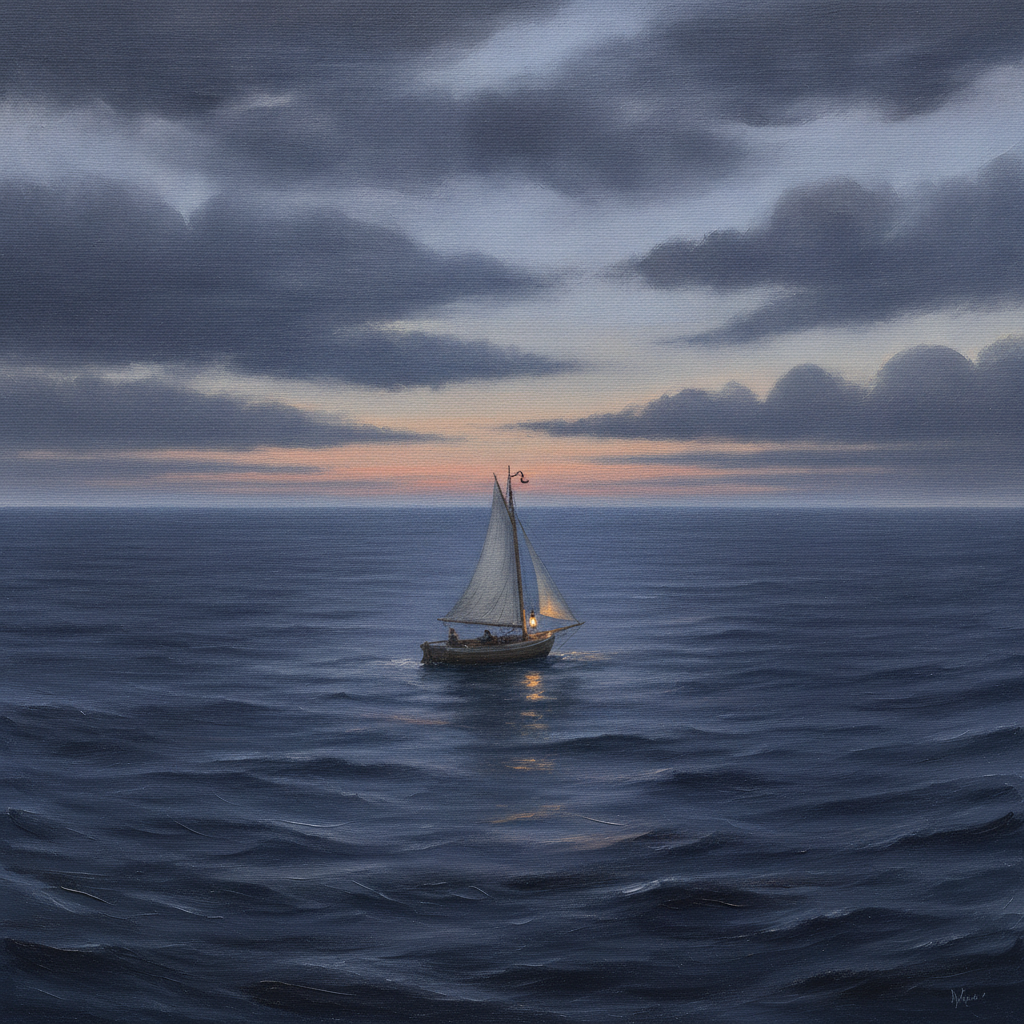
On 9 July 1975 a thirty-three-year-old Dutch artist cast off from Chatham, on Cape Cod, in a boat twelve and a half feet long. The vessel was a modified Guppy 13 pocket cruiser, a fibreglass daysailer of the kind normally kept on a trailer and used on a lake. He had named her Ocean Wave. His destination was Falmouth, in England, roughly three thousand miles across the North Atlantic, and he expected the passage to take somewhere between two and three months. He was not attempting a stunt for a sponsor. The voyage was the middle section of an artwork called In Search of the Miraculous.
His name was Bastiaan Johan Christiaan Ader, known as Bas Jan Ader. Radio contact broke off about three weeks out. He never reached England, and no trace of him has ever been found.
He was born on 19 April 1942 in Winschoten, in the north of the Netherlands. Both his parents were Calvinist ministers. His father, Bastiaan Jan Ader, hid Jewish refugees during the German occupation; he was arrested and shot by a firing squad in 1944, together with a group of other prisoners. Bas Jan was two years old. He and his younger brother Erik were raised by their mother, Johanna Adriana Ader-Appels, who was a writer as well as a minister and who wrote about the loss.
The sea entered his life early and by accident. As a young man he made his way to Morocco and took work as a deckhand on a yacht bound for California. The passage lasted about eleven months and ended, in one of the ironies that his biography keeps producing, in a shipwreck near the American coast. He arrived in southern California in 1963 and stayed. He studied at the Otis Art Institute in Los Angeles and took a master's degree at Claremont Graduate School in 1967. He married a fellow artist, Mary Sue Andersen. He taught at the University of California, Irvine. He lived the last twelve years of his life in Los Angeles, on the far side of the ocean his father's country faces.
The work he made there was small in quantity and unmistakable in character. Ader used himself as the only performer and gravity as the only special effect. In Fall I, Los Angeles (1970) he sits on a chair on the pitched roof of his own house and rolls off it into the shrubbery. In Fall II, Amsterdam (1970) he cycles along a canal and rides straight into the water. In Broken fall (organic) (1971) he hangs from the branch of a tree over a stream in the Amsterdam woods until his arms give out. In I'm too sad to tell you (1970 to 1971) he films his own face, in black and white, for around three minutes, crying, and offers no explanation at all. The pieces are usually short, silent, and framed with the deadpan precision of a man who had thought very carefully about how long a viewer can look at a failure.
In Search of the Miraculous was conceived as a work in three parts, and it grew directly out of that logic. The first part, made in 1973 and titled In Search of the Miraculous (One Night in Los Angeles), is a sequence of black and white photographs of Ader walking alone through the city at night, from the hills down to the Pacific, with the beam of a flashlight in front of him. Across the images he wrote, by hand in white, lines from the Coasters song Searchin'. The sequence ends at the water. In the spring of 1975 the work was shown at the Claire Copley Gallery in Los Angeles, and the opening included a student choir singing sea shanties, among them the song from which he took the name of his boat.
The second part was the crossing itself. The third was to be an exhibition in the Netherlands, at the Groninger Museum, with photographs from the voyage and the shanties sung again, closing the circle on European ground. He intended, according to those who knew the plan, to make the crossing in the smallest boat in which anyone had attempted it single-handed from west to east.
Preparation was real, not symbolic. Ocean Wave was modified for the ocean, and Ader took what a solo sailor of the period took: charts, a radio, provisions, safety line. He was an experienced small-boat sailor, not a romantic amateur.
He left Chatham on 9 July 1975. For roughly three weeks there was radio contact. Then it stopped. Weeks passed, then the estimated arrival window, then months. His wife and his brother pressed for searches and for information from shipping. Nothing came back. By the autumn he was presumed lost at sea.
Nine months after his departure, on 18 April 1976, the crew of a Spanish trawler, the Eduardo Pondal, sighted a very small boat off the southwest approaches to Ireland. Reports of the position vary between roughly one hundred and two hundred nautical miles offshore, west of Land's End and southwest of the Irish coast. It was Ocean Wave. She was floating almost vertically, bow down, held up by her flotation, and she was empty. From the growth of barnacles on the hull the trawler's captain judged that she had been drifting for about six months.
The boat was taken into A Coruna in northwestern Spain, where the Spanish authorities examined her. Personal effects were aboard, among them Ader's identity card from the University of California. His widow and his brother made arrangements to travel and inspect her.
They never did. Some time between 18 May and 7 June 1976, Ocean Wave was stolen from the harbour at A Coruna, most probably for her salvage value by someone who had no idea what she was. She has never been recovered. With her went the only physical evidence in the case: the deck fittings, the safety line, the state of the rigging, everything that might have shown how a man leaves a boat in the middle of an ocean.
Bas Jan Ader's body was never found. He was thirty-three. The Groningen exhibition, the third part of the work, was never made in the form he planned. His output amounts to a handful of films, some photographs and a few installations, and it has since been shown in retrospectives across Europe and the United States, making him one of the most influential artists of his generation with one of the smallest bodies of work.
Conclusions and Open Questions
There are essentially two readings, and the case has never produced enough evidence to close the gap between them.
The first is that this was a sailing accident. Ader's brother Erik, an experienced ocean sailor himself, has argued that Ader went overboard in heavy weather and that the fixed point on deck to which his safety line was attached tore out under the load. That would explain an empty boat that was still afloat, still upright enough to be spotted nine months later, and it fits the North Atlantic in the autumn better than any other explanation. Its weakness is that it cannot be tested. The boat was stolen before anyone who knew Ader could look at the fittings, and without the deck there is no way to confirm or refute the torn attachment point.
The second reading, which took hold quickly in the art world, is that the voyage was a planned disappearance: a work whose subject was the artist's own death, staged rather than suffered. It draws on his own material. His art was made of falling, of failure, of the moment before impact; he had filmed himself weeping without explanation; and his father had died a hero's death that shaped the family for a generation. The weakness of this reading is that there is no evidence for it whatsoever. Ader had booked the third part of the trilogy. He had a life, a marriage and a teaching post to come back to. He prepared the boat as a sailor prepares a boat. His widow, Mary Sue Andersen, said plainly that his students had invented scenarios because they could not live with the plain fact of the loss. One theory holds that he intended a symbolic crossing and accepted the risk of not surviving it; even that is an interpretation of temperament, not a finding.
A third and looser idea, occasionally raised, is that he simply walked away and lived under another name. Nothing supports it. No sighting, no document, no trace in fifty years, and a boat found empty and adrift in the open Atlantic is a poor way to fake a departure.
What remains unexplained is the middle of the story. Nobody knows what happened between the last radio contact, about three weeks out, and the moment Ocean Wave began drifting alone. There is no logbook, no wreck site, no position, no distress call. The barnacle estimate of six months adrift, made by eye on a working trawler, would place the loss somewhere in the autumn of 1975, but it is an estimate and nothing more.
The open questions are mostly questions about evidence that no longer exists. Where did Ocean Wave go after she was taken from A Coruna, and could a hull thirteen feet long still be sitting in a Galician yard or garden? Were the Spanish inspection notes and photographs from 1976 ever archived, and has anyone reread them with a sailor's eye? What exactly did the last radio transmissions say, and to whom? And the question that the art world and the family have answered differently for fifty years: whether an artwork that requires the artist to cross an ocean alone in a boat that small should be read as a work of hope, a serious calculation of risk, or something else entirely. Ader left the title, and it is not an innocent one. He called it In Search of the Miraculous, and he did not come back to explain what he meant.