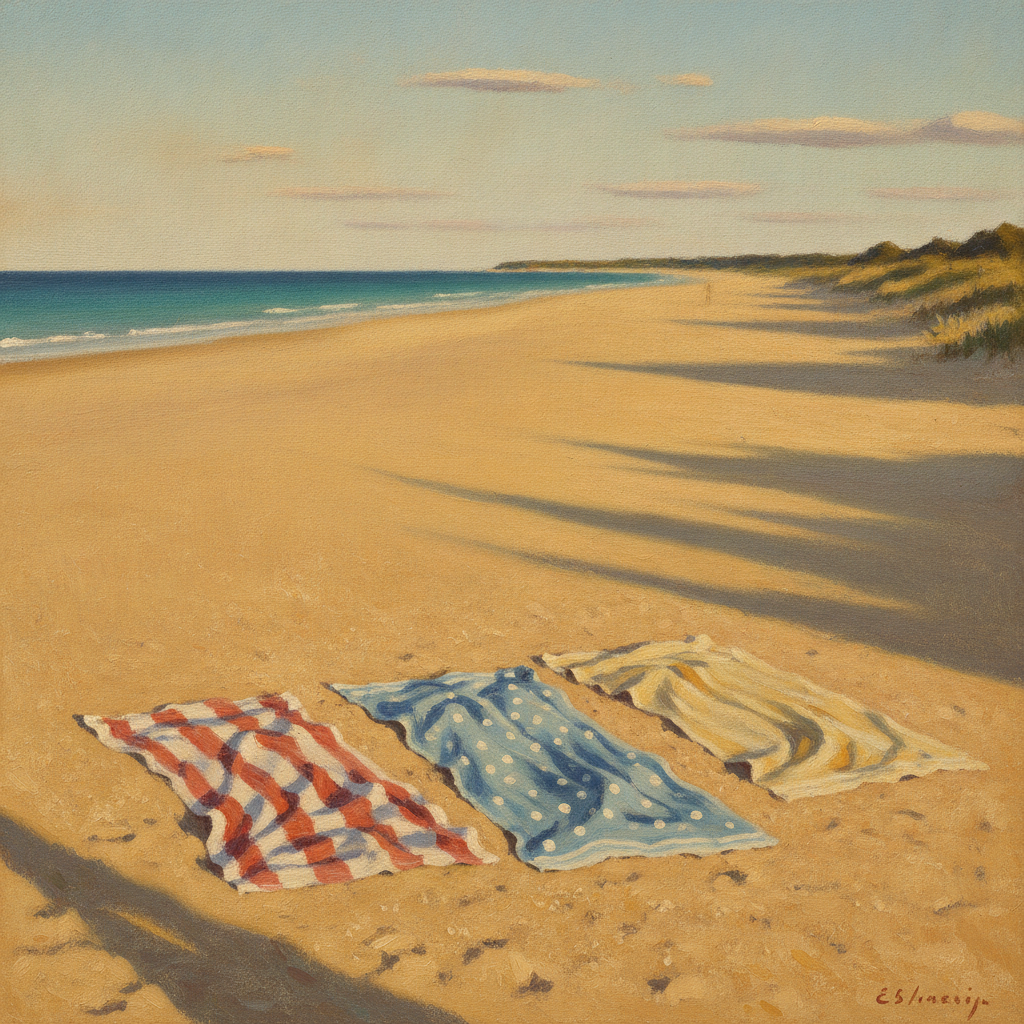
Three Children, One Pound Note, and Sixty Years of Silence
Adelaide was in the middle of a heatwave on 26 January 1966. It was Australia Day, a public holiday, and the temperature in the South Australian capital was climbing towards 40 degrees. At 109 Harding Street, in the quiet seaside suburb of Somerton Park, three children asked their mother whether they could go to the beach.
Their father, Grant Ellis Beaumont, known to everyone as Jim, was a travelling salesman for a linen company and had left on a sales trip. Their mother, Nancy, was at home. Jane Nartare Beaumont was nine, a careful and protective older sister. Arnna Kathleen was seven. Grant, named for his father, was four. Glenelg beach was a five minute bus ride from the corner near their house, and the three had made exactly the same trip alone the day before and come home on time.
Nancy gave Jane a handful of silver coins for the bus fares and for lunch. Accounts of the exact sum differ slightly, but every version agrees on one point: it was small change, and it did not include a one pound note. The children left the house shortly before nine in the morning and caught the bus. They were due home on the noon service.
At Glenelg they were seen almost immediately, and they were not alone. Several independent witnesses at Colley Reserve, the grassed area behind the beach, described the three children playing with a man. He was tall and lean, with fair to light brown hair, a thin face, a deep suntan and an athletic build, apparently in his mid thirties, wearing only swimming trunks. What struck the witnesses most was the children's manner. They were relaxed and playful with him. Arnna, the middle child, was seen chasing him and laughing. Jane, normally wary of strangers, showed no hesitation at all. Several witnesses assumed he was their father.
One detail from that morning would trouble investigators for the next sixty years. A witness reported that the man appeared to be searching through the children's towels and clothes, and that he mentioned money had gone missing from under them. It is a small thing. It is also the kind of story an adult might use to make three children trust him.
At some point before half past twelve the group was seen walking away from the water together, the children dressed and carrying their bags. Shortly afterwards Jane walked into Wenzel's cake shop on Moseley Street, a bakery the family knew well, and bought pies, pasties, buns and drinks. It was far more food than three children would normally buy for themselves, and the shop assistant later told police that the Beaumonts had never bought a meat pie on any previous visit. Jane paid with a one pound note.
That banknote is the single hardest fact in the case. Nancy Beaumont was certain she had not given her daughter a pound. Somebody else had.
The last reported sighting came from a postman, Tom Patterson, who knew the children by sight and saw them walking alone along Jetty Road, holding hands and laughing, heading away from the beach in the direction of home. He first placed the sighting in the middle of the afternoon. Later he acknowledged he could no longer be certain whether it had been the morning or the afternoon. It remains the last time anyone is known to have seen Jane, Arnna and Grant Beaumont.
The noon bus came and went. So did the two o'clock. Nancy walked to the stop, then to the beach. Jim came home from his trip in the late afternoon and searched the foreshore himself. At about half past five the parents walked into the Glenelg police station and reported their three children missing.
The first response was routine. Police assumed the children had lost track of time and organised a search of the beach and the streets behind it. Within days it had become the largest search operation South Australia had ever mounted. On 29 January the Patawalonga boat haven was drained after a woman reported seeing three similar children near it on the evening of the disappearance. Nothing was found. Sand dunes were dug over, drains were opened, thousands of homes were doorknocked, and the first reward was posted.
The case broke something in Australian public life. Within three days a Sunday newspaper headline in Adelaide read that a sex crime was now feared. Parents who had thought nothing of sending children to the beach alone stopped doing it. More than half a century later, the disappearance is still described as the moment Australian childhood changed.
In November 1966 the Dutch clairvoyant Gerard Croiset was flown to Adelaide amid enormous publicity. He identified a warehouse not far from the children's home, and said the bodies lay near an old brick kiln beneath it. The owners resisted, then gave way to public pressure after some 40,000 dollars was raised by the public to demolish the building. Nothing was found. A further search of the site in 1996 also found nothing.
About two years after the disappearance the Beaumonts received letters, one apparently written by Jane and one from a man claiming to be the children's guardian, postmarked Dandenong in Victoria. The letters described a comfortable life and offered a return. A meeting place was named. Nobody came. A third letter accused the family of bringing a detective in disguise and said the children would be kept. In 1992, with improved fingerprint techniques, the letters were proved to be a hoax and traced to a man then aged 41 who had written them as a teenager. Too much time had passed for charges to be laid.
Attention later turned to a factory site at North Plympton, the former New Castalloy works. A limited excavation in 2013 followed ground penetrating radar readings and found nothing. In February 2018 detectives returned for a nine hour dig that produced animal bones and buried rubbish. In February 2025 a third, privately funded search organised by South Australian MP Frank Pangallo ran for a week at the same site. It also ended with nothing.
Jim and Nancy Beaumont never moved on in any ordinary sense. They stayed for years in the Harding Street house because Nancy could not bear the thought of the children coming home and finding no one there. They eventually separated and withdrew from public life. Nancy died in an Adelaide nursing home on 16 September 2019, aged 92. Jim died on 9 April 2023, aged 97. Neither ever learned what happened.
The reward now stands at one million Australian dollars. South Australia Police have never closed the file.
Conclusions and Open Questions
Almost everything in this case is contested except one thing. The pound note in Jane's hand at Wenzel's bakery did not come from her mother, and the police view has never seriously changed: an adult was with the children, and the children trusted him.
Several men have been publicly named over the decades. None has ever been charged in connection with the Beaumont children, and each theory carries its own defect.
Detectives long looked at Bevan Spencer von Einem, jailed for life in 1984 for the murder of teenager Richard Kelvin. An informant known in court as Mr B claimed von Einem had boasted of taking three children from a beach. The difficulty is arithmetic and pattern: von Einem was about nineteen in 1966, far from the mid thirties every witness described, and his known offending involved teenage and young adult males, not small children.
Arthur Stanley Brown, a Queensland maintenance carpenter charged in 1998 over the 1970 murders of the Mackay sisters, bore a genuine resemblance to the Glenelg identikit. He was never tried, having been found to have dementia, and died in 2002. But he was 53 in 1966, and no record has ever placed him in Adelaide that summer.
James Ryan O'Neill, serving life for the 1975 murder of a nine year old boy in Tasmania, is reported to have hinted at responsibility to acquaintances, and famously answered a detective's question with the words that he could not have done it because he was in Melbourne, adding that this was not a denial. South Australia Police interviewed him and discounted him. Derek Percy has also been raised, though he was seventeen in 1966 and had no known access to a car.
The most publicised recent theory concerns Harry Phipps, a wealthy Glenelg factory owner who died in 2004 and was named in the 2013 book The Satin Man. Supporters point out that he resembled the identikit, lived a few hundred metres from the beach, was in the habit of handing out one pound notes, and was later accused of abusing children. His estranged son said he saw the Beaumonts in the family yard that day, and two men said they had been paid as youths to dig a large hole in the factory yard that weekend. The weakness is equally clear. Every element surfaced decades after the fact, from a small number of witnesses, and three separate excavations of the site have produced nothing.
Other names, including a former scoutmaster later convicted of unrelated child sex offences, have been investigated and set aside for want of evidence.
What remains unexplained is the completeness of it. Three children vanished in daylight, on a crowded public holiday beach, in a suburb of a small city, and left no trace at all. Nobody who watched the man for hours could later put a name to him. No item of clothing, no bag, no remains have ever been recovered, despite sixty years of searching.
The open questions are still the original ones. Who gave Jane the pound note, and why? Was the story about stolen money a genuine incident or a way in? Was the postman's sighting from the morning, which would leave hours unaccounted for, or from the afternoon, which would mean the children left the man and met someone else? And is there anyone still alive who saw something at Glenelg that day and has never told the police?