The Ribbon Called Steve: How Amateur Sky-Watchers Named a Light Science Had Missed
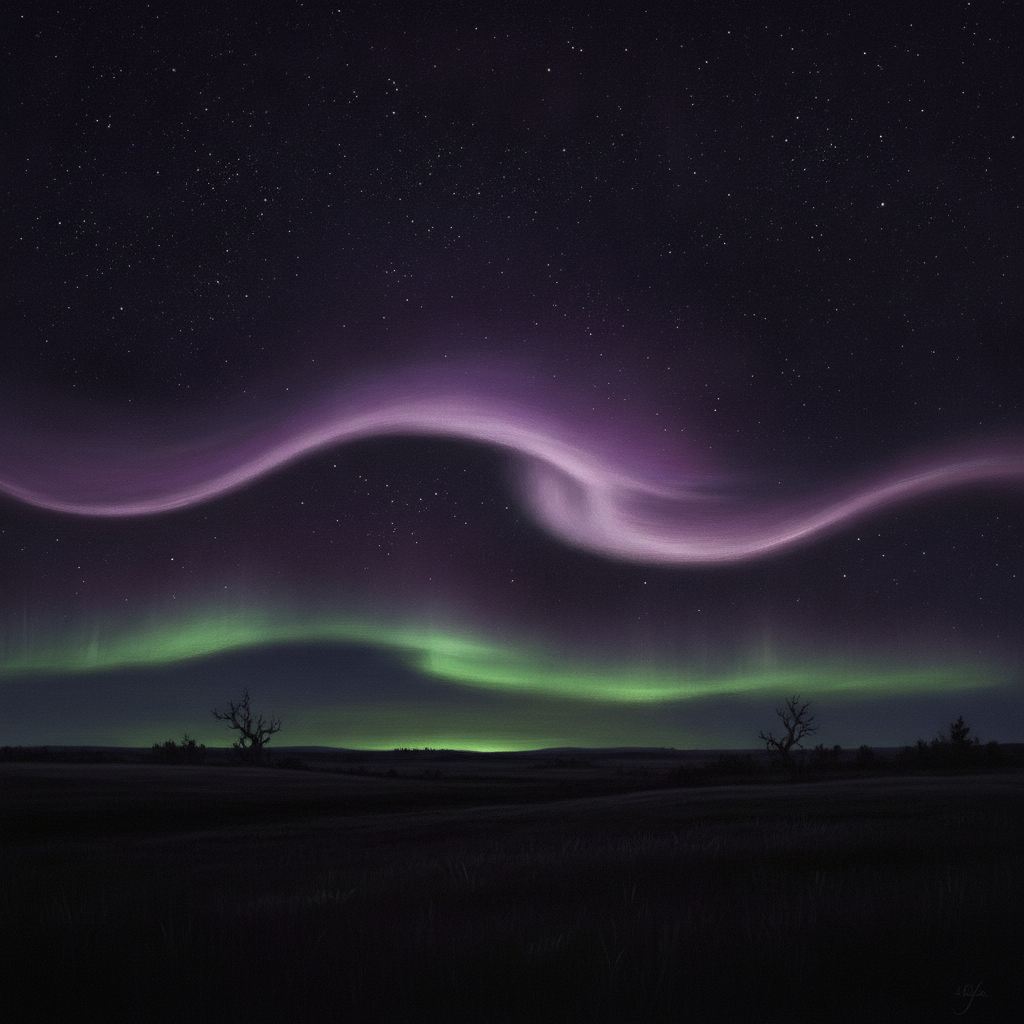
On a cold, clear night in the winter of 2015, a small cluster of photographers stood in the dark somewhere across the Canadian province of Alberta, tripods planted in the snow, waiting for the northern lights. What rose above them was not the northern lights. Instead of the familiar green curtains rippling along the horizon, a thin ribbon of pale purple stretched straight across the sky from east to west, narrow and sharp-edged, like a scratch of light drawn with a ruler. It did not sway the way an aurora sways. It hung there, glowing mauve, sometimes fringed along its lower edge with a row of short green streaks that looked, to more than one observer, like a picket fence standing on end.
The photographers had seen it before. They had been shooting it for years, and they still had no idea what it was. They belonged to a Facebook group called the Alberta Aurora Chasers, a loose community of amateurs who drove out on freezing nights to hunt the sky. Among themselves they had taken to calling the strange purple arc "Steve," a deliberately silly, deliberately meaningless placeholder borrowed from the 2006 animated film Over the Hedge, in which the frightened animals give an unfamiliar object a harmless human name so it stops being scary. The joke stuck, and the images kept accumulating.
The chasers shared their photographs with two people who might know: Elizabeth MacDonald, a space-weather scientist at NASA and the founder of Aurorasaurus, a project built to fold citizen sightings into real research, and Eric Donovan, an auroral physicist at the University of Calgary. Between them, MacDonald and Donovan carried decades of experience studying the upper atmosphere. Neither could say what Steve was. They were looking at a bright structure arcing over populated cities, photographed night after night, that did not appear in the scientific literature.
Donovan concluded that the answer would not come from photographs alone. What was needed was a coincidence: a satellite passing directly through the ribbon at the exact moment a camera on the ground caught it. The European Space Agency had the right instruments in orbit, a trio of satellites called Swarm, designed to measure Earth's magnetic and electric fields. Donovan waited for an alignment, and when he matched a ground sighting of Steve to a Swarm pass, the numbers were startling. At the altitude where Steve glowed, roughly 450 kilometers up, the satellite flew through a ribbon of gas about 25 kilometers wide where the temperature spiked to around 3,000 degrees Celsius, and where charged particles were streaming westward at close to six kilometers per second, thousands of times faster than the air on either side.
That measurement gave the placeholder a permanent home. In a 2018 paper published in Science Advances, the first peer-reviewed study of the phenomenon, the team kept the name the chasers had chosen but reverse-engineered it into an acronym: Strong Thermal Emission Velocity Enhancement. Steve had become STEVE. It was a rare instance of professional science formally adopting a label invented by hobbyists, and it recorded a discovery that had traveled from a Facebook album to a scientific journal in a little over two years.
Aurorasaurus became the connective tissue of the work. It was a platform where ordinary people could log what they saw and where researchers could search for the rare alignments that turn an anecdote into evidence. In the years that followed, hundreds of sightings were reported. Together they established that STEVE was not a quirk of one camera or one night but a recurring, repeatable feature of the subauroral sky, and that it tends to appear at lower latitudes than the classic aurora, closer to where most people actually live.
The physics that Swarm measured was not itself new. Fast westward flows of hot plasma at those altitudes are well known to specialists under another name: a subauroral ion drift, or SAID, described within the broader family of subauroral polarization streams. These flows had been studied for decades. What had never been connected to them was a visible light. A SAID was understood to be invisible, a river of energy that instruments could detect but eyes could not see. The Alberta photographs, matched to the satellite data, established that a subauroral ion drift can be accompanied by a glow bright enough to photograph from a roadside.
The 2018 study also established what STEVE is not. An ordinary aurora glows because charged particles from space rain down along magnetic field lines and strike oxygen and nitrogen high in the atmosphere, exciting those atoms until they release light. That downpour is called precipitation, and it is the engine of every classic aurora. When the researchers examined the satellite and ground data for STEVE, they found no meaningful electron precipitation falling into the mauve ribbon. On that basis the 2018 paper and the work that followed it state plainly that STEVE is not an aurora, even though it appears alongside the aurora and looks, to a casual eye, like a relative of it.
Spectroscopy sharpened the picture further. When the Transition Region Explorer instrument in Canada captured STEVE's light and split it into a spectrum in 2019, the mauve ribbon turned out to have no clean signature at all. There was no single bright emission line, only a broad continuum of color, the kind of smear that heating produces rather than the discrete atomic fingerprints an aurora leaves. The green stripes beside it gave a different reading. Their light was dominated by the 557.7-nanometer emission of oxygen, the same green that ordinary auroras produce.
So the record now contains a measured altitude, a measured width, a measured temperature, a measured velocity, a formal name in a peer-reviewed journal, a confirmed association with subauroral ion drifts, a demonstrated absence of electron precipitation, and two distinct spectral behaviors sitting side by side in the same structure. STEVE is one of the few phenomena in modern space science that was named by amateurs, catalogued by amateurs, and only then handed to the instruments.
Conclusions and Open Questions
What the file does not contain is a mechanism. Scientists know where STEVE forms and what it rides on, and they cannot yet explain from first principles how a subauroral ion drift produces light at all.
The leading account, put forward by the Science Advances team and developed in follow-up modeling work, is that the glow is thermal in nature: gas moving at six kilometers per second against slower surrounding plasma is heated by friction and collisions, and the heated gas radiates the broad mauve continuum the spectrograph recorded. Its weakness is that no published model reproduces the observed brightness and spectrum in detail from the measured conditions, which is why researchers describe the emission as a continuum of uncertain origin rather than a solved process.
A second theory, advanced by researchers examining the 2019 spectrum, addresses the green picket fence rather than the mauve ribbon. It holds that electric fields aligned with the magnetic field energize electrons locally, low down where the fence forms, letting them strike the atmosphere and glow without any particles falling from space. It fits the oxygen signature well. Its weakness is scope: it says nothing about the mauve ribbon itself, and the local acceleration it requires has not been measured directly during a STEVE event.
A third position, implied by the two spectra, is that the picket fence and the ribbon are lit by two unrelated processes that merely coincide. Its weakness is that it leaves the coincidence unexplained, and it does not account for why the fence appears before STEVE on some nights, after it fades on others, and not at all on many.
Some argue that STEVE has been visible over inhabited land for as long as people have looked up, and that the old aurora literature is scattered with references to mauve arcs and unexplained purple bands that were sightings of STEVE, logged and forgotten because no framework existed to hold them. It is a plausible reading. Its weakness is that those old records are too vague to test, and cannot be distinguished from ordinary auroral forms after the fact.
One theory holds that the episode says less about the sky than about the institutions that study it, that a bright structure over populated cities went unremarked for decades not because it was hard to see but because it was outside what credentialed observers expected to find, and that other phenomena are being overlooked on the same grounds right now. That is an argument about scientific attention, not about physics, and there is no way to test it.
The open questions are specific. Why does a subauroral ion drift, present on many nights, only sometimes light up as a visible ribbon? What exactly sets the mauve continuum glowing, if not falling particles? Why does the picket fence appear only sometimes, and in no fixed order relative to the ribbon? Where does STEVE end and the aurora begin on nights when both are driven by the same disturbance in near-Earth space? And how many older aurora reports quietly folded a sighting of STEVE into the record without anyone noticing the difference? STEVE has been named, located, timed and measured. Whether it has been explained is a separate question, and the researchers who work on it do not claim otherwise.