The Sea That Glows: Chasing the Milky Seas Science Has Touched Only Once
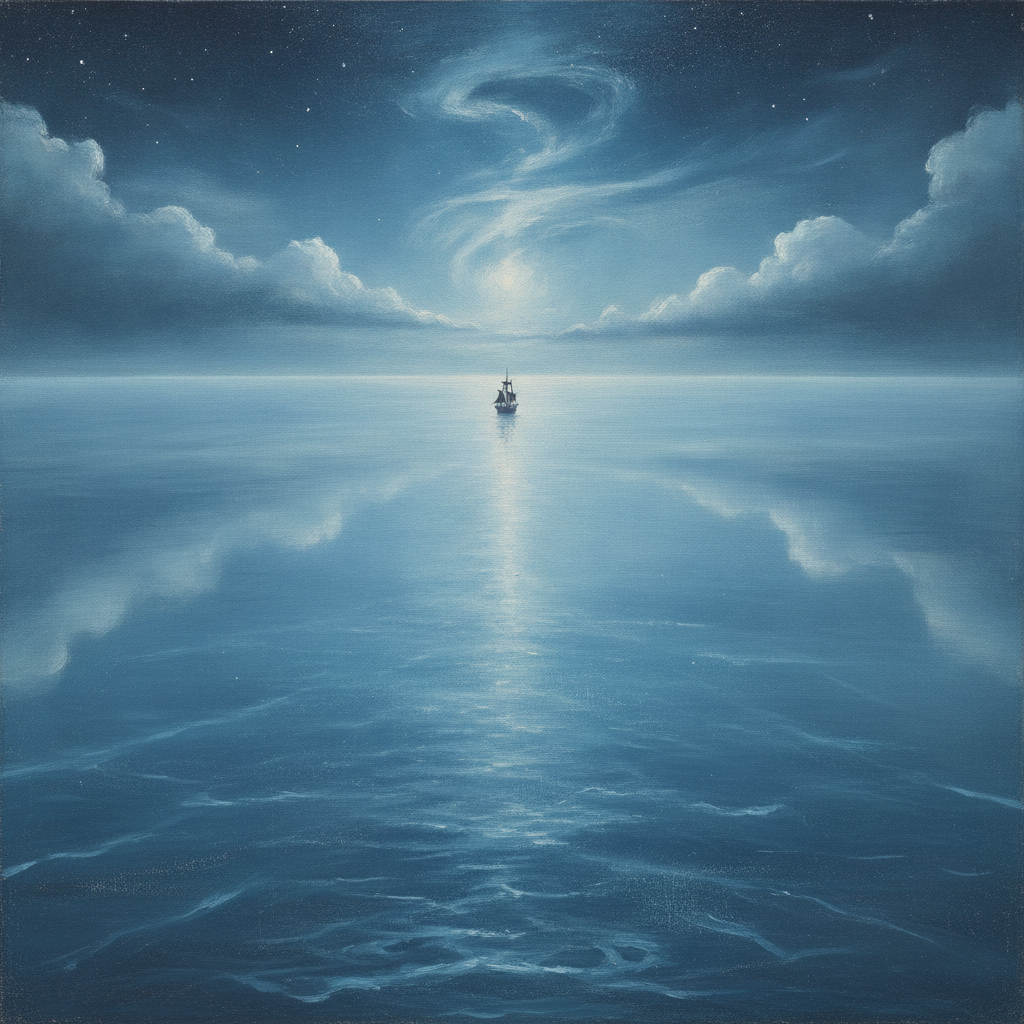
On the night of 25 January 1995, the British merchant vessel SS Lima was steaming through the Arabian Sea about 150 nautical miles east of the Somali coast when the ocean began to glow. It was not the familiar sparkle of a ship's wake on a dark night, that flicker of disturbed plankton breaking against the hull. A pale, steady, whitish light spread out in every direction to the horizon, uniform and even, so that the ship seemed to be sailing not on water but across a field of fresh snow, or through a bank of low cloud lit softly from beneath. The glow held for more than six hours. The crew logged it carefully, fixing their position, and later described a sea that shone with a soft milky radiance under an otherwise pitch dark sky. They had sailed into one of the ocean's rarest and least understood spectacles, a milky sea.
Sailors have been reporting these glowing waters for a very long time, at least since the 1600s. Hundreds of accounts are scattered through ships' logs and, over some eighty years, through the pages of a journal called The Marine Observer. The phenomenon reached literature as well: Jules Verne sent the Nautilus gliding through a luminous sea of milk in Twenty Thousand Leagues Under the Sea, drawing on the real tales of mariners. For centuries the reports were filed as curiosities, sailors' yarns, the sort of thing that earned a raised eyebrow back in port.
Two features set a milky sea apart from ordinary marine bioluminescence. The first is scale. Witnesses describe a glow that stretches farther than the eye can follow, covering the whole visible circle of the sea rather than a patch alongside the hull. The second is stillness. Ordinary bioluminescence flashes only when it is disturbed, a spark struck by a passing wave or an oar. A milky sea does not flash. It burns, silent and continuous, sometimes for night after night.
The organism most closely associated with the glow is a luminous bacterium called Vibrio harveyi. These microbes can produce light, but only under a peculiar condition. A single bacterium adrift in open water gives off no visible light at all; for one cell to burn alone would be a hopeless waste of energy. They light up only when their numbers reach an enormous density, a threshold they detect chemically through a mechanism called quorum sensing. The bacteria, in effect, count themselves, and switch on their light in unison once the crowd is large enough to matter. To raise a milky sea bright enough to be seen from a ship's deck, and later from orbit, the numbers required are staggering, on the order of a hundred million bacterial cells in every single milliliter of seawater, coating the surface layer of the ocean across an area that can rival a small country.
Human beings have laid hands on the phenomenon exactly once. In 1985 a research vessel blundered by pure chance into a milky sea and managed to scoop up a water sample before the glow was gone. When scientists examined it, they found Vibrio harveyi thriving in association with a bloom of microscopic algae called Phaeocystis. That single bucket of glowing water remains, to this day, the only physical sample of a milky sea ever collected. Everything else in the record rests on eyewitness description and, more recently, on the patient eye of satellites.
The satellite chapter began with the SS Lima. A decade after that 1995 night, an atmospheric scientist named Steven Miller, then at the US Naval Research Laboratory and later at Colorado State University, asked whether the glow the Lima's crew had described might have been faintly recorded from space at the time. He pulled archived images from the US Defense Meteorological Satellite Program, whose low light sensors had for years been quietly watching the night side of the Earth, and there it was: a vast patch of faint luminescence sitting exactly where the Lima had logged its position, on exactly the right nights. The glowing area covered roughly 15,400 square kilometers, about the size of the American state of Connecticut, and it persisted for around three nights. Reported in 2005, it was the first time a milky sea had ever been confirmed from orbit, and it lifted the subject out of folklore and into measurable data.
The old military sensors were crude, barely able to register so faint a glow. What transformed the field was a new generation of instrument, the Day-Night Band aboard modern weather satellites, sensitive enough to catch the light of a single fishing boat on a moonless sea. Using it, Miller and his colleagues began to hunt systematically, and in a 2021 study they reported a series of events no one had ever seen. The most spectacular was a milky sea that bloomed south of the Indonesian island of Java in 2019. It sprawled across roughly 100,000 square kilometers, larger than many nations, and it glowed for more than forty consecutive nights.
The researchers then worked backwards. Rather than wait for the next chance encounter, they assembled a database of every milky sea they could find, some 415 sightings reaching from the 1600s to the present, harvested from ships' logs, the long run of The Marine Observer, scattered scientific notes and the modern satellite record. Patterns rose out of the pile. Milky seas are not randomly distributed. They cluster overwhelmingly in a handful of places: the northwest Indian Ocean, off Somalia and across the Arabian Sea, accounts for well over half of all sightings, with a secondary hotspot in the waters south of Java and around the Banda Sea. They also appear to track the great climate rhythms, rising and falling with the Indian Ocean Dipole and the El Nino Southern Oscillation, and with the churn of the monsoon, which drags nutrients up from the deep.
That is where the documented record stands. One accidental sample in 1985, a confirmed satellite detection published in 2005, a six week event off Java in 2019, and a catalogue of 415 sightings that gives researchers, for the first time, a rough sense of where and when to look. The stated purpose of the database is practical: to anticipate the next event closely enough to send a research ship into the glow while it is still burning, and to collect only the second physical sample in four centuries.
Conclusions and Open Questions
What the record establishes is narrower than it first appears. There is a strong candidate for what glows, Vibrio harveyi, and a rough map of where and roughly when milky seas occur. What is missing is the trigger. Nothing in the evidence explains what tips a patch of ordinary dark ocean into a hundred thousand square kilometers of coordinated light, and a single sample from 1985 cannot show whether every milky sea is the same organism doing the same thing, or whether one label quietly covers several different phenomena that merely look alike from a deck at night.
The bacterial explanation, championed by Steven Miller and accepted by most of the field, is compelling but incomplete. Its strength is the 1985 sample and the well understood biology of quorum sensing, which accounts neatly for why the glow is steady rather than flashing and why it demands such extraordinary numbers. Its weakness is that free living luminous bacteria in the open sea are normally far too sparse to glow at all, and no one has yet shown convincingly how they multiply to the required density across such immense reaches of water.
One theory, older than the satellite work, holds that the bacteria glow as a kind of advertisement, a lure meant to be eaten. A glowing patch of water attracts fish, the fish swallow the bacteria, and inside a fish gut the microbes find a rich, stable home far better than drifting alone in cold seawater. On this reading a milky sea is less a natural wonder than an enormous, slow motion act of biological seduction. The weakness is plain: the idea has never been tested at the scale of an actual milky sea, and no one has followed the bacteria from the open water into the fish.
Some argue that a milky sea is really a two part performance. In the one sample we possess, the bacteria were living on Phaeocystis, which suggests that an algal bloom first sets the table, providing surfaces to cling to and nutrients to feed on, and only then do the bacteria colonize it densely enough to ignite. If that is the mechanism, forecasting milky seas would mean forecasting the blooms, and therefore the currents, winds and nutrient pulses that feed them. The weakness is the evidence base: the whole idea rests on a single bucket of water collected by accident, and no one has watched the sequence unfold.
Another theory holds that the question has been framed at the wrong scale altogether. If luminous bacteria are always present at low background levels, then what is being watched may not be a population arriving but a population crossing a line, an entire region of ocean tipping over a threshold the way a supersaturated solution crystallizes in an instant. In that reading the mystery belongs less to the microbe than to the sea itself. Its weakness is that no one has ever measured background bacterial levels across a stretch of ocean before it began to glow.
The open questions are therefore specific rather than vague. What conditions of temperature, nutrient supply and stillness precede an event? Do the climate correlations found in the 415 sighting database carry real predictive power, or only descriptive value? Is Vibrio harveyi present in every milky sea, or only in the one that happened to be sampled? Why do the same few regions produce almost all of the sightings? And can a research vessel be placed inside a glow while it still burns? In four hundred years of recorded sightings, across a phenomenon that can cover a hundred thousand square kilometers and blaze for six weeks without pause, human beings have held a milky sea in their hands exactly once, and that by accident.