The Waterfall That Swallowed Half a River — and How Two Numbers Solved It
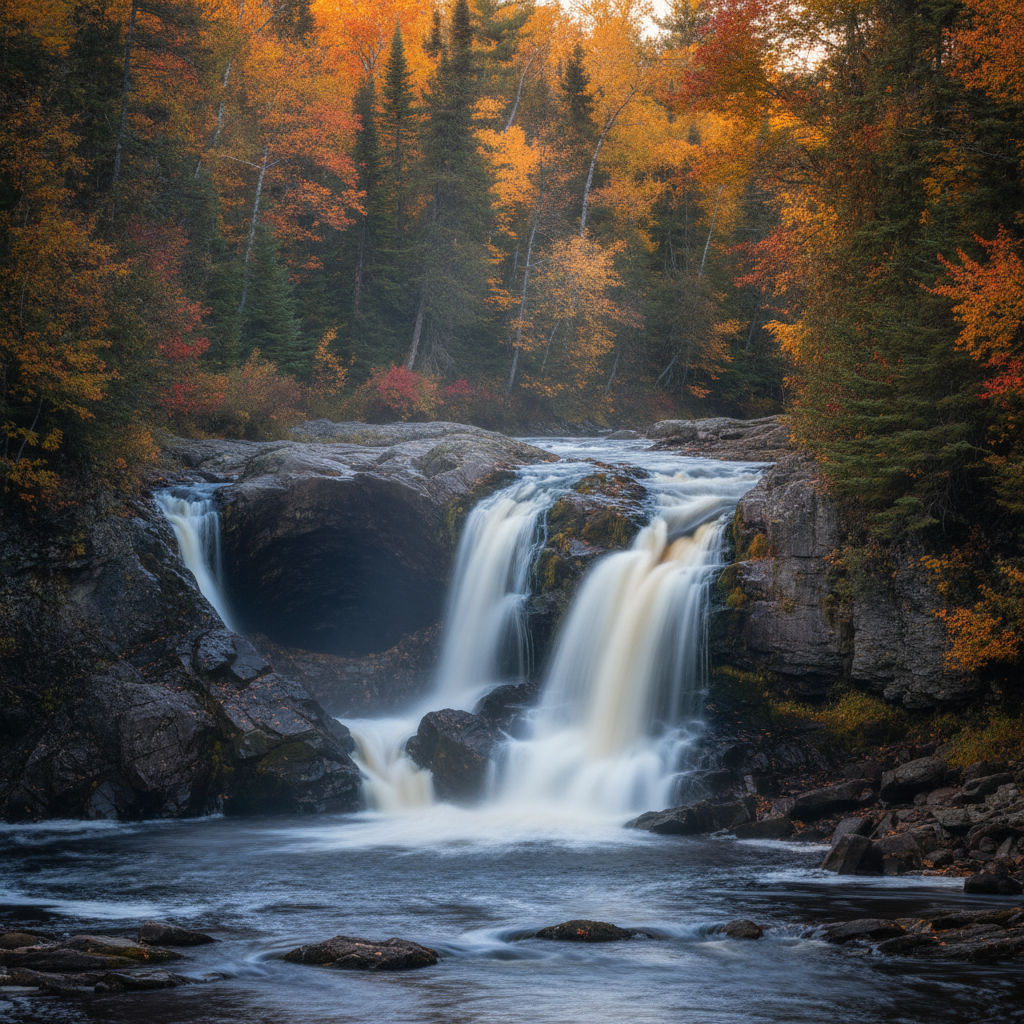
On the North Shore of Lake Superior, inside Judge C.R. Magney State Park in Minnesota, the Brule River comes down through the forest in a hurry. About a mile and a half before it reaches the great cold lake, the water runs up against a stubborn knuckle of ancient volcanic rock that splits the current in two. The eastern half tips over the lip of an ordinary waterfall, drops some fifty feet, and carries on toward Lake Superior the way rivers are supposed to. The western half pours sideways into a gaping cylindrical pothole in the stone, a churning hole the locals call the Devil's Kettle, and then it is simply gone.
Visitors reach the spot on foot, and the trail ends at a wooden overlook above the falls. From the rail the split is unmistakable: one river, two destinations, and only one of them accounted for. Jeff Green first stood there as a tourist on a family outing, years before his working life gave him any professional interest in the place. He asked what every visitor asks, the question that hole had been putting to people for a hundred years. Where does the water go?
For more than a century, the people who asked it answered in the most direct way they could think of. They threw things in. Sticks and logs went into the Kettle first. Then, as the road brought more visitors, came ping-pong balls by the bagful, colored dye, and anything else that might be spotted again downstream. According to the durable folklore of the North Shore, none of it ever came back out. The stories grew in the retelling. People said the hole had swallowed GPS trackers without a ping. People said that someone, once, had rolled an entire car into it and watched it disappear.
Almost none of that canon comes attached to a name, a date, or a witness who can be asked what they saw, and nobody appears to have been posted downstream for hours, watching the foam for a ball that might come bobbing back. The record of swallowed objects is anonymous and secondhand. What it did supply was a simple and seductive piece of logic: if the objects never reappear, the water carrying them must be going somewhere else.
The rock was better documented. The bedrock at the falls is rhyolite lying over basalt, hard volcanic stone laid down more than a billion years ago, when this part of the continent was pulling apart along what geologists now call the Midcontinent Rift. That origin matters, because stone of that kind does not do what the legend required of it. Lava tubes form in the runny basaltic lava of places like Hawaii, not in rhyolite. Underground rivers dissolve their channels out of soft, soluble limestone, and the North Shore has no limestone karst to dissolve.
There were larger physical problems as well. Half the Brule pouring into Lake Superior through a hidden conduit would have to announce itself at the far end, boiling up as a giant spring somewhere on the lake bed, and no such spring has ever been found. A tunnel wide enough to take half a river would also have spent a hundred years swallowing logs, gravel and debris, and should long since have choked itself shut.
The measurement that finally settled the case required nothing exotic: no cave divers, no dye visible from the air, no new technology. It needed a stream gauge and an afternoon. You measure how much water is flowing in the river above the falls, measure again a little way below, and compare the two numbers. In the fall of 2016 two hydrologists with the Minnesota Department of Natural Resources, Heather Emerson and Jon Libbey, went and did exactly that, as part of a project that Green, by then a springshed mapping hydrologist with the DNR, helped lead.
Above the falls, the Brule was flowing at about 123 cubic feet of water per second. A few hundred feet below the falls, downstream of the Kettle that supposedly ate half the river, it was flowing at about 121 cubic feet per second. In stream gauging, as Green put it, those two numbers are essentially identical, comfortably inside the tolerance of the equipment. Had the Kettle really been piping half the Brule off somewhere, the downstream gauge should have read something nearer sixty. A drop of roughly two cubic feet per second is what spray, evaporation and ordinary instrument scatter produce.
The finding was announced in early 2017, and it was almost anticlimactically simple. The lost water was not going anywhere far. It resurges in the riverbed just below the falls, rejoins the Brule a short way downstream, and rolls on to Lake Superior with the rest of the river.
That left the vanishing objects, and the plunge pool accounts for them. The pool at the base of the Kettle is not a placid drain but a ferociously powerful hydraulic system, a churn of recirculating currents strong enough to catch a stick and hold it under, and to grind branches and debris against the rock until they are reduced to splinters and pulp. Whatever goes in is battered, waterlogged, driven down and eventually released far downstream, unrecognizable and unremarked. Calvin Alexander, a University of Minnesota geologist who worked on the puzzle, noted that even dye makes a poor witness in such a system, because it dilutes below the threshold of visibility long before it could resurface where anyone was watching.
One piece of the investigation was promised and never delivered. Green and Alexander planned to return in the low water of autumn 2017, pour a harmless vegetable-based dye into the Kettle, and watch downstream to see exactly where and when it bloomed back into the river. That visible confirmation never took place. A state parks official later explained that there was no significant scientific reason to go back, because the flow numbers had already answered the question. The Devil's Kettle is now that genuinely rare thing, a famous mystery with a documented ending.
Conclusions and Open Questions
Before the gauges, three explanations held the field, none of them attached to a named researcher. The most popular, repeated by generations of visitors and local guides, was an underground river: a secret channel draining the lost water straight through the bedrock to Lake Superior. Its weakness is geological. Channels like that are dissolved out of limestone, there is no limestone here, and the giant lake-bed spring the theory requires has never been located.
The second explanation was a lava tube, an ancient hollow pipe left in the volcanic rock and threading unseen beneath the forest floor. It at least respected the volcanic setting, but it fails on petrology, because lava tubes belong to fluid basaltic lava and the rock at the lip of the falls is rhyolite. The third and boldest sent the water on a long subterranean journey to a distant outlet, in the tallest tellings as far as Canada. Nothing has ever been found at the far end, and after 2016 there is no missing half-river left to travel.
The measurement did not close every gap. The decisive evidence is two gauge readings taken on a single autumn day. A small, steady leak, a cubic foot or two per second slipping into the rock, could in principle hide inside the margin of error of those instruments, and nobody has ruled out a modest loss of that kind, although nothing approaching half a river can be hiding there. Nor can anyone point to the precise seam in the churning rock through which the western half of the Brule threads its way home. The mechanism is understood; the exact plumbing is not.
The cancelled dye test leaves the case resting on a negative. The flow figures show that the water does not leave. They do not show, directly and visibly, where it returns. The celebrated anecdotes were never investigated at all: nobody has established whether a car really went into the Kettle, or whether GPS trackers were ever dropped in, so those stories remain neither confirmed nor refuted.
The largest open question is not about water but about people. Why did a hundred years pass before anyone walked down with a gauge? Some argue that the mystery was worth more than the solution, and that neither the park nor the local tourist trade had much incentive to pay for an afternoon of work that would end a famous legend. No evidence of any such decision exists, and a simpler reading fits: the confirming evidence selected itself. Every stick that went in and did not visibly come out was quietly filed as proof, while every shredded fragment that surfaced half a mile downstream went unremarked, because nobody could know it was the same stick. One theory holds that the legend was built out of exactly the observations a churning plunge pool would produce, which leaves a last open question. How many other famous mysteries are made of the same material?