Dead Mountain: Why Nine Hikers Cut Their Way Out of Their Tent and Ran Into the Night
They set out laughing. The photographs later recovered from their cameras show ten young people in high spirits, mugging for the lens in the snow, loading a truck, clowning on the train north - a student ski expedition like a hundred others in the Soviet Union of 1959. In late January, ten students and graduates of the Ural Polytechnical Institute in Sverdlovsk set out on a punishing Category III winter trek through the northern Urals, the hardest grade the Soviet system recognised, bound for a remote peak called Otorten. The plan carried them for days on skis through frozen, thinly inhabited country, far from any road or ready rescue, hauling everything they needed to survive. One of them, Yuri Yudin, fell ill early on with rheumatic pain and turned back not long after the group left the last settlement. That accident of health saved his life. He would help bury his friends within weeks, and outlive the mystery until his own death in 2013. He was the last person to see the other nine alive.
The nine who went on were not amateurs. Their leader, twenty-three-year-old Igor Dyatlov, was a gifted radio engineer who designed and built his own equipment. Around him were Zinaida Kolmogorova and Lyudmila Dubinina, both seasoned and well-liked, along with Yuri Doroshenko, Rustem Slobodin, Georgy Krivonischenko, Alexander Kolevatov, and Nikolai Thibeaux-Brignolle, a descendant of a French engineer. The oldest by far was Semyon Zolotaryov, thirty-seven, a decorated veteran of the Second World War who had joined the group late, more than a decade older than anyone else in it. On the night of 1 February the group pitched their single long tent high on the exposed slope of Kholat Syakhl, rather than descending to the shelter of the tree line about a mile below. The mountain's name, taken from the language of the local Mansi people, is usually rendered as Dead Mountain.
The hikers left a detailed record of their own last days. Several cameras and personal diaries survived in the abandoned tent, and the developed film shows the ordinary rhythm of expedition life right to the end: the group wading through deep snow, hauling sledges and packs, the long tent rising against the bare slope as the daylight failed. On the night of 24 January someone had even typed up a mock newsletter, the Otorten Evening, that joked, of all subjects, about whether snowmen really existed. One late frame from Thibeaux-Brignolle's camera shows a dark, blurred figure among the trees, which some would later take for a menk, the wild man of Mansi legend; the soberest reading is that it is simply one of the group, probably Zolotaryov, stepping out from behind a trunk. The final exposures on the reels are near-abstract smears of light, taken in the tent's last hours, their content impossible to make out.
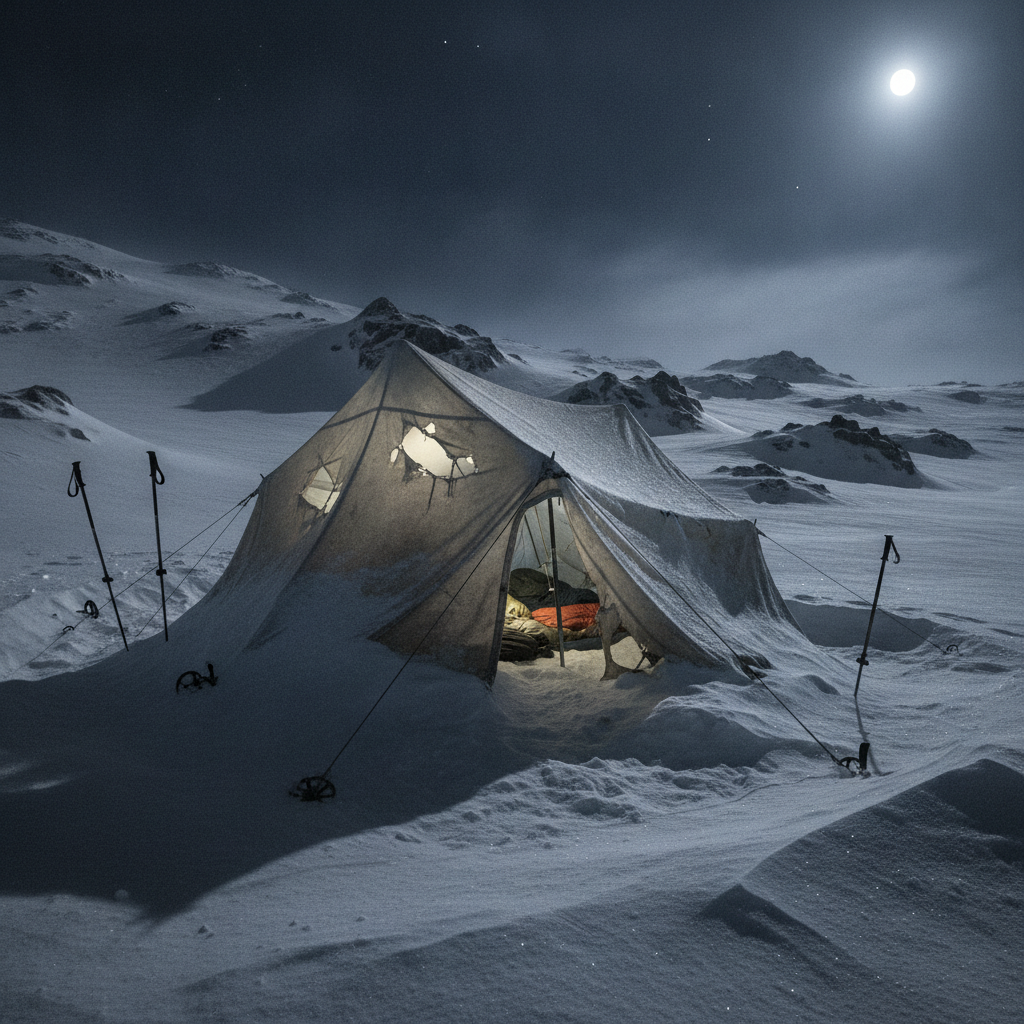
The party was expected back around the middle of February. When no telegram came and the days stretched on, alarmed relatives pressed the institute to act, and search parties of volunteers and rescuers set out to comb the slope. On 26 February they found the tent still standing high on the slope, half-buried in drifted snow and slit open from the inside. Almost everything the hikers needed to survive had been left behind: boots, warm coats, an axe, food, and the cameras themselves. A line of footprints led away downhill, some of them left by bare or stockinged feet, descending roughly a mile toward the forest before they disappeared under fresh snow. Whatever had happened, the group had left their only shelter in lethal cold without stopping to dress.
The first bodies turned up at the edge of the forest. Two of the young men lay beneath a tall cedar beside the ashes of a small fire, stripped to their underwear, their hands burned, with branches snapped off high up the tree as though someone had climbed it to look out or to gather wood. Three more, Igor Dyatlov among them, were strung out along the line between the cedar and the tent, their faces turned toward the slope, as though they had died while trying to struggle back up to the camp. All five had frozen to death. The temperature that night probably fell below minus 25 degrees Celsius, and the wind on the open slope would have made it feel far colder still.
The last four were not recovered until May, once the snow began to melt. They were found buried under several metres of snow in a ravine near a stream, and they carried injuries that cold and exhaustion cannot produce. Thibeaux-Brignolle had a fractured skull. Dubinina and Zolotaryov had massive fractures of the chest, ribs driven inward with a force that a medical examiner compared to a high-speed car crash, and yet there were almost no matching wounds on the skin above them. Dubinina was missing her tongue, her eyes, and part of her lips; Zolotaryov's eyes were also gone, and so were Kolevatov's. Later still, laboratory tests found traces of beta radiation on some of the recovered clothing.
Investigators catalogued the scene in detail. The tent had been cut open from within by one or more of its occupants; the scatter of the bodies traced a retreat from the tent down to the cedar and, for some, a doomed attempt to climb back; and the injuries of the four in the ravine had no visible external cause at all. The forensic examiner recorded that the force needed to drive in Dubinina's and Zolotaryov's ribs was greater than anything a fall, or a blow from another person, could account for. Nothing in the physical evidence pointed to a struggle with an outsider, and no tracks but the group's own were ever found on the slope.
The Soviet inquest closed the file in the spring of 1959. It ruled that the hikers had died from a compelling natural force that they had been powerless to resist, without ever saying what that force had been. The case materials were classified and locked away, and the pass itself was closed to hikers for the next three years. Nine experienced mountaineers had climbed Dead Mountain in good weather and high spirits, and within hours of making camp every one of them was dead.
Conclusions and Open Questions
For sixty years the silence around the case was filled with theory, and the most rigorous answer arrived only recently. In 2019 Russian prosecutors reopened the investigation, and in July 2020 they announced a conclusion: a snow avalanche had driven the group from the tent, and poor visibility in the dark had kept them from finding their way back. In January 2021 the physics caught up with the verdict, when Johan Gaume of EPFL and Alexander Puzrin of ETH Zurich published a study in the Nature journal Communications Earth and Environment. They modelled how a small slab avalanche could have struck the tent hours after the group cut into the slope to pitch it, once strong katabatic winds had loaded fresh snow onto the block above. A rigid slab landing on sleepers braced against the hard tent floor, their simulations showed, could crack ribs and skulls while barely marking the skin. In 2022 the same journal reported the first video evidence of recent slab avalanches on those very slopes, confirming the terrain is steeper and more avalanche-prone than the gentle hill long described.
Other theories still compete, and each has a weakness. Secret military tests - a stray rocket or parachute mine - are invoked to explain the injuries and the radiation, and some searchers did report orange lights in the sky those nights, but no craters or shrapnel were ever found. The writer Donnie Eichar argued that wind curling over the mountain generated infrasound that induced blind panic, which fits the flight from the tent but cannot crush a ribcage. A Mansi attack was suspected in 1959 and dismissed, since the only footprints on the slope belonged to the group. One theory holds that Zolotaryov, Kolevatov and Krivonischenko were undercover agents carrying radioactive material to a staged meeting that turned lethal, which would tie together the radiation and the older latecomer, though it rests on no documentary proof. Pathologists offer the soberest reading of the worst details: Dubinina lay face-down in meltwater for months, and decomposition and scavengers take the softest tissue first, while the beta traces may come from Krivonischenko's work at the Mayak nuclear complex or from contaminated gear.
Even the avalanche verdict leaves questions open. Searchers in 1959 reported no obvious avalanche debris. If a slab struck the tent, why did the survivors walk a mile downhill away from their equipment rather than dig it out, and how did injured people carry two comrades with crushed chests that far? The radiation has no place in the avalanche account at all, and a snow slide does not explain why the tent was cut open from the inside by people who seemed to be fleeing something they could see or feel. The avalanche is the most tested explanation anyone has offered, and it deserves more weight than the rockets and the yetis. But the only witnesses left their answer in footprints that stop in the snow, and the state that investigated preferred silence to sense. Nine young people went up Kholat Syakhl laughing, and the mountain has never fully told us why they came down the way they did.